
Population
≈10 million across Lima and the constitutional province of Callao — around a third of Peru's entire population
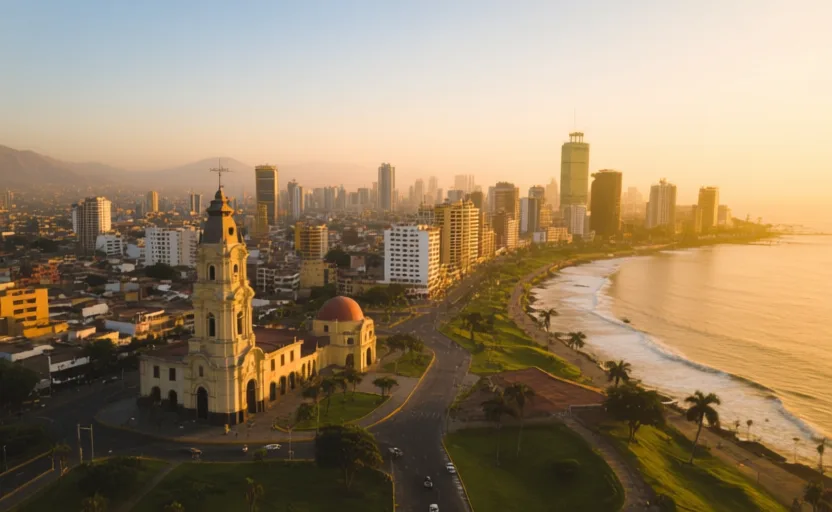 AI city illustration · Artistic impression
What people learn after moving
≈10 million across Lima and the constitutional province of Callao — around a third of Peru's entire population
Spanish. Quechua and Aymara are co-official where they predominate, which is not Lima. English is common in international offices and rare elsewhere
Peruvian sol (PEN). US dollars circulate widely and many leases and property prices are quoted in them
PET (GMT−5) — Peru does not observe daylight saving, so the gap to the US East Coast shifts twice a year
AI city illustration · Artistic impressionCost of living in Lima
Check your eligibility
Pick your passport to see entry rules and the long-stay routes we have researched.
Pick your passport to see whether you can enter Peru — and what it takes to stay.
Peru's system is built around the calidad migratoria — a migratory status granted for 365 days and renewed annually — evidenced by the carné de extranjería. The work route depends on a labour contract registered under Decreto Legislativo 689, whose company-level quotas decide who can be hired at all. Most of the process runs online through MIGRACIONES' Agencia Virtual, with an appointment at the end for biometrics.
A foreign licence is usable for a limited period after arrival; after that you need a Peruvian brevete, obtained either by exchange where a reciprocity arrangement exists or by sitting the medical, theory and practical assessments. The larger question is whether you want to drive at all. Lima's traffic is among the worst in the world, informal driving norms are aggressive, and taxi apps plus the Metropolitano cover most needs for less than the cost of parking.
You need a carné de extranjería before a Peruvian bank will open a full account — a passport alone will not do it at the major banks. Peru's banking system is unusually dual-currency: most banks give you a soles account and a dollar account under the same client number, and salaries, rents and property are quoted in either. Instant payment through Yape and Plin has become the default for everyday transfers in a way that surprises people.
If you are employed, your employer must enrol you in EsSalud and pay a contribution equal to 9% of your salary — this is the employer's cost, not a deduction from you. EsSalud covers you properly but with waits, and there is a qualifying period before entitlement begins. Most professionals in Lima also carry an EPS plan through work or private insurance, and use the private clinics along Javier Prado and in San Borja. Self-employed people must arrange cover themselves.
Peru requires every SIM to be registered against an identity document, and for foreign residents that means the carné de extranjería or a passport. Four operators compete — Claro, Movistar, Entel and Bitel — and prepaid is genuinely usable, which matters because postpaid contracts often want a credit history you do not have yet. Fibre is fast and cheap in the central districts and highly dependent on the individual building.
Peru's central concept is domicilio, not residence. You become domiciled after more than 183 calendar days in Peru within any twelve-month period — but the change only takes effect from 1 January of the following year. Until then, Peruvian-source employment income is withheld at a flat 30% of gross with no deductions. Once domiciled, you are taxed on worldwide income at progressive rates after a 7 UIT allowance. Separately, your district municipality bills the impuesto predial and arbitrios on the property you occupy.
Each guide has verified costs, timelines, required documents, and the non-obvious gotchas — sourced from official government pages. Last verified August 2026.
Reading a list isn’t learning it. Globe Quest turns these into a trainer — hear each phrase spoken, drill them with spaced repetition, and get scored as you say them out loud.
Peru treats you as non-domiciled until you have been in the country more than 183 calendar days within any twelve-month period, and even then the change of status only takes effect from 1 January of the following year. In the meantime, Peruvian-source employment income is withheld at a flat 30% of gross with no deductions and no 7 UIT allowance. Someone arriving in March pays that rate for nearly two years before progressive rates start. Model your net pay on the non-domiciled rate for the whole first stretch, and negotiate the offer knowing that is what will actually land in your account.
Decreto Legislativo 689 caps foreign staff at 20% of a company's headcount and 30% of its total wage bill. A small Lima company with nine employees cannot lawfully make you the tenth without an exemption, however well the interview went. Exemptions exist — for people married to Peruvians or with Peruvian children, for immigrant status holders, and for specialised professional and management roles granted an exoneration — but they take work. Ask what the company's current foreign headcount is before you get emotionally committed to an offer.
Resident statuses in Peru are granted for 365 days and must be renewed through MIGRACIONES' Agencia Virtual before they expire. Let it lapse and you accrue a daily fine and complicate the three-year clock toward permanent residence — which itself also requires that you were not outside Peru for three continuous months, or six alternating months in any year, over those three years. Diary the renewal the day you receive the card, and diary your time abroad too.
Lima routinely appears near the top of global congestion rankings, and the distance between two points tells you almost nothing about the journey. Miraflores to San Isidro is a short walk or a long crawl depending on the hour. If you will work in San Isidro's financial district, living in Miraflores, Magdalena or San Borja keeps you inside a fifteen-to-thirty-minute window; living in La Molina or the northern districts can double or triple it. Test the commute at 8am on a weekday before you sign anything.
Peru sits on the Nazca subduction zone and Lima has been levelled before; know your building's evacuation route and the location of the safe zones marked with an S. Separately, Sedapal's tap water is treated but is not considered potable, and essentially nobody drinks it unboiled. Buy a filter or a bidón dispenser in your first week rather than buying bottled water daily, which is both expensive and a lot of plastic.
Lima gets a handful of millimetres of rain a year, so nothing here is built to shed water or to hold heat. From May to November the garúa produces near-total cloud, humidity above 80% and indoor temperatures in the mid-teens that no flat is equipped to fix. Locals wear coats indoors. When viewing a flat in summer, ask which way it faces and whether there is any heating at all — an oil radiator and a dehumidifier are standard first purchases here.
Compañía de Minas Buenaventura, Southern Copper, Antamina, Cerro Verde, Nexa
Peru is among the world's largest producers of copper, silver and zinc, and almost every mine in the country is run from a Lima head office — the corporate, financing and engineering layer of the industry sits in San Isidro, not at the pit.
Credicorp / BCP, BBVA Perú, Interbank, Scotiabank Perú, Bolsa de Valores de Lima
The financial district along Javier Prado and Canaval y Moreyra in San Isidro concentrates essentially all of Peruvian banking, and Credicorp is one of the largest financial groups in the Andes.
Camposol, Danper, Agrokasa, TASA, Austral Group
Peru is the world's leading exporter of fishmeal and a dominant supplier of blueberries, grapes, asparagus and avocados. The farms are on the northern coast; the trading, logistics and export offices are in Lima.
Central, Maido, Kjolle, Astrid y Gastón, Rafael
Lima has repeatedly held the top position in the World's 50 Best Restaurants list and is the reason Peruvian cuisine became a global category. It is a genuine employer, not a tourist line — cooking here is a serious career path.
Alicorp, InRetail, Grupo Falabella, Cencosud, Grupo Gloria
Peru's large domestic groups run supermarkets, pharmacies, shopping centres and food manufacturing across the Andean region from Lima, and the sector is one of the main employers of foreign commercial talent.
Yape, Belcorp, Globant, Crehana, Rappi Perú, NTT Data
The fintech layer around the banks — Yape alone has tens of millions of users — plus a growing set of regional shared-service centres has made Lima a real, if modest, engineering market, concentrated in San Isidro and Miraflores.
Nature · Miraflores and Barranco clifftops
Ten kilometres of clifftop park two hundred feet above the Pacific, with paragliders launching over the traffic below.
Local tip: The parks run continuously from Magdalena to Barranco and are the city's real public living room — free outdoor gyms, cycle lanes, and a sunset that is the one reliable reward for the garúa. The beaches at the bottom are stony and the current is serious; the cliff path is the point, not the sand.
Nightlife · South of Miraflores along the coast
Lima's bohemian district — republican-era houses in faded colours, galleries, bars and the Puente de los Suspiros.
Local tip: The stretch around Parque Municipal is where visitors go; the better bars and the small live-music venues are inland along Avenida Grau and in the streets behind the Bajada de Baños. Thursday is quietly the best night — Friday and Saturday bring the whole city.
Landmark · Cercado de Lima, north of the modern centre
The colonial core and a UNESCO World Heritage site — Plaza Mayor, the cathedral, and the catacombs beneath San Francisco.
Local tip: Most Limeños from the southern districts almost never come here, which is a shame and also a warning: it is superb by day and thins out fast after dark. The Convento de San Francisco catacombs hold the bones of tens of thousands of people and are the single most memorable hour in the city.
Food · Surquillo, across the Vía Expresa from Miraflores
The working market where much of Lima's restaurant scene shops, five minutes from Miraflores and a different world.
Local tip: Come before 10am. The fruit section alone runs to varieties with no English name — lúcuma, chirimoya, granadilla, aguaymanto — and the ceviche counters at the back serve the same fish as restaurants charging ten times more. Bring cash and small notes.
Culture · Miraflores, six blocks from Parque Kennedy
A pre-Inca adobe pyramid from around 500 AD sitting in the middle of a residential district, still being excavated.
Local tip: There are more than three hundred huacas scattered through modern Lima and most people walk past them for years. Pucllana is the one with evening guided tours — the floodlit adobe against the apartment blocks is the clearest possible picture of what this city is built on.
Nature · Chorrillos, 30 minutes south of Miraflores
A protected coastal wetland inside the metropolitan area — reed beds, lagoons, and several hundred bird species including flamingos.
Local tip: A Ramsar-listed wetland surrounded by a city of ten million, and almost no foreign resident knows it exists. Go early on a weekday morning with binoculars; the migratory season from September brings the numbers up sharply. Entry is a few soles and there are marked circuits of different lengths.
Side-by-side cost of living, language, climate and careers — to help you choose.