
Population
≈295,000 in the municipality; roughly 540,000 across the central Slovenian region — the smallest capital on this list by a wide margin
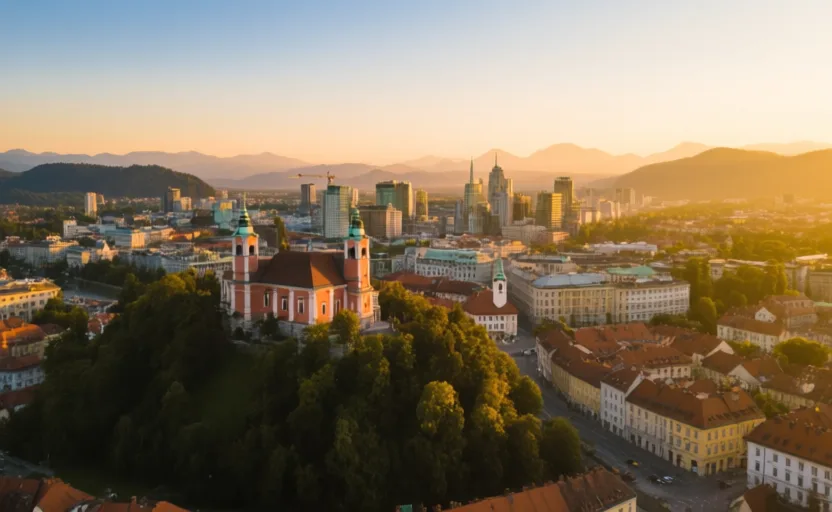 AI city illustration · Artistic impression
What people learn after moving
≈295,000 in the municipality; roughly 540,000 across the central Slovenian region — the smallest capital on this list by a wide margin
Euro. Slovenia adopted the euro in 2007, the first of the 2004 accession states to do so
In Schengen since 2007 — the longest-standing Schengen member in this cluster
Slovene, a South Slavic language with a rare dual grammatical number. English is very widely spoken; Italian and German are common in border regions
AI city illustration · Artistic impressionCost of living in Ljubljana
Check your eligibility
Pick your passport to see entry rules and the long-stay routes we have researched.
Pick your passport to see whether you can enter Slovenia — and what it takes to stay.
Slovenia's mainstream route is the single residence and work permit — one document covering both, issued by the administrative unit covering where you will live, resting on consent from the Employment Service of Slovenia. The EU Blue Card is now much more accessible after the July 2025 threshold cut. A genuine digital nomad permit opened on 21 November 2025. What Slovenia does not offer is an arrive-and-freelance route: self-employment as a basis for residence generally requires a year of prior legal residence.
EU and EEA licences are valid and exchangeable without a test. Licences from countries with which Slovenia has a reciprocal arrangement can be exchanged, in some cases after a test; others require the full Slovenian examination. Motorways need an electronic vignette bought against the plate — Slovenia dropped the windscreen sticker at the end of 2021. The city itself is the point: the historic centre is closed to cars, the municipality is compact, and a car here is a liability more often than an asset.
Slovenian retail banking is orderly and unremarkable, which is a compliment. Slovenia has been in the euro area since 2007, so there is no currency question and euro-area transfers are SEPA payments. The prerequisite is the Slovenian tax number (davčna številka) from the Financial Administration, which banks require from foreign customers alongside a passport and proof of address. Card acceptance is high and the country is comfortably digital.
Employment in Slovenia brings compulsory health insurance through ZZZS and entitlement to treatment through a chosen personal doctor. Slovenia used to run a system in which basic cover left a substantial co-payment that almost everyone insured privately against; that supplementary insurance was replaced by a compulsory health contribution, which simplified the position considerably. The persistent problem is not cost but capacity: finding a personal doctor accepting new patients in Ljubljana can be genuinely difficult.
Slovenia has a small telecoms market — Telekom Slovenije, A1 and Telemach are the main players — serving about two million people, and prices sit around the European middle rather than at the regional low end. Prepaid SIMs are easy on a passport; postpaid wants the tax number and usually a Slovenian bank account. Fixed broadband in Ljubljana is good, with fibre widespread. The compensations for a small market are excellent coverage for the geography and straightforward customer service in English.
Slovenia runs a progressive personal income tax with five bands rising to a 50% top rate, applied after employee social contributions of 22.1% and a general allowance that materially helps lower earners. There is no municipal surcharge and no local variation, so unlike Croatia the rate does not depend on where you live. FURS prepares an informative calculation each year which becomes your assessment unless you object. Slovenia offers no digital nomad tax exemption of the Croatian kind.
Each guide has verified costs, timelines, required documents, and the non-obvious gotchas — sourced from official government pages. Last verified August 2026.
Reading a list isn’t learning it. Globe Quest turns these into a trainer — hear each phrase spoken, drill them with spaced repetition, and get scored as you say them out loud.
Where Bulgaria charges a flat 10%, Hungary a flat 15% and Romania a flat 10% on a post-contribution base, Slovenia runs five progressive bands topping out at 50%, on top of 22.1% in employee social contributions. There is a general allowance that reduces the base for lower earners, and the effective rate on a middling salary is far below the headline. But a well-paid engineer in Ljubljana keeps materially less of a given gross than the same person in Sofia or Budapest, and that gap is the single most important number to model before accepting an offer here.
The route went live on 21 November 2025 and is genuinely new. It is available to non-EU nationals working remotely for an employer or clients based outside Slovenia, requires monthly means of at least twice the Slovenian average net salary, and runs for up to one year with no extension — you must wait six months after expiry before applying again. Family members may join immediately, without the waiting period that applies to family reunification on other permits, which is unusually generous. There is no tax exemption attached: unlike Croatia, Slovenia offers no statutory carve-out for foreign income.
This catches people coming from Czechia, where a trade licence is the standard freelancer route. In Slovenia, self-employment as a basis for residence generally requires a year of prior uninterrupted legal residence, with narrow exceptions for certain regulated professions such as architects and lawyers. So the sequence that works elsewhere in the region — arrive, register a sole trader, get residence on that basis — does not work here. Come on employment, study, family or the nomad permit, and consider self-employment once the year is behind you.
Until 21 July 2025 the Slovenian Blue Card required a gross annual salary of 1.5 times the national average. It now requires 1.0 times — a substantial relaxation that moves a lot of mid-level engineering and specialist salaries into scope. If an adviser or employer tells you the threshold is somewhere around €44,000, they are quoting the pre-July-2025 multiple. The Blue Card is worth having over the single permit: it counts toward permanent residence and allows Blue Card time in other member states to be aggregated.
Ljubljana progressively pedestrianised its historic core and Slovenska cesta, the main artery, and it is not a partial scheme with exemptions everywhere. Deliveries run in defined windows, residents have restricted access, and the free electric Kavalir vehicles ferry anyone who needs them across the pedestrian zone. Combined with a compact city of under 300,000 people, the BicikeLJ bike share and a €37 monthly bus pass, this makes Ljubljana one of the easiest capitals in Europe to live in without a car — and one of the more annoying to live in with one.
Ljubljana's price per square metre is high relative to Slovenian incomes and to the wider region, and the rental stock is small — this is a city of under 300,000 people with a university of roughly 40,000 students in it. September is brutal: student demand arrives all at once and the decent flats go in days. The practical consequences are to search outside the September peak if you can, to be ready to decide on the day you view, and to widen your search beyond the ring road earlier than you would in a larger city.
Outfit7, Bitstamp, Celtra, Zemanta, Databox, Sportradar
Outfit7 created Talking Tom in Slovenia and sold for over a billion dollars; Bitstamp, one of the longest-running cryptocurrency exchanges in the world, was also founded here.
Cosylab, Kolektor, Domel, Iskra, Dewesoft
Cosylab writes control systems for particle accelerators and proton therapy centres and supplies major physics facilities worldwide — an extremely specialised niche that a country this size has no business dominating.
Lek (Sandoz/Novartis), Krka, Bia Separations
Lek in Ljubljana is one of Novartis's significant generic manufacturing and development sites, and Krka in nearby Novo Mesto is one of central Europe's largest generics companies.
NLB, NKBM, SKB, Intesa Sanpaolo Bank, Bank of Slovenia
The Bank of Slovenia and the Ljubljana Stock Exchange are here, and NLB has expanded into a regional group across the former Yugoslavia.
Port of Koper (Luka Koper), Intereuropa, Petrol
Koper is the northern Adriatic's shortest route to central Europe and competes directly with Trieste and Rijeka; its head office functions and much of the trade sector sit in Ljubljana.
University of Ljubljana, Jožef Stefan Institute, National Institute of Chemistry
The Jožef Stefan Institute is the largest research institute in Slovenia and a serious presence in artificial intelligence, nuclear physics and materials — the country's main pipeline into deep tech.
Landmark · Central
The river through the old town, lined with terraces and crossed by Jože Plečnik's Triple Bridge, Cobblers' Bridge and market colonnade.
Local tip: Plečnik's works in Ljubljana were inscribed as a UNESCO World Heritage site in 2021 — a single architect's reshaping of an entire capital. The covered market colonnade along the river is the least visited and the most quietly brilliant part of it.
Landmark · On the hill above the old town
The hilltop castle reached by funicular or on foot in twenty minutes, with a viewing tower over the city and the Alps beyond.
Local tip: The funicular is quick and the walk up through the woods from Študentovska ulica is better. On a clear day the tower shows the Kamnik Alps and the Julian Alps at the same time, which is the fastest way to understand how small this country is.
Nature · West of the centre
A large landscaped park running straight into wooded hills, with running trails climbing to Rožnik and Šišenski hrib.
Local tip: The park is the postcard; the hills behind it are what people actually use. The Path of Remembrance and Comradeship — a 34-kilometre trail following the line of the wartime occupation fence around the city — starts here and is the best long run in any European capital.
Food · Along the river by the Triple Bridge
Plečnik's riverside market colonnade, with an open-air street food market taking over the square every Friday from spring to autumn.
Local tip: Odprta kuhna — Open Kitchen — runs on Fridays in good weather and is where the city's restaurants cook outdoors. Go early; by one o'clock the queues at the good stalls are twenty deep. The fish hall under the colonnade is open all week and almost empty.
Nightlife · Behind the railway station
A former Yugoslav army barracks occupied in 1993 and turned into an autonomous cultural centre — galleries, clubs and painted walls.
Local tip: It looks derelict and is not. Metelkova has run continuously for over thirty years and is the closest thing Ljubljana has to a counterculture, sitting a hundred metres from the national museum of contemporary art. Weekends only for the clubs.
Nature · A 34-kilometre ring around the whole city
A tree-lined trail following the exact line of the barbed wire fence with which occupying forces encircled Ljubljana between 1942 and 1945.
Local tip: It is a memorial, a commuter route and the city's main running circuit at the same time. Every May a mass march covers the whole loop. Most visitors never learn it exists, and it is the single most Ljubljana thing in Ljubljana — a wartime siege line turned into a park you jog on.
Side-by-side cost of living, language, climate and careers — to help you choose.