
Population
~3.4 million (city), ~6.7 million (metro)
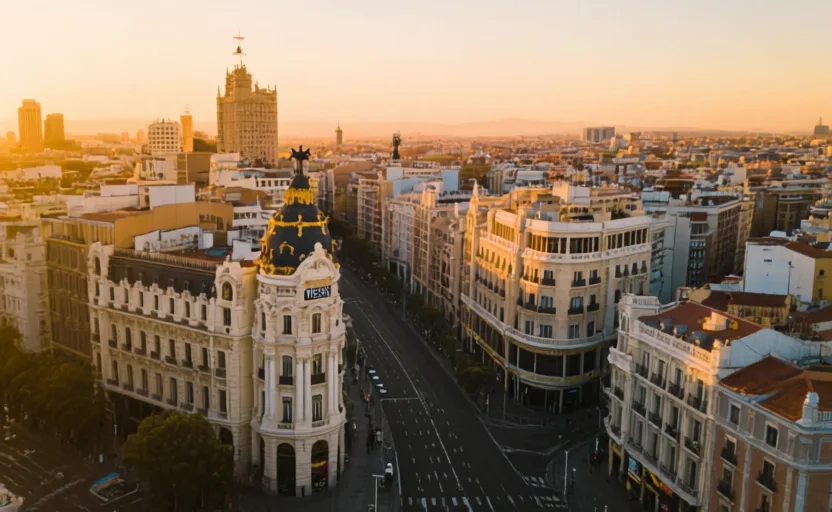 AI city illustration · Artistic impression
What people learn after moving
~3.4 million (city), ~6.7 million (metro)
Spanish (Castilian)
Euro (EUR)
Monday–Friday
AI city illustration · Artistic impressionCost of living in Madrid
Check your eligibility
Pick your passport to see entry rules and the long-stay routes we have researched.
Pick your passport to see whether you can enter Spain — and what it takes to stay.
Spain splits residency by passport. EU/EEA/Swiss citizens just register and walk out with a green A4 certificate carrying their NIE number. Non-EU professionals need a visa or residence authorisation first (employer-sponsored work permit, Highly Qualified route, or the 2023 Startups Law Digital Nomad Visa), then a TIE plastic card. One step quietly gates everything for everyone: the empadronamiento (padrón) at the Madrid town hall. The system itself is sound; the real obstacle in 2026 is getting a cita previa (appointment) at all.
EU/EEA licences stay valid while in force, but after 2 years of residence you must register or renew them under Spanish rules. Non-EU residents may drive on a foreign licence for only 6 months. After that you must either exchange it (canje) — which only works if your country has a bilateral agreement with Spain (UK, Japan, South Korea, most of Latin America, etc.) — or, for countries with no agreement (notably the US, China, India and Australia), pass the full Spanish theory and practical test plus the medical exam. A canje for agreement countries can now be started online via the DGT, but still needs one in-person visit and a medical certificate.
Spain splits accounts into 'resident' and 'non-resident'. A normal resident account effectively needs your NIE plus proof of a Madrid address (empadronamiento). Until those are sorted, a non-resident account needs a paid, periodically-renewed certificado de no residencia — or you skip the whole problem on day one with an EU fintech (N26, Revolut) that gives you a Spanish ES IBAN from your phone.
If your employer registers you with Social Security (alta), public healthcare is free and you get a regional health card (tarjeta sanitaria) from SERMAS that assigns you a GP. But the card is gated: you must be padrón-registered (empadronamiento) at a Madrid address first, then prove your Social Security right, then enrol at your local centro de salud. Self-employed and non-EU remote workers who are not contributing rely on private insurance (Sanitas, Adeslas, DKV) or the pay-in 'convenio especial'; the Digital Nomad Visa specifically demands full private cover with no co-pays. For emergencies, 112 works everywhere; 061 reaches Madrid's SUMMA medical dispatch directly.
A Spanish prepaid SIM (prepago) is easy to buy with just your passport — registration of your ID is mandatory by law (Ley 25/2007), but no NIE and no bank account are needed. A monthly contract (contrato) is cheaper per gigabyte but almost always requires a NIE and a Spanish bank account (IBAN) for direct debit. The practical newcomer move: grab a prepaid SIM now, then port your number to a cheap contract — Digi is the carrier of choice — once your NIE and IBAN exist. All plans 'roam like home' across the EU at no extra charge.
If you live in Spain more than 183 days in a calendar year you become a tax resident and owe IRPF on your worldwide income at progressive rates (in Madrid the combined top rate is about 45%, the lowest in Spain). Your employer withholds tax monthly (retención), so most employees just file the annual return, Modelo 100, between April and June. The big lever for new arrivals is the special regime for displaced workers, the Beckham Law: a flat 24% on Spanish employment income up to €600,000 for up to six years, but you must elect it within six months of starting work via Modelo 149.
Each guide has verified costs, timelines, required documents, and the non-obvious gotchas — sourced from official government pages. Last verified June 2026.
Reading a list isn’t learning it. Globe Quest turns these into a trainer — hear each phrase spoken, drill them with spaced repetition, and get scored as you say them out loud.
Madrid runs late: lunch is 2-3:30pm, dinner 9-10:30pm, and nightlife doesn't start until well past midnight. Shops and offices often pause midday. Fighting it just leaves you eating alone in an empty restaurant.
The main meal is a long midday lunch, frequently a great-value menú del día (starter, main, drink, dessert for ~€13-18). Dinner is usually lighter — often just tapas.
Socially, women greet with two cheek kisses (and men kiss women) — start to your right, brushing left cheeks. Men usually shake hands or hug. A formal handshake is fine in business.
There's no 15-20% culture. Round up the bill or leave a euro or two for good service; locals often leave nothing for a quick coffee or caña.
Outside tourist spots and big firms, English is limited, and almost all bureaucracy is in Spanish. Even basic Spanish dramatically smooths daily life and admin.
The empadronamiento (registering your address at the town hall) is the quiet master-step: you need it for public healthcare, residency paperwork, school places and more. Book the cita the week you sign a lease.
Santander, BBVA, the Bolsa de Madrid
Spain's financial capital, with the major banks and the stock exchange headquartered along the Castellana.
Cabify, Jobandtalent, Google, Amazon, Microsoft
A fast-growing startup and big-tech hub; the South Summit conference and a new digital-nomad inflow.
Telefónica, Iberdrola, Repsol, Naturgy
Several of the largest IBEX 35 companies run global operations from Madrid.
The Big Four, IE Business School, global law firms
A deep professional-services market and a top business-school ecosystem.
Airbus (Getafe), Ferrovial, ACS, Indra
World-leading engineering, construction and aerospace employers based around the city.
Meliá, NH Hotels, Iberia
A global tourism powerhouse and the home base of Spain's flag carrier.
Nature · Retiro
Madrid's grand royal park with a boating lake, rose garden and the glass Palacio de Cristal.
Local tip: Sunday afternoons fill with drummers and picnics by the lake; the Crystal Palace hosts free contemporary art.
Culture · Paseo del Arte
One of the world's greatest art museums — Velázquez, Goya and the Spanish masters.
Local tip: Entry is free the last two hours each day; go then but queue early, and pair it with the nearby Reina Sofía for Guernica.
Food · La Latina
The tapas heartland, and on Sundays the sprawling El Rastro flea market.
Local tip: Skip the touristy Mercado de San Miguel for the bars on Cava Baja; Sunday is tapas-and-vermouth day after El Rastro.
Nightlife · Malasaña
The bohemian, hip district of indie bars, vintage shops and the spirit of la movida.
Local tip: It doesn't get going until midnight — start with a rooftop drink and follow the crowd from there.
Landmark · Centro
The grand early-1900s avenue and the historic arcaded main square at the city's heart.
Local tip: Walk Gran Vía at dusk when the facades light up, then get churros con chocolate at the century-old San Ginés.
Culture · Parque del Oeste
A genuine ancient Egyptian temple, gifted to Spain and reassembled on a hill west of the centre.
Local tip: It's Madrid's best free sunset spot — arrive 30 minutes early, the crowds and the light are worth it.
Side-by-side cost of living, language, climate and careers — to help you choose.