Population
≈259,000 in the canton at the 2022 census — Ecuador's fifth city, and about a tenth the size of Guayaquil
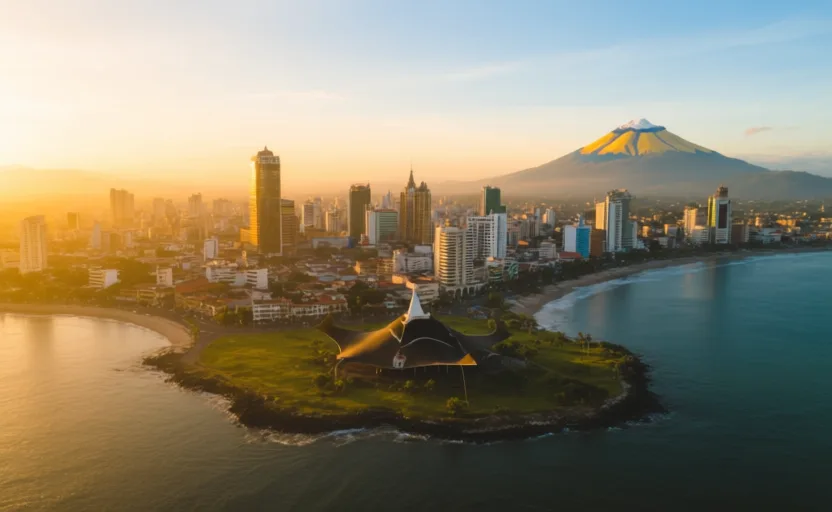 AI city illustration · Artistic impression
What people learn after moving
≈259,000 in the canton at the 2022 census — Ecuador's fifth city, and about a tenth the size of Guayaquil
Spanish in a strong manabita coastal accent. English is limited to the port, the canneries and the beach-sports communities out at Santa Marianita and Crucita
US dollar — Ecuador has been dollarised since 2000. US notes and coins circulate alongside Ecuadorian centavo coins
ECT (GMT−5) — no daylight saving, and almost exactly on the equator the day is twelve hours long all year
AI city illustration · Artistic impressionCost of living in Manta
Check your eligibility
Pick your passport to see entry rules and the long-stay routes we have researched.
Pick your passport to see whether you can enter Ecuador — and what it takes to stay.
Ecuador grants temporary residence for two years, renewable, and permanent residence after 21 months of continuous temporary residence. Thresholds are multiples of the salario básico unificado, USD 482 for 2026 — so the pensioner and rentista routes need three SBU, USD 1,446 a month. What is genuinely different about doing this from Manta is logistics rather than law: this is a provincial city, the foreign consular presence is thin, and several steps that are a morning in Quito or Guayaquil become a day's travel from here.
Two governments touch your car. The licence is an ANT matter, national and identical everywhere, requiring a medical and psychosensometric assessment and — for most nationalities — a course and examination rather than a straight exchange. The vehicle is the municipality's: Movilidad de Manta EP handles matriculación and the revisión técnica vehicular, with appointments booked online. Beyond the city, the coast road is the real subject: it is how you reach Santa Marianita, Crucita, Montecristi and Puerto López, and it is worth understanding before you rely on it.
Ecuador uses the US dollar, which removes exchange risk, spreads and the whole apparatus of currency management. What it adds instead is the Impuesto a la Salida de Divisas on money leaving the country, and a banking culture conservative about opening accounts for people without a cédula. Manta's practical difference from the big cities is branch depth: the national banks are all here, but the range of products, the specialist desks and the tolerance for an unusual case are all thinner, and a complicated file may still be decided in Guayaquil.
Employees are enrolled in the IESS by their employer from the first day of work. Everyone else can affiliate voluntarily by declaring a contribution base and paying 17.60% of it, from USD 84.83 a month at the 2026 floor. Manta's specific health picture has three parts: endemic mosquito-borne disease at sea level, an arid coast where water supply is itself a health variable, and the plain fact that a serious or unusual case will be transferred to a larger city — which is the single most important thing to plan for before you need it.
Three mobile operators cover the market and SIM registration against an identity document is mandatory. Manta itself is flat and reasonably well served — fibre reaches the main residential districts and the towers along the seafront. The constraint here is not topography but distance: the beach towns that make this coast attractive, Santa Marianita, Crucita, Puerto Cayo, are exactly where fibre thins out and where one operator's mobile coverage can be usable and another's not, street by street.
Ecuador taxes its residents on worldwide income — the opposite of territorial neighbours like Costa Rica and Panama, and the single most misunderstood point among people comparing the region. Residence turns principally on days present. Employees are withheld at source; anyone invoicing needs a RUC. Ecuador also levies the Impuesto a la Salida de Divisas on money leaving the country. Separately, the municipality publishes its own tax gazette and levies its own charges on property and on economic activity in the canton.
Each guide has verified costs, timelines, required documents, and the non-obvious gotchas — sourced from official government pages. Last verified August 2026.
Reading a list isn’t learning it. Globe Quest turns these into a trainer — hear each phrase spoken, drill them with spaced repetition, and get scored as you say them out loud.
Guayaquil gets the coverage because it has the largest absolute count. Manta is a canton of roughly 259,000 people and it recorded 363 violent deaths in the eleven months to November 2025 — the third-highest total of any canton in the country, behind only Guayaquil and Durán, and by rate it sits among the very worst of Ecuador's cantons with more than 100,000 inhabitants. Manabí is among the five most violent provinces. The reason is the same as everywhere on this coast: a working deepwater port on a cocaine route, and the disputes that come with it. In July 2023 the city's own mayor, Agustín Intriago — re-elected months earlier with 61% of the vote — was shot dead while visiting a municipal construction site. None of this makes ordinary life impossible and foreign residents are not the target, but treat any comparison that leans on Guayaquil's raw numbers to make Manta sound calm as simply wrong.
The Norma Ecuatoriana de la Construcción divides the country into six seismic zones. The entire national territory is classified as high hazard except the north-east, which is intermediate, and the coast — which is very high, saturating the design map at 0.50 g and forming zone VI on its own. The sierra cities sit at zone V and 0.40. This is not theoretical: the magnitude 7.8 earthquake of 16 April 2016 devastated Manabí and demolished much of Manta's Tarqui district. When you rent or buy here, when the building was built and to which edition of the code is a material question, informal self-built construction is a real risk category, and knowing your building's exit and your own meeting point is an ordinary local habit rather than an anxious one.
A temporary resident may be outside Ecuador for no more than ninety days in a year, counted cumulatively across the visa's validity rather than resetting on renewal. Permanent residents have historically faced a 180-day annual limit during their first two years. There is no warning letter and no grace, and it is how residence is most commonly lost in Ecuador. The reforming law published on 24 October 2025 rewrote the article on losing permanent residence, so confirm the current wording before planning an extended trip. Keep a spreadsheet of every entry and exit from the day you land.
Manta's climate is classified hot desert: mean temperatures run roughly 22 to 29°C all year and total rainfall is small and concentrated in a short wet stretch from January to April. What that description misses is the cloud. The Humboldt current keeps a low overcast over this coast for a large part of the year, so Manta is a hot city with a grey sky, not a Caribbean one — people who moved here for beach sunshine and arrived in August are routinely thrown by it. Sea breeze makes the heat far more bearable than Guayaquil's, air conditioning is less of a permanent necessity a block from the water, and the ultraviolet is still high through cloud.
Manabí is arid and Manta's supply has long been the city's most-discussed public service, run by the municipal company EPAM. Interruptions and low pressure are ordinary rather than exceptional, and buildings cope with them very differently. The practical answer is the same one residents use: a cisterna and a roof tank with a pump, checked before you sign anything. Ask the porter or the neighbours how often the supply goes and for how long, rather than asking the landlord. Tap water is not drinkable here in any case — bottled or a proper filter.
Manta is on the ocean, not on a river sixty kilometres from it, and the difference runs through everything: the air, the food, the weekends and the property market. Murciélago is the city beach with the promenade and the restaurants. San Lorenzo and Santa Marianita, twenty to thirty minutes south-west, are where the wind blows reliably enough that Santa Marianita is a genuine international kitesurfing spot. Crucita, north, is one of South America's better-known paragliding sites. Learn the word aguaje for the spring tides, respect the currents on the open beaches, and understand that the surf-town foreign community out at the beaches is a completely different scene from the port city itself.
Nirsa, Marbelize, Eurofish, Seafman, and the plants packing for Bumble Bee and Van Camp's
Manta is the centre of Ecuador's tuna industry and one of the largest tuna landing and processing ports in the Eastern Pacific. The canneries are the city's largest private employers and the reason its port, its cold chain and its industrial estate exist at all.
Autoridad Portuaria de Manta, cold-storage operators, bunkering and ship-supply firms, customs agencies
A deepwater Pacific port that handles fish, containers and cruise calls, and which is closer to Asian routes than Guayaquil's river port. Successive concession attempts have made its future a recurring political story rather than a settled one.
La Fabril, Ales, and the palm and peanut supply chains inland
La Fabril, one of Ecuador's largest industrial groups and a major producer of edible oils, fats and consumer goods, is rooted in this corner of Manabí. Together with the canneries it makes Manta a food-manufacturing city more than a services one.
Local contractors, engineering consultancies, and the seismic-retrofit and inspection trade
The 2016 earthquake set off a decade of demolition, rebuilding and code enforcement that is still working through the city. Structural engineering, inspection and retrofit remain unusually large lines of work here compared with any inland Ecuadorian city.
Hotels along the Malecón and Murciélago, Santa Marianita kitesurf schools, Crucita paragliding operators, whale-watching boats
Domestic beach tourism plus two genuine international niches — the reliable cross-shore wind at Santa Marianita and the ridge lift at Crucita — and humpback whales off this coast between roughly June and September.
Universidad Laica Eloy Alfaro de Manabí (ULEAM), the municipality, hospitals and the port authority
ULEAM is the main public university of the province and Manta's largest single institution outside the fishing industry, supplying most of the local professional workforce and much of the city's youth population.
Nature · The city's main beach, north-west of the centre
A wide urban beach with a promenade of restaurants and bars behind it — the centre of Manta's public life and its safest stretch of sand.
Local tip: This is where the city goes at weekends and it is patrolled, which is why it works. Eat ceviche at the stalls rather than in the restaurants behind — it is better and it is a third of the price. Swim between the flags and ask about the aguaje: at spring tides the currents here change character completely.
Nature · About twenty-five minutes south-west along the coast road
A long, wind-scoured beach that has become one of South America's more reliable kitesurfing destinations, with a small resident foreign community to match.
Local tip: The wind is most dependable roughly June to December, which is exactly when the city is greyest — the two facts are the same fact, because the same Humboldt-driven pattern produces both. Schools rent gear and teach beginners. It is a genuinely different social world from Manta itself, and a lot of people who thought they were moving to the city end up living out here.
Culture · Twenty minutes inland, at the foot of its hill
The hat town: the birthplace of Eloy Alfaro and the place where the finest toquilla straw hats in the world are woven and finished.
Local tip: What the world calls a Panama hat is Ecuadorian, and the very finest superfino weaves come from here — a single hat can take a weaver months and cost thousands. Buy from a workshop rather than a stall on the main road, ask to see the weave against the light, and visit the Alfaro mausoleum on the hill while you are up there.
Nature · On the coast road south-west, beyond Santa Marianita
A protected coastal cloud forest sitting improbably above an arid shoreline, with howler monkeys, orchids and a fog-fed canopy.
Local tip: Almost nobody who comes to Manta goes, which is the point. A wet green forest twenty minutes from a desert beach is a genuine ecological oddity — it is fed by the coastal fog rather than by rain. Go early when the howlers are loud and the fog is still in the trees, take a guide from the community, and combine it with a beach afternoon.
Food · The centre, and the working beach where the boats land
Manabí food at source — viche, tonga, ceviche and the peanut-thickened cooking the province is famous for, beside a beach where the catch is still landed onto the sand.
Local tip: Go early — the fish comes in at dawn and the market food counters are a morning business. This is the best eating in the city by a distance and effectively none of it is aimed at visitors. Bring cash and small notes, and do not photograph the boats or the crews without asking.
Neighborhood · About an hour north along the coast
A long beach town below a line of cliffs whose ridge lift makes it one of the best-known paragliding sites in South America.
Local tip: Pilots fly the cliffs most afternoons when the sea breeze fills in, and tandem flights are cheap by any international standard. The town itself is scruffier and far cheaper than Manta, with a small but real foreign community — worth a weekend before you conclude the coast is only the city.
Side-by-side cost of living, language, climate and careers — to help you choose.