Population
≈1 million in the city; the Marrakech-Safi region considerably more
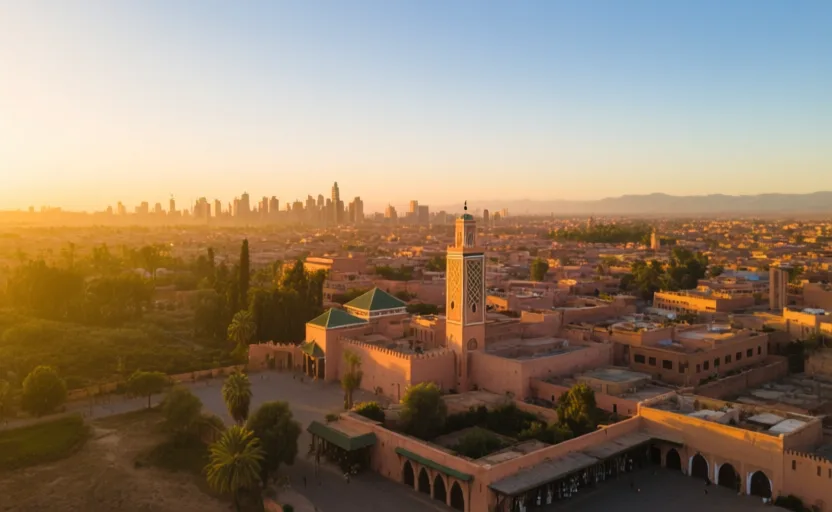 AI city illustration · Artistic impression
What people learn after moving
≈1 million in the city; the Marrakech-Safi region considerably more
Moroccan Arabic (Darija) and Tashelhit Amazigh in daily use; French near-universal in business and tourism; English widespread in hospitality
Moroccan dirham (MAD) — not freely convertible, and subject to Office des Changes rules
GMT+1 year-round, reverting to GMT+0 for the month of Ramadan
AI city illustration · Artistic impressionCost of living in Marrakech
Check your eligibility
Pick your passport to see entry rules and the long-stay routes we have researched.
Pick your passport to see whether you can enter Morocco — and what it takes to stay.
The rule is simple — beyond three months you must hold a carte d'immatriculation, applied for locally, carrying a mention that describes why you are here. Marrakech is unusual in how many foreigners live here without one, cycling in and out on ninety-day visa-free stays. That works until it does not: it builds no residence history, it can be refused at the border, and it quietly blocks a licence exchange, a bank account of the right type, and any property or business step that asks for a residence card.
Your foreign licence is valid for twelve months from taking up residence. Within that window NARSA will exchange it for a Moroccan one if your country has a reciprocity agreement — France, Spain, Belgium, Italy and Germany among them. After that, or without an agreement, you take the Moroccan tests. In Marrakech specifically, the car question is different from Casablanca's: you cannot drive into the medina at all, but you badly want a vehicle for the Atlas, Essaouira and Agadir.
The dirham is not freely convertible, so the account type you choose decides whether your money can ever leave. A convertible-dirham or foreign-currency account holds funds imported from abroad and keeps their right to be transferred out; an ordinary resident dirham account does not. In Marrakech this matters most to property buyers: the right to repatriate the proceeds when you eventually sell rests on the purchase having been funded by a declared transfer of foreign currency through the banking system.
If a Moroccan employer hires you, CNSS registration from day one is compulsory and AMO comes with it. If you are here on a visiteur card, running your own business, or working remotely for foreign clients, you are outside it and private insurance is not optional. Marrakech has good private clinics but a thinner specialist market than Casablanca, and serious cases are frequently referred there. The city's own health hazard is the summer heat.
Anonymous prepaid SIMs no longer exist in Morocco — every card is registered against an identity document, so you buy in an operator shop with your physical passport. Mobile data is fast and cheap, which is why so many remote workers pick Marrakech. Fixed connectivity is the complication: Gueliz and the new districts are well served, and getting a proper line into a medina riad through metres of alley and rubble-stone wall is a genuinely different proposition.
Article 23 of the Code Général des Impôts makes you a Moroccan tax resident if you have your permanent home here, your centre of economic interests here, or spend more than 183 days here over any rolling 365. Residents are taxable on worldwide income subject to treaty relief. In Marrakech the live issues are usually property: rental income is taxable, and since loi n° 80-14 and its 2023 implementing decree, letting a riad or an apartment to tourists is a licensed activity with a classification, not an informal one.
Each guide has verified costs, timelines, required documents, and the non-obvious gotchas — sourced from official government pages. Last verified August 2026.
Reading a list isn’t learning it. Globe Quest turns these into a trainer — hear each phrase spoken, drill them with spaced repetition, and get scored as you say them out loud.
The city is busiest from roughly October to May and empties in the July–August heat, when daytime temperatures regularly exceed 40°C and much of the foreign population leaves. Rents on furnished property are quoted with that in mind, hospitality hiring is seasonal, and the people you meet in February may genuinely not be here in August. If you are signing a long lease, the summer discount is real and negotiable; if you are relying on seasonal work, budget for the gap.
Medina houses are old, share walls, and are reached through alleys no vehicle can enter — every bag of cement arrives by handcart or donkey. Renovation costs routinely exceed the purchase price. And if you intend to let it to guests, loi n° 80-14 and its 2023 implementing decree brought riads, guest houses and short-term tourist lets into the same authorisation and star-classification framework as hotels. Operating without the authorisation is not a grey area, and the platforms and the authorities both now check.
Marrakech sits in a severely water-stressed basin. The Lalla Takerkoust dam that serves the region has run at a fraction of its normal storage for years, groundwater has fallen, and authorities have imposed restrictions including closing public hammams and showers for part of the week. Pools, gardens and golf are politically and practically exposed. Ask any property what its water source is, whether it has a tank, and what happens in a restriction — and check the current position, because the measures change.
You apply at the commissariat covering your address, and the file wants a legalised lease or deed, an attestation de résidence from the moqaddem or the local authority, a medical certificate under three months old, and a criminal-record extract from your home country. Marrakech's prefecture handles a large foreign caseload and is comparatively used to it — which helps, but does not exempt you from a complete file. Get the home-country police certificate before you fly.
The dirham is not freely convertible. Money brought into Morocco and converted into an ordinary resident account cannot simply be sent back out. If you are buying, the purchase must be funded through a declared transfer of foreign currency via the banking system — that declaration to the Office des Changes is what preserves your right to repatriate the sale proceeds later. Riads bought informally with cash brought in over several trips become very difficult to sell and take the money home.
Marrakech has more people whose living depends on visitors than anywhere else in Morocco, and the first price, the first offer of help and the first directions are all calibrated to that. Opening in Darija — even badly — moves you into a different category almost instantly. French works everywhere and is not the same signal. This is the highest-return effort available to a newcomer here and it takes an afternoon.
Four Seasons, Mandarin Oriental, Royal Mansour, La Mamounia, hundreds of independent riads
Marrakech is Morocco's tourism capital and the sector is the local economy rather than a part of it — which is why the city is unusually exposed to anything that stops people travelling, as 2020 demonstrated.
Independent architects, maîtres d'œuvre, specialist medina builders
A whole professional ecosystem exists around buying, restoring and licensing medina property for foreign owners: architects, project managers, tadelakt and zellige craftsmen, and the lawyers who deal with undivided family title.
Sidi Ghanem industrial zone workshops, Marrakech Design, ceramics and leather cooperatives
Sidi Ghanem on the northern edge is the design and light-manufacturing district — furniture, lighting, ceramics and leather producing for European buyers. It is where the city's creative export economy actually sits.
Atlas Studios (Ouarzazate), local fixers and production services, Marrakech International Film Festival
Southern Morocco's landscape and the Ouarzazate studios three hours away sustain a real production-services industry, with Marrakech as its base for crews, casting and logistics.
Citrus, olive and market-garden operations across the Haouz plain
The plain around Marrakech is intensively farmed for export to Europe, which is also why regional water allocation is politically fraught — agriculture and tourism compete for the same shrinking supply.
Coworking spaces in Gueliz and the Palmeraie, independent consultants and founders
A visible but legally awkward population: fast internet, cheap living and a European time zone attract remote workers, but Morocco has no visa for them, so most are on visa-free stays or on a residence card obtained through a Moroccan company.
Landmark · Medina
The great square — snake charmers, storytellers, orange juice and a night food market — with the covered souks running north from it.
Local tip: The square is genuinely worth an evening and genuinely a tourist economy. Locals eat around it rather than in it: the mechoui pit stalls in the alley off the north-west corner, and the grill places on Rue Riad Zitoun. Prices in the souks fall sharply two or three lanes off the main routes.
Neighborhood · New town, west of the medina
The French-built modern quarter — boulevards, galleries, supermarkets, and where most working foreigners actually live.
Local tip: This is the practical answer to 'where do I live in Marrakech'. Rue de la Liberté and the streets around the Carré Eden have the cafés and galleries; the residential streets behind Avenue Mohammed V are quieter and much better value than their reputation.
Culture · Between Gueliz and the Palmeraie
The cobalt-blue garden Jacques Majorelle made and Yves Saint Laurent saved, plus the museum built alongside it.
Local tip: It is the single most visited site in Morocco and the queue reflects that — book online for the first slot of the day. The adjacent Berber Museum is included and is better than the garden, and almost everyone walks past it.
Neighborhood · Industrial zone, northern edge
The design and workshop district — furniture, ceramics, lighting and leather producers with factory-door showrooms.
Local tip: Most workshops sell direct at a fraction of medina prices and will make to order. It is spread out and needs a taxi, and much of it closes early and on Fridays. Go on a weekday morning with a list and measurements.
Nature · 45–60 minutes south
River valleys and Berber villages climbing into the Atlas, with Toubkal — North Africa's highest peak — beyond them.
Local tip: The Ourika roadside restaurants are a Marrakech Sunday institution. Note that the Al Haouz province south of the city was the epicentre of the 2023 earthquake; rebuilding continues in parts of the range, and it is worth checking road and village conditions rather than assuming a route is as it was.
Nature · South and west of the medina walls
Twelfth-century royal irrigated orchards and a reservoir pavilion with the Atlas behind it — huge, old, and mostly empty.
Local tip: Everyone photographs the Menara pavilion and leaves. The Agdal, far larger, is a working olive and citrus orchard fed by the same medieval khettara water system, and on a weekday afternoon you can walk for an hour and see almost nobody. It is also the clearest way to understand how this city was watered before it had a problem.
Side-by-side cost of living, language, climate and careers — to help you choose.