
Population
≈1.5 million across the metropolitan zone — the largest city on the Yucatán peninsula
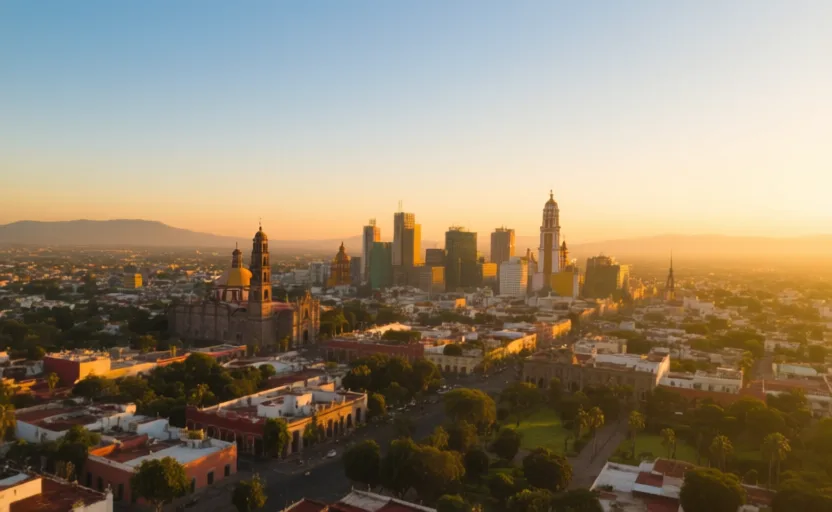 AI city illustration · Artistic impression
What people learn after moving
≈1.5 million across the metropolitan zone — the largest city on the Yucatán peninsula
Spanish, with Yucatec Maya spoken by several hundred thousand people statewide and audible in the markets
Mexican peso (MXN, $)
Central Time, GMT−6 all year — Mexico abolished daylight saving in 2022, so the offset to US clocks shifts twice a year
AI city illustration · Artistic impressionCost of living in Merida
Check your eligibility
Pick your passport to see entry rules and the long-stay routes we have researched.
Pick your passport to see whether you can enter Mexico — and what it takes to stay.
Mexican temporary residency starts at a consulate outside Mexico, which places a visa sticker in your passport. You enter Mexico with the entry record marked for canje and have 30 days to begin the exchange at INM for the physical resident card. Mérida's population of retirees and remote workers means the economic-solvency route dominates here rather than employer sponsorship — and anyone with sufficient pension income should check whether they qualify for permanent residency outright, skipping four years of temporary cards and renewals.
You may drive on a valid foreign licence; an International Driving Permit is a translation rather than an authorisation. A first Yucatán licence requires a medical certificate and both theory and practical examinations, and is normally issued the same day if you pass. You choose two, three or five years of validity — roughly MXN 800–900 for a two-year car licence, MXN 2,100–2,300 for five. Yucatán also runs one of the more generous fee-relief schemes in Mexico: Decreto 143/2025 gives a 50% discount to lower earners and a full exemption to some groups, on the two-year licence only.
Mexican accounts are tiered: a fintech Nivel 2 account opens from your phone in minutes with a passport and CURP but caps monthly deposits, while a Nivel 4 account has no cap, can receive a salary and needs a comprobante de domicilio and normally an RFC. Mérida's distinctive problem is not opening the account but feeding it. A large share of residents here live on pensions or foreign salaries, and the difference between a bank's exchange rate and a specialist transfer service, applied every month for years, is one of the biggest recurring costs in the city.
A formal Mexican job enrols you in IMSS by law; everyone else can buy voluntary IMSS through Seguro de Salud para la Familia, subject to waiting periods and permanent exclusions, or buy private cover. Mérida has the strongest private hospital cluster in south-east Mexico and prices well below Monterrey's. The issue specific to this city is age: Mexican insurers generally will not write a new individual policy past their upper age limit, so people who move here in their sixties intending to arrange insurance later often find that door already closed.
Buy a prepaid SIM on arrival and register it: linking every Mexican line to a CURP and a photo ID became compulsory on 9 January 2026, and unregistered prepaid numbers are being suspended through the second half of 2026 on a calendar set by the last digit. This is the non-biometric successor to the PANAUT registry the Supreme Court struck down, so no fingerprints are involved. Telcel has the best coverage across the peninsula and the gap widens as soon as you leave Mérida. Fibre in the city is cheap and fast; the constraints are thick colonial masonry and the fact that hurricane season takes out power rather than networks.
Federal income tax works as it does everywhere in Mexico: employers withhold ISR through payroll, most single-employer staff never file, and independent professionals should look hard at RESICO's 1–2.5% rates on gross receipts. The state layer is narrower than the internet suggests. Yucatán is one of seven states with an impuesto cedular, but its version reaches only gains on selling property (5%) and an individual's business income (4.5% from 2026) — rents are not covered at all. The trap is not the letting, it is the exit: the 5% is settled at the notario's table on the day you sell, and people who modelled a restoration on federal capital-gains rules alone find it there.
Each guide has verified costs, timelines, required documents, and the non-obvious gotchas — sourced from official government pages. Last verified August 2026.
Reading a list isn’t learning it. Globe Quest turns these into a trainer — hear each phrase spoken, drill them with spaced repetition, and get scored as you say them out loud.
Article 27, section I of the Mexican constitution bars foreigners from acquiring direct ownership of land in a strip 100 km along the borders and 50 km along the coast, and inside that strip a foreigner holds residential property through a fideicomiso — a bank trust, authorised by the SRE under article 11 of the Ley de Inversión Extranjera, running 50 years and renewable, in which the bank holds title and you hold every ownership right. Mérida's centre sits roughly 33–36 km from the Gulf at Progreso, which puts the city inside 50 km of the coast on any ordinary reading, and long-established local sources say exactly that. Yet a great many Mérida agents, and some local firms, assert with real confidence that the city is 'inland and exempt' and sell direct deeds on that basis. Neither the constitution nor the statute specifies the measuring datum, and no official map resolves it. The formal way to settle it is a written consultation to the SRE, which is the authority that determines whether a given property sits in the zone; failing that, get your notario público's determination in writing before you commit money. If it falls inside, budget roughly MXN 15,000–25,000 to set the trust up plus an annual bank fee of several hundred dollars. Note also that the 'just use a Mexican company' shortcut does not work for a home: under article 10 of the same law a Mexican company with foreign shareholders may hold restricted-zone property only for non-residential purposes.
Yucatán is one of seven states with an impuesto cedular, and the lists circulating online say it taxes rental income. It does not. The Ley General de Hacienda del Estado de Yucatán contains exactly two cedular chapters: 5% on gains from selling property in the state (article 20-I), and 4.5% on an individual's business income (article 20-D, cut from 5% for 2026). The words arrendamiento and uso o goce temporal appear nowhere in the law. So letting a colonial house here attracts federal ISR and no state income tax — but selling it attracts a 5% state charge on the gain, calculated on the same base as the federal tax, due within 30 working days and normally settled by the notario at closing. Your principal residence is exempt up to 700,000 UDIs. Model the exit, not the rent.
In INEGI's national urban security survey for the second quarter of 2026, 38.2% of adults in Mérida said they considered the city unsafe — against a national figure of 59.8%, and consistently placing Mérida among the fifteen safest cities in the country. That gap is real and it is the main reason the foreign population has grown so fast. But the figure is 38%, not 0%: opportunistic theft, motorbike snatches and road safety are ordinary urban risks here, and the low violent-crime rate is not a reason to stop locking the door.
The hot dry season before the rains is brutal — sustained 38–40°C with peninsula humidity — and air conditioning runs most of the year. CFE applies a subsidised summer tariff in Yucatán from 1 April to 31 October, and Mérida inside the periférico sits on tariff 1C, which allows an average of 850 kWh a month. Pass that as a rolling twelve-month average and the service is reclassified to the high-consumption DAC tariff, which strips the subsidy entirely — and the tariff attaches to the meter, not to you. Ask a landlord for the last four bills and read the tariff code, not just the amount: you inherit the previous occupant's consumption history along with the flat.
Yucatán has no rivers. All water comes from a shallow karst aquifer only metres below the surface, which makes supply cheap and reliable and makes the aquifer easy to contaminate. Practically, the water is very hard: it scales kettles, ruins washing machines and boilers, leaves deposits on tiles and is unkind to hair and skin. Nearly every established household has a softener and drinks from garrafones. Factor both into the first month's spending.
This is the cheapest of Mexico's major relocation cities and also the thinnest professional job market of them. Yucatán's economy runs on tourism, healthcare, construction, logistics through Progreso and agro-industry, not on corporate headquarters. If your income arrives from abroad, that arithmetic is entirely in your favour. If you need to be hired locally at an international salary, Mérida is a much harder proposition than Guadalajara or Monterrey and it is better to know that before the move than after.
Boutique hotel groups, Chichén Itzá and Uxmal operators, Grupo Xcaret regional operations
Mérida is the base for the western Maya archaeological circuit and, since the Tren Maya opened, an increasingly practical gateway to the whole peninsula. Hospitality is the largest private employer.
Star Médica, Clínica de Mérida, Hospital Faro del Mayab, IMSS Regional
Mérida has the deepest private hospital concentration in south-east Mexico and treats patients from across the peninsula, plus a growing flow of North American residents and medical tourists.
Regional developers, restoration specialists, notarías and title firms
The Centro Histórico has gone from derelict to one of Latin America's most active restoration markets in about fifteen years, and the northern corridor is building new gated developments continuously.
Puerto de Progreso, textile and light-assembly maquilas, agroindustrial processors
Progreso, 35 km north, is the peninsula's deep-water port and cruise terminal, and its expansion plus the Tren Maya freight component is the main industrial bet the state is making.
Grupo Bepensa, pork and poultry producers, honey cooperatives, citrus processors
Yucatán is Mexico's leading honey producer and a major pork exporter, and Bepensa is the peninsula's Coca-Cola bottler and one of the state's largest private groups.
BPO centres, distributed engineering teams, coworking operators
Central Time with no daylight saving, cheap fibre and low costs have made Mérida a quiet base for people employed elsewhere — which is now a visible part of the local economy rather than a curiosity.
Landmark · North of Centro
A boulevard of mansions built by henequen barons in the early 1900s, deliberately modelled on the Champs-Élysées.
Local tip: Sunday morning the avenue closes to cars for the Bici Ruta and the whole city comes out. That, rather than a weekday walk, is when the street makes sense. The Casas Gemelas are open as a museum and worth the entry.
Culture · Centro Histórico
The main square, ringed by the oldest cathedral on the American mainland — built partly from the stones of the Maya city it replaced.
Local tip: Look at the cathedral's exterior stonework closely; some of the blocks are recycled from T'hó, the Maya city that stood here. The confidence-chair benches in the square face each other for a reason, and the free Saturday night dance in front of the Palacio Municipal is genuinely local.
Neighborhood · Centro Histórico
The two barrios around their own colonial churches and market squares where most of the restoration and most of the foreign residents have concentrated.
Local tip: Eat at the Santa Ana market food stalls in the morning and at the Santiago park taco stands at night — the parks flip roles at different hours. Wednesday night dancing in Parque de Santiago is for the neighbourhood, not for visitors, and you are welcome at it.
Food · Southern Centro
The vast, chaotic central market — produce, butchers, hammocks, huipiles and the cheapest cochinita in the city.
Local tip: Go before nine, eat cochinita standing at a counter, and buy your hammock upstairs by the thread count rather than the colour — a proper matrimonial in fine cotton is a different object from the tourist versions on Montejo.
Nature · 45–60 min south-east
Dozens of open and cavern cenotes in a small area of farmland, most of them run by the villages themselves.
Local tip: Go on a weekday and pick two or three rather than a package of seven. The community-run ones charge a small entry and the money stays in the village. Do not wear sunscreen or insect repellent before swimming — it goes straight into the aquifer that supplies the state.
Nature · North-east of Centro
Twenty hectares of former railway yard — Mérida's central station until 1974 — turned into the city's largest central park, opened in November 2023.
Local tip: Meridanos use it constantly and almost no guidebook mentions it. It has the city's best running loop, an outdoor auditorium and the restored station buildings, and it is one of the few places in Centro with real shade and a breeze after six.
Side-by-side cost of living, language, climate and careers — to help you choose.