
Population
≈1.37 million in the comune; ≈3.2 million in the metropolitan city and over 5 million in the wider urban region
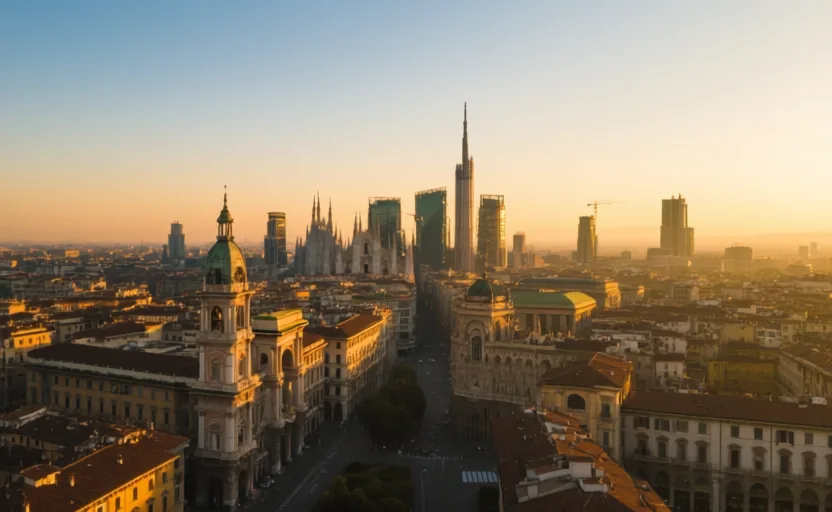 AI city illustration · Artistic impression
What people learn after moving
≈1.37 million in the comune; ≈3.2 million in the metropolitan city and over 5 million in the wider urban region
Italian. English is more widely spoken in professional Milan than anywhere else in Italy, but public offices operate in Italian only
Euro (EUR)
CET (GMT+1), CEST (GMT+2) with daylight saving from late March to late October
AI city illustration · Artistic impressionCost of living in Milan
Check your eligibility
Pick your passport to see entry rules and the long-stay routes we have researched.
Pick your passport to see whether you can enter Italy — and what it takes to stay.
Italy runs a fixed chain: nulla osta from the Sportello Unico, then a type-D visa from your consulate, then entry, then an application for the permesso di soggiorno within eight working days — filed on paper at a post office, not online. Separately and in parallel you register your address with the comune, which sends a municipal police officer to your flat to verify you live there. EU citizens skip the permit entirely and go straight to the comune.
EU and EEA licences can be used indefinitely and exchanged on request. Licences from a short list of countries with reciprocity agreements convert administratively; everything else means taking the Italian theory and practical tests in Italian, with a one-year grace period from the date you register residence. Meanwhile Milan operates two overlapping traffic restrictions — Area C, a congestion charge in the historic core, and Area B, a much larger low-emission zone — and both are camera-enforced with no barrier to warn you.
Italian banks distinguish sharply between a conto residenti and a conto non residenti, and the second is more expensive and more limited. You need a codice fiscale for either. Milan has the deepest branch network and the most English-speaking staff in Italy, and the digital banks — which are widely accepted for salary — are usually the fastest way to a working IBAN in your first week.
Registration with the Servizio Sanitario Nazionale is compulsory and free for employees, self-employed people and their families. Everyone else — students, elective residents, some permit holders — registers voluntarily and pays a contribution that was restructured from 1 January 2024 into an income-based charge with a €2,000 annual minimum for most adults. Registering assigns you a medico di base, the gatekeeper for every referral, and produces the tessera sanitaria that doubles as your codice fiscale card.
Italian mobile is cheap by European standards — large data bundles for well under €15 a month — but every SIM, prepaid included, must be registered to an identity document and a codice fiscale. There is no anonymous prepaid market. Home connectivity in Milan is genuinely good, with FTTH across much of the city, but the historic centre's older buildings and shared risers frequently mean a copper or FTTC connection dressed up in fibre marketing.
You become an Italian tax resident by being registered in the anagrafe, or having your habitual abode or centre of interests here, for more than 183 days in a calendar year — and residents are taxed on worldwide income. Three regimes matter to newcomers: the impatriate regime, substantially rewritten for anyone moving from 2024; the flat tax for new residents with large foreign income, whose price has now risen twice; and the forfettario regime for the self-employed. On top of IRPEF sit regional and municipal surcharges, and on top of your flat sit TARI and, if it is not your main home, IMU.
Each guide has verified costs, timelines, required documents, and the non-obvious gotchas — sourced from official government pages. Last verified August 2026.
Reading a list isn’t learning it. Globe Quest turns these into a trainer — hear each phrase spoken, drill them with spaced repetition, and get scored as you say them out loud.
Non-EU arrivals on a long-stay visa must submit the residence-permit application within eight working days of entering Italy. It is done on paper: you collect a yellow kit at a Poste Italiane counter marked 'Sportello Amico', fill it in, buy a €16 revenue stamp at a tobacconist, and hand it back with roughly €30 in postal and permit fees. The postal receipt is your proof of lawful stay while the Questura processes it, and it is the document banks and employers will ask to see. Missing the deadline does not automatically void your stay, but it complicates everything afterwards and the Questura will ask about it.
The tax code is the key to Italian life — no lease, bank account, SIM contract, health card or utility connection without it. Non-EU nationals arriving on a work or family visa are usually assigned one at the Sportello Unico or by the Questura when the permit is filed; everyone else applies at an Agenzia delle Entrate office with a passport and a declared reason. It is free and issued the same day. You do not need residence, an address or a permit in hand to get one, which is exactly why it should be the first errand.
Idealista put Milan at €23.3 per square metre a month in the second quarter of 2026, ahead of Florence and Venice and well ahead of Rome. A modest one-bed inside the city walls is €1,200–1,800; the same flat in Turin is roughly half. Landlords routinely ask for a guarantor, three months' deposit and a payslip showing three times the rent, and desirable flats are gone within days of listing. Budget for the deposit plus the agency commission — customarily around one month's rent plus VAT — before you arrive.
Anyone moving to Italy from 2024 falls under the new rules in D.Lgs. 209/2023: 50% of qualifying employment or professional income is exempt, capped at €600,000 of income a year, for five tax years, and only if you hold a high qualification or specialisation, were not tax-resident in Italy for the previous three years, and commit to staying tax-resident for at least four. The old 70% (and 90% in the south) exemption still fills search results and applies only to people who moved earlier. Milan is where the new regime is worth the most, because the salaries are large enough for the exemption to be real money.
Area C is the congestion charge inside the old walls: €7.50 a day, Monday to Friday 7:30–19:30, cameras and no barriers. Area B is far larger — most of the municipal territory — and is an emissions zone operating on the same weekday hours, from which older diesels including Euro 5 are excluded. Both apply to foreign-plated cars, and fines arrive months later through an international recovery agent. If you are bringing a car, check its Euro class against the current Area B table before you drive in, not after.
Milanese offices, agencies, the Questura's public counters and half the restaurants thin out drastically from the first week of August, with the fortnight around Ferragosto on 15 August close to a full stop. Plan bureaucracy around it. Separately, 7 December is Sant'Ambrogio, the city's patron saint, and it is a public holiday in Milan only — schools, offices and public services close while the rest of Italy works, and it usually bridges into 8 December for a four-day weekend.
Intesa Sanpaolo, UniCredit, Mediobanca, Borsa Italiana (Euronext Milan), Generali
Italy's only financial centre — the stock exchange, the asset managers and essentially every foreign bank's Italian operation sit within a few streets of Piazza Affari and Porta Nuova.
Armani, Prada, Dolce & Gabbana, Moncler, Versace, Kering and LVMH Italian operations
Design and commercial headquarters rather than manufacturing, which sits in the Veneto, Tuscany and the Marche. Fashion Week in February and September reorders the whole city.
Alessi, Kartell, Molteni, Salone del Mobile, RCS, Mondadori, Publitalia
The Salone del Mobile each April is the world's largest furniture fair and the week around it — Fuorisalone — takes over entire districts. Italy's publishing and advertising industries are also concentrated here.
The Big Four, McKinsey, BCG, Bain, major international law firms
Milan is where multinationals put their Italian head office, so the advisory market is far deeper than anywhere else in Italy and is the most reliable English-speaking entry point.
Chiesi, Zambon, Bracco, Recordati, IEO, Humanitas, San Raffaele
Lombardy accounts for a large share of Italian pharmaceutical output, and the private research hospitals around Milan are among the strongest clinical research centres in southern Europe.
Bending Spoons, Satispay, Scalapay, Prima Assicurazioni, plus Google, Amazon and Microsoft Italian offices
Italy's startup scene is small by European standards but almost all of it is here, clustered around the Politecnico, Bocconi and the regenerated Porta Nuova and Bovisa districts.
Landmark · Centro storico
The marble cathedral that took nearly six centuries and the glass-roofed arcade beside it.
Local tip: The roof terraces are the point, not the interior — you walk among the spires and out onto the marble. Buy the timed ticket online and take the stairs rather than the lift; the queue is a third as long.
Nightlife · Porta Ticinese, south-west
Two surviving canals from the medieval system Leonardo worked on, now the densest drinking strip in the city.
Local tip: The Naviglio Grande towpath is where visitors go. Locals drift one canal over to the Naviglio Pavese or into the Vicolo dei Lavandai courtyards. The last Sunday of the month brings a long antiques market along the water.
Neighborhood · Centre-north
Cobbled streets, the Pinacoteca's Renaissance collection, and the art academy that gives the district its character.
Local tip: The Orto Botanico behind the academy is free, almost always empty and one of the quietest places in central Milan. The Pinacoteca is free on the first Sunday of the month, which is also the worst day to go.
Neighborhood · North of the centre
Milan's skyline — the Bosco Verticale towers and the elevated park at Biblioteca degli Alberi — against the low-rise old Isola quarter behind.
Local tip: Isola is where people actually eat and drink; the towers are the postcard. Walk north from Piazza Gae Aulenti and you are in a 1930s working district in two minutes.
Culture · Magenta
The refectory holding Leonardo's Last Supper, which survived a 1943 bomb that destroyed the wall opposite.
Local tip: Tickets are released in batches months ahead and sell out immediately; the fifteen-minute slots are strictly enforced. Check the official site the moment a new quarter opens rather than paying a reseller.
Culture · North-west, near Porta Volta
An open-air museum of funerary sculpture, where Milan's industrial families commissioned serious artists.
Local tip: Free, rarely busy, and genuinely extraordinary — Art Nouveau mausoleums, a Futurist tomb and the Toscanini family plot. Pick up the free map at the entrance; the tram 12 and 14 stop outside.
Side-by-side cost of living, language, climate and careers — to help you choose.