
Population
≈1.3 million in the city and around 1.9 million in the metropolitan area — over half of Uruguay's entire population
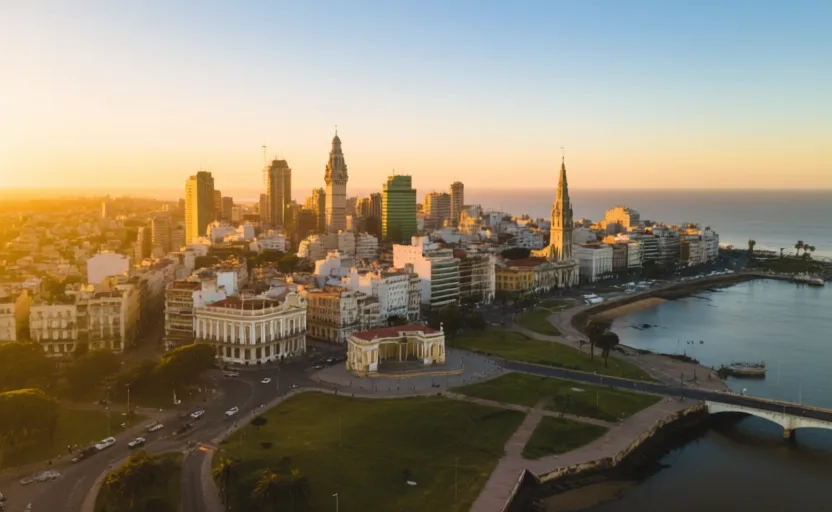 AI city illustration · Artistic impression
What people learn after moving
≈1.3 million in the city and around 1.9 million in the metropolitan area — over half of Uruguay's entire population
Spanish, in the rioplatense variety — 'vos' rather than 'tú', and the 'll' and 'y' sounds pronounced as 'sh'. English is common in the free zones and the tech sector
Uruguayan peso (UYU). Many contracts, rents and tax thresholds are written in inflation-indexed units — UI and UR — rather than pesos
UYT (GMT−3). Uruguay abolished daylight saving in 2015, so the gap to Europe and North America shifts twice a year
AI city illustration · Artistic impressionCost of living in Montevideo
Check your eligibility
Pick your passport to see entry rules and the long-stay routes we have researched.
Pick your passport to see whether you can enter Uruguay — and what it takes to stay.
Uruguay has two residence tracks: a Mercosur route for nationals of member and associated states, which is fast to file and can go straight to permanent, and a common regime for everyone else with no published income threshold — the DNM assesses whether you can support yourself. Both are slow. What makes the slowness survivable is that once the file is admitted you can obtain a provisional cédula as a 'residente en trámite' and get on with your life.
Uruguay is unusual in that the licence is a municipal document. You apply at the Intendencia de Montevideo, with a medical examination and, depending on your country, a theory and practical test. Two rules matter more than the paperwork: the blood-alcohol limit is zero, not low, and vehicle tax was unified nationally through SUCIVE so the old trick of registering a car in a cheap department no longer works.
A cédula de identidad — including a provisional one — is what opens a Uruguayan bank account. Uruguay's financial-inclusion law pushed salaries, rents and large payments onto electronic rails, so an account is not optional here in the way it might be elsewhere in the region. Dollar accounts sit alongside peso ones as standard and a great deal of the economy, including property, is priced in dollars.
Formal employees and their employers contribute to FONASA, and you then choose a provider — a mutualista or ASSE — which becomes your entire health system. People without formal employment can pay a mutualista directly. On top of either, most households subscribe separately to a private mobile emergency service, which is a distinctly Uruguayan arrangement that catches newcomers out at exactly the wrong moment.
Antel is a state monopoly on fixed-line infrastructure and competes with Movistar and Claro on mobile. Uruguay's fibre-to-the-home penetration is among the highest in the Americas because Antel built it out nationally rather than commercially, and Montevideo is comprehensively covered. A cédula is needed for a postpaid contract; prepaid works on a passport.
Uruguay taxes individuals under a dual system: labour income at progressive rates, capital income at a flat rate, and — historically — very little foreign income at all. Ley 20.446, the 2025–2029 budget law, rebuilt both the scope of foreign-income taxation and the tax holiday for new residents with effect from 1 January 2026. The old choice between a decade of exemption and a permanent 7% flat rate no longer exists for people acquiring residency now, and almost everything written online still describes it.
Each guide has verified costs, timelines, required documents, and the non-obvious gotchas — sourced from official government pages. Last verified August 2026.
Reading a list isn’t learning it. Globe Quest turns these into a trainer — hear each phrase spoken, drill them with spaced repetition, and get scored as you say them out loud.
For years the pitch was simple: become a Uruguayan tax resident and choose between roughly a decade of exemption on foreign income or a permanent 7% flat rate. Ley 20.446, the 2025–2029 budget law, replaced that from 1 January 2026. New tax residents can elect to be taxed as non-residents on foreign capital income for the year of acquisition plus ten more, but the qualifying conditions are now real — either more than 183 days in Uruguay each year, or property worth over UI 12,500,000 (around USD 2 million), or at least UI 625,000 a year (around USD 100,000) into approved venture-capital funds. People who had already elected under the old regime are grandfathered. Almost every article you will find online still describes the old rules.
The Dirección Nacional de Migración grants legal residence. The DGI decides tax residence, on entirely separate tests: more than 183 days in the calendar year; your spouse and minor children habitually living here; earning more gross income in Uruguay than in any other single country; or an economic-interest test measured by investment — property above UI 3,500,000 acquired since July 2020 combined with 60 days' presence, property above UI 15,000,000 with no presence requirement, or a business investment above UI 15,000,000 creating fifteen full-time jobs. You can hold one without the other. Buying a flat does not give you residence, and holding residence does not by itself make you taxable here.
Uruguay does not run on security deposits. A landlord wants a guarantee: a deposit lodged at the Banco Hipotecario del Uruguay (up to five months' rent for housing), a solvent Uruguayan co-signer, or an institutional guarantee from ANDA, the Contaduría General de la Nación for public servants and registered employers, or a private guarantor company. A newcomer has none of these on arrival. ANDA is the usual answer and charges a monthly percentage of the rent plus a membership fee. Solve this before you start viewing rather than after you find a flat.
Uruguayan residence files take a year, often more, and the internet is full of people describing this as a nightmare. It is slow, but once the file is admitted you can obtain a provisional cédula de identidad as a 'residente en trámite' and with it work legally, open a bank account, enrol in health cover, get a phone contract and arrange a rental guarantee. Ask for it at your first DNM appointment. The people who suffer are the ones who wait passively for a decision instead.
Uruguay has among the highest consumer prices in Latin America — electronics, cars, clothing and imported food in particular carry heavy duties, and fuel is state-priced and high. Salaries are good by regional standards but do not close the gap for imported goods. If you are arriving from Buenos Aires, Lima or Bogotá, plan on a materially higher cost of living than the map suggests, with the compensation being public services that actually work.
Montevideo's winters are not cold by northern standards — single digits at night — but humidity comes off the Río de la Plata and almost nothing has central heating. Locals use electric or gas heaters room by room and the electricity bill in July reflects it. Then in January the city genuinely empties: Uruguayans take their holidays as a block and much of Montevideo relocates to the coast. Do not plan to get anything administrative done in January.
Globant, dLocal, Mercado Libre, PedidosYa, Genexus, Infocorp
Uruguay exports more software per head than any other country in Latin America, and dLocal — a cross-border payments company — became the country's first technology unicorn. The sector is concentrated in the free zones and around Punta Carretas.
Zonamerica, Aguada Park, WTC Free Zone, Sabre, Tata Consultancy Services, PwC
A large share of Montevideo's professional jobs sit inside free zones operating under Ley 15.921, with their own tax regime and a statutory requirement to keep at least 75% of staff Uruguayan — 50% for qualifying service activities.
Conaprole, Marfrig, Minerva Foods, Estancias del Lago, UPM
Uruguay's beef, dairy and forestry exports underpin the economy, and Conaprole is one of the largest dairy exporters in the southern hemisphere. UPM's second pulp mill is the largest private investment in the country's history.
dLocal, Prex, Banco República (BROU), Itaú Uruguay, Santander, Scotiabank
A small, conservative and well-regulated banking sector, plus a fintech layer that has grown out of the free-zone software industry. Ley 19.210 on financial inclusion pushed salaries and large payments onto electronic rails.
Administración Nacional de Puertos, Katoen Natie / TCP, Montecon
Montevideo's deepwater port is a regional transhipment hub for Paraguayan and Bolivian cargo as well as Uruguayan exports, and the free-port regime lets goods be stored and reworked without entering customs territory.
UTE, Ventus, Enercon, Akuo Energy
Uruguay generates the great majority of its electricity from renewables — wind, hydro and biomass — after a build-out that took roughly a decade, and it exports power to Argentina and Brazil. It is a genuine engineering employer, not a talking point.
Nature · The entire southern coast, Ciudad Vieja to Carrasco
More than twenty kilometres of continuous waterfront promenade — the longest of its kind anywhere and the spine of daily life here.
Local tip: Uruguayans walk it with a thermos under one arm and a mate gourd in the other hand, at any hour, in any weather. Sunset at Punta Carretas or Playa Pocitos on a summer evening is the single most Montevideano thing you can do, and it costs nothing.
Landmark · The old city on the peninsula
The colonial and nineteenth-century core — the Mercado del Puerto, Plaza Matriz, Teatro Solís, and the banking district that grew around them.
Local tip: It empties completely after office hours and at weekends, which surprises people expecting a residential old town. The Mercado del Puerto is a working parrilla hall at lunchtime and a tourist affair in the evening — go at one o'clock on a weekday.
Food · Goes, north of the centre
An 1913 iron-framed produce market restored into a food hall that still has real greengrocers and butchers among the restaurants.
Local tip: Unlike most restored markets this one kept its working half. The butchers and fishmongers on the perimeter are the reason locals come, and prices there are ordinary Montevideo prices rather than tourist ones. Saturday morning is the moment.
Culture · Immediately east of Ciudad Vieja along the coast
The historic Afro-Uruguayan neighbourhoods and the home of candombe — the drumming tradition that is Uruguay's most distinctive cultural export.
Local tip: On Sunday evenings the cuerdas de tambores rehearse and process through the streets, and anyone can follow. It is not a performance for visitors — it is the neighbourhood doing what it has done for two centuries. Stand back, do not photograph the drummers' faces without asking, and walk with it.
Neighborhood · East along the coast from the centre
The dense, walkable, beach-fronted district where most newcomers end up — towers, tree-lined streets and a proper city beach.
Local tip: The blocks immediately behind the rambla are the expensive ones; go three or four streets inland and the rents drop noticeably while everything remains within walking distance. Villa Biarritz market on Tuesdays and Saturdays is the best produce in the district.
Landmark · Across the bay, west of the port
The hill that gave the city its name, topped by the Fortaleza General Artigas and the country's oldest working lighthouse.
Local tip: Almost no foreign resident ever crosses the bay, which is why this is the best view in Montevideo and you will usually have it to yourself. The fortress museum is small and good, and the panorama takes in the whole peninsula, the port and the river. Go on a clear afternoon; the neighbourhood below is working-class and unremarkable rather than dangerous.
Side-by-side cost of living, language, climate and careers — to help you choose.