
Population
2.22 million in the city at the 2023 census — Pakistan's sixth largest, and the effective capital of south Punjab
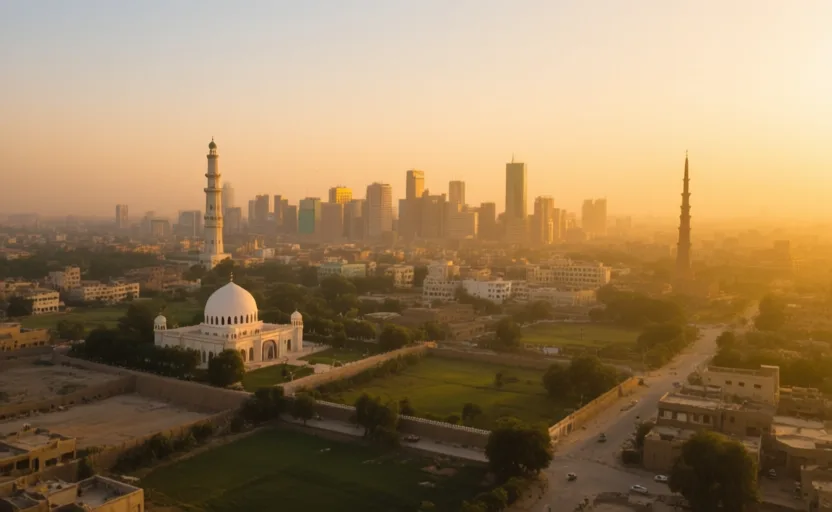 AI city illustration · Artistic impression
What people learn after moving
2.22 million in the city at the 2023 census — Pakistan's sixth largest, and the effective capital of south Punjab
Saraiki is the mother tongue of the city and the region, and is a distinct language rather than a Punjabi dialect; Urdu is the national register and English the language of business, law and higher education
Pakistani rupee (PKR)
PKT (GMT+5) — no daylight saving
AI city illustration · Artistic impressionCost of living in Multan
Check your eligibility
Pick your passport to see entry rules and the long-stay routes we have researched.
Pick your passport to see whether you can enter Pakistan — and what it takes to stay.
Pakistan issues a short entry visa and does the substantive work at the extension, where a security clearance sits. Nothing accumulates toward permanent residence, and the first question is always whether you have Pakistani ancestry, because NADRA's Pakistan Origin Card confers indefinite stay and the right to work with no visa at all. The Multan-specific nuance is administrative geography: the province stood up a South Punjab secretariat here in 2020 and DGI&P runs several passport offices in the city, but the Ministry of Interior's business-visa extension powers still attach to provincial capitals, so some errands remain a Lahore trip.
Multan is the only Pakistani city between Lahore and Karachi with mass transit: the Metrobus runs about 18.5 km across 21 stations from Bahauddin Zakariya University to Chowk Kumaharan, and living on the corridor genuinely removes most driving from a week. Where you do drive, Punjab has the best licensing system in the country — DLIMS 2.0 handles application, ePay payment and card tracking online — and the heat is the real hazard. This is a city where a car breaking down in June is a medical situation rather than an inconvenience.
The decisive question is resident or non-resident, because the State Bank treats non-resident rupee accounts as a separate regime with different documentation and different repatriation rights. Pakistan operates genuine exchange controls: getting money out later depends on how it came in and which account held it. What Multan adds is a strongly seasonal, agriculture-facing local economy — branches here are fluent in crop finance, export documentation for horticulture, and the timing pressures of a mango season, and much less practised at handling a foreign passport.
Multan is the medical centre of south Punjab: Nishtar Hospital, founded in 1951 and attached to Nishtar Medical University, is the tertiary referral point for a catchment of tens of millions, alongside the Children's Hospital and the cardiology institute. Private provision around it is adequate. What makes health planning here different from Faisalabad or Lahore is the climate at both ends of the year — heat illness in summer and severe smog in winter are the two things that actually put people in hospital, and both are foreseeable months in advance.
Every Pakistani SIM is biometrically bound to an identity document at the point of sale — a fingerprint matched against NADRA in real time. Foreign nationals register against a passport through NADRA's foreigner verification route and are held to a much lower SIM ceiling than citizens. Mobile data is very cheap and coverage across the Multan urban area is good. Fixed broadband follows the northern corridor: reasonable along Bosan Road and Gulgasht, and noticeably worse in the old city and the southern and eastern edges.
Pakistan's tax year runs 1 July to 30 June and you are a resident individual on 183 days or more of presence within it, taxed on worldwide income. Filer status on the FBR's Active Taxpayers List materially reduces withholding on ordinary transactions and comes from filing on time rather than from registering. The Punjab layer changed in 2025: the standard services tax rate is sixteen percent, and the Punjab Finance Act 2025 reorganised the schedules so that services are taxable unless specifically listed as tax-free. The South Punjab secretariat does not change any of this — tax administration stayed provincial and federal.
Each guide has verified costs, timelines, required documents, and the non-obvious gotchas — sourced from official government pages. Last verified August 2026.
Reading a list isn’t learning it. Globe Quest turns these into a trainer — hear each phrase spoken, drill them with spaced repetition, and get scored as you say them out loud.
Summer here is not Lahore's summer. May to July regularly runs above 45°C with dust, and the city sits in one of the hottest inhabited belts in South Asia — heatstroke is a genuine seasonal public-health problem rather than a theoretical risk, and the working day shifts around it. Then, from November, south Punjab gets the same smog as the rest of the province and Multan has recorded some of the worst readings anywhere in the world during the worst episodes. The practical answer is unglamorous and works: a house you can actually cool and actually seal, HEPA purifiers bought in October, a heat plan for the household including domestic staff, and the province's own AQI dashboard on your phone instead of guesswork.
The Punjab Rented Premises Act 2009 requires tenancy agreements to be registered and creates dedicated Rent Tribunals presided over by special judges with real execution powers, rather than sending disputes to ordinary civil courts as Sindh and Khyber Pakhtunkhwa do. The protection follows the registration. It is the step landlords most often want to skip, it costs very little, and it is worth more than anything else you will negotiate.
NADRA's Pakistan Origin Card is for foreign nationals of Pakistani descent, including foreign spouses. NADRA's own statement of its effect covers multiple visa-free entry, indefinite stay, exemption from reporting to police or foreigners' registration offices, the right to buy and hold property anywhere in Pakistan, banking rights and eligibility for employment. A POC holder needs no work visa. NICOP is the different document, for people who remain Pakistani citizens. South Punjab has sent very large numbers of people to the Gulf and to Britain, so the proportion of arrivals who qualify without ever checking is high.
Punjab established a separate South Punjab civil secretariat in 2020, covering the Multan, Bahawalpur and Dera Ghazi Khan divisions, with an Additional Chief Secretary seated in Multan and a protected share of the provincial development budget. Departments still publish separate South Punjab order streams. What this means in practice is that some provincial business can be done here that a Faisalabad resident would take to Lahore — and some cannot, because the arrangement has been contested, trimmed and re-argued since it was created. Ask which stream your particular matter falls into rather than assuming either way, and note that the Ministry of Interior's visa-extension powers still name provincial capitals rather than divisional headquarters.
Saraiki is the mother tongue of most of Multan and of south Punjab, it is linguistically distinct from Punjabi, and it carries a live political identity — the South Punjab province movement is built on it. Urdu works everywhere and English works professionally, so you will never be stuck. But describing Saraiki as 'Punjabi with an accent' in a Multan office is the kind of remark that quietly costs you goodwill you will not get back, and learning even a handful of words buys disproportionate warmth.
The Multan Metrobus runs about 18.5 km from Bahauddin Zakariya University to Chowk Kumaharan across 21 stations, most of them elevated, on a segregated corridor operated by the Punjab Masstransit Authority. It runs a flat fare in the region of PKR 25 from early morning until late evening. For a city of two and a quarter million that is a genuine amenity — Faisalabad, half again as large, got its first buses only in September 2025 and still runs them in mixed traffic — and living on the corridor removes most of the driving from a normal week. Fares on Punjab mass transit have been revised more than once, so confirm the current figure rather than trusting any published one.
Mango and citrus exporters, Fatima Group, Four Brothers, agri-input distributors
Multan is the centre of Pakistan's mango belt and one of its largest citrus and cotton markets. Horticulture export — packing, cold chain, phytosanitary certification, air and sea freight to the Gulf and beyond — is a real professional sector here rather than a rural adjunct, and it is seasonal in a way that reorganises the whole city in June and July.
South Punjab Secretariat departments, divisional and district administration, Multan Development Authority
The 2020 South Punjab secretariat put an Additional Chief Secretary and a set of departmental offices in Multan, covering three divisions and a protected share of the provincial development budget. Public administration and policy work here is regional rather than municipal, which is unusual for a non-capital.
Nishtar Hospital, Nishtar Medical University, Children's Hospital Multan, Multan Institute of Cardiology
Nishtar, founded in 1951, is one of the oldest and largest teaching hospitals in Pakistan and the tertiary referral centre for the whole of south Punjab and beyond. The catchment is tens of millions, which gives clinical and public-health roles here a scale the city's own population would never generate.
Cotton ginners, oil and flour mills, Multan Industrial Estate manufacturers, fertiliser and pesticide plants
Cotton comes off the surrounding districts and is ginned, spun and processed here before moving north to Faisalabad or south to Karachi. It is a less glamorous part of the textile chain than Faisalabad's but it is where the raw material actually enters the industry.
Multan Dry Port operators, freight forwarders, M-4 and M-5 corridor haulage
Multan is where the M-4 from Faisalabad meets the M-5 running south to Sukkur and on toward Karachi — the hinge of Pakistan's motorway network. Combined with the dry port and an international airport, that makes it the natural distribution point for the whole south of the province.
Bahauddin Zakariya University, Emerson University, the blue-tile and camel-skin workshops of the old city
BZU is the region's main university and a large employer in its own right. Separately, Multan's kashi tilework and naqashi camel-skin lamps are living crafts with export markets rather than museum pieces — one of the few Pakistani cities where a traditional craft is still a functioning industry.
Landmark · The fort mound, old city
A colossal octagonal brick-and-tile mausoleum built in the 1320s on the mound of the old fort — one of the great pre-Mughal monuments of South Asia and visible from most of the city.
Local tip: Go an hour before sunset, when the low light does something to the blue tilework that photographs cannot reproduce, and walk the fort mound around it afterwards. Dress modestly, remove shoes at the threshold, and expect to be welcomed rather than watched.
Food · Old city
The main bazaar of old Multan — spices, dried fruit, cloth, and the sohan halwa shops the city is known for.
Local tip: Buy the sohan halwa in a tin rather than loose, and go early: the lanes are genuinely impassable by mid-morning. The best eating here is breakfast — halwa puri and lassi from the stalls before the shops open.
Culture · Around the old city and Qasim Bagh
Working kashi tile kilns and naqashi camel-skin lamp studios, still producing the crafts that face every shrine in the city.
Local tip: These are workshops, not showrooms, and the way in is to ask at the shops that sell the finished work. A camel-skin lamp survives a flight badly and a tile does not survive one at all — buy small, and watch it being made rather than buying to take home.
Neighborhood · North Multan
The modern residential and commercial spine running out past BZU and Nishtar — where most professionals live and where the cafés, clinics and better schools are.
Local tip: Bosan Road is also where the Metrobus corridor runs, which makes the northern end of the city the one part of Multan you can genuinely live in without a car. That is worth more than it sounds in a city with these summers.
Nature · About 20 km north-west of the city
A barrage on the Chenab with river banks, birdlife and the nearest real open water to a very dry city.
Local tip: This is where Multan goes when the heat finally breaks in late September, and it is close to empty on a weekday. Go early, take everything you need, and treat the river with respect — the channel is fast and there is nothing resembling a lifeguard.
Culture · Bohar Gate, old city
A low, flat-roofed twelfth-century tomb entirely sheathed in blue and white kashi tile, wedged into a lane in the old city.
Local tip: Almost every visitor goes to Shah Rukn-e-Alam and almost none find this, which is a shame — it is older, it is smaller, and the tilework is arguably the finest in Multan. Ask for Bohar Gate and then ask again; it is invisible until you are in front of it.
Side-by-side cost of living, language, climate and careers — to help you choose.