
Population
≈390,000 and falling — the prefectural capital, and among the Japanese municipalities losing population fastest in absolute terms
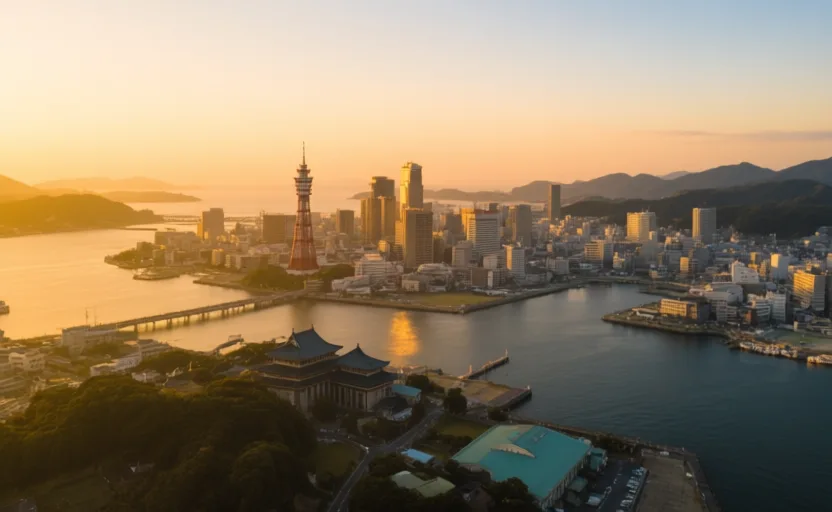 AI city illustration · Artistic impression
What people learn after moving
≈390,000 and falling — the prefectural capital, and among the Japanese municipalities losing population fastest in absolute terms
Japanese, in the local Kyushu dialect. English support is decent around the heritage sites and thin in daily administration
Japanese yen (JPY)
JST (GMT+9) — Japan does not observe daylight saving
AI city illustration · Artistic impressionCost of living in Nagasaki
Check your eligibility
Pick your passport to see entry rules and the long-stay routes we have researched.
Pick your passport to see whether you can enter Japan — and what it takes to stay.
Japan issues your residence card at the airport, but the card alone is not enough — you must register your address within fourteen days, and that registration is what unlocks health insurance, banking and a phone contract. Two things here differ from the standard Japanese account. Nagasaki is a core city with no administrative wards, so there is no ward office: registration is done by the city. And its immigration counter is a branch office rather than a regional bureau, with Fukuoka as the parent about two hours away.
Converting a foreign licence — gaimen kirikae — requires a knowledge check and, for most countries, a practical test on a closed course that is notoriously exacting. A defined list of countries is exempt. The rules tightened nationally on 1 October 2025: a jūminhyō is now compulsory for every applicant, so short-stay visitors are shut out of the route, and the knowledge check went from ten questions at 70% to fifty questions at 90%. An International Driving Permit is valid for one year only. The Nagasaki wrinkle is geographic: the central city is narrow, steep and served by a cheap flat-fare tram, and a great many houses cannot be driven to at all — so before you convert, work out whether a car can actually reach where you intend to live.
Japanese banks vary enormously in how they treat new foreign residents, and several major banks effectively require six months of residence before opening a full account. Japan Post Bank and the online banks are the usual first stop because they do not. You need address registration first. In Nagasaki the megabank branch network is thin, and the regional institutions — Eighteenth Shinwa Bank above all — are what local employers, landlords and guarantor companies actually deal with.
Enrolment is a legal obligation, not a choice. Once enrolled you pay 30% of the cost of most treatment at the point of care and the scheme pays the rest, with a monthly ceiling that caps catastrophic costs. Pension enrolment is equally compulsory — and if you leave Japan you can claim a lump-sum withdrawal of part of what you paid, which a great many departing residents never do. Nagasaki additionally administers the Atomic Bomb Survivor's Health Handbook and hosts Nagasaki University's atomic-bomb disease and tropical medicine institutes, giving a city of this size an unusual medical profile.
Japanese mobile has historically been expensive, dominated by three carriers with long contracts and heavy handset subsidies. Government pressure changed that, and the low-cost sub-brands and MVNOs now offer genuinely cheap plans on the same networks. You need a residence card and usually a Japanese bank account or credit card. Nagasaki adds a terrain problem that a flat city does not have: the valley walls and the slope districts create real coverage shadows, and the network that works for a colleague may not work at your address.
Most employees never file a return — the employer's year-end adjustment handles it. The two things that catch foreign residents are residence tax, calculated on last year's income and billed from the following June, and the distinction between non-permanent and permanent tax residence, which decides whether Japan taxes your foreign income at all. The Nagasaki detail is that the bill is shaped differently from a designated city's: a flat per-capita floor of ¥5,500, of which ¥500 is a prefectural forest levy, plus 10% of last year's income divided in the standard 6% city / 4% prefecture proportions rather than the 8% / 2% split used in Sendai, Hiroshima and Saitama. The total is the same; the line items are not.
Each guide has verified costs, timelines, required documents, and the non-obvious gotchas — sourced from official government pages. Last verified August 2026.
Reading a list isn’t learning it. Globe Quest turns these into a trainer — hear each phrase spoken, drill them with spaced repetition, and get scored as you say them out loud.
Nagasaki is a core city — a 中核市 — rather than one of Japan's ordinance-designated cities, and unlike Fukuoka, Kobe, Hiroshima, Sendai or Saitama it has no administrative wards at all. Your address registration, My Number, National Health Insurance and residence tax are all handled by Nagasaki City directly, at the city hall in Sakuramachi or at one of the local centres across the city. Every guide to living in Japan tells you to find your ward office; here you simply need the right counter at one municipality. It is easier, not harder — but it means the standard advice does not map, and it also means the residence-tax split on your bill differs from a designated city's.
Japanese law requires you to register your address at the municipality covering it within fourteen days of moving in. That registration produces the jūminhyō certificate and triggers your My Number, and without it you cannot enrol in health insurance, open most bank accounts or complete a phone contract. Check before you go whether the local centre nearest you handles new foreign-resident registration or whether it has to be the main city hall — for a first registration the main office is the safe choice.
Nagasaki has a branch office of the Fukuoka Regional Immigration Services Bureau, in the Nagasaki Port joint government building at Matsugae-machi, near the cruise terminal and the Ōura slope. It is not a regional bureau: Fukuoka covers Fukuoka, Saga, Nagasaki, Ōita, Kumamoto, Kagoshima, Miyazaki and — through the Naha sub-bureau — Okinawa. Routine applications are taken here; anything unusual sits with Fukuoka, roughly two hours away by rail. That is the sharpest administrative difference between living here and living in Hiroshima or Sendai, both of which host full bureaux. File extensions from three months before expiry rather than at the last minute.
Nagasaki is built into a steep amphitheatre around its harbour, and a substantial share of its houses sit on slope land with no vehicle access — you reach them, and everything you carry to them, on foot up a stairway. That shapes removals, refuse collection, deliveries, ambulance access and whether the house is realistic to grow old in, and it is a large part of why the city has so many vacant houses on the slopes and runs subsidy schemes to bring them back into use. Walk the route from the nearest road, with shopping, before you sign anything above the flat.
Nagasaki runs a set of housing support schemes aimed squarely at its vacancy problem: a settlement-promotion vacant-house scheme, a subsidy toward clearing out the previous occupant's furniture and effects, a renovation subsidy for people moving in from elsewhere, and separate support aimed at households with children. Terms and budgets change year to year and most of the detail is published only in Japanese, so treat this as a question for the housing policy division rather than something to read off a page — but do ask, because the sums involved are large relative to Nagasaki's low prices and almost no newcomer knows they exist.
The Nishi-Kyūshū Shinkansen opened on 23 September 2022, running 66 km from Takeo-Onsen to Nagasaki with five stations. It is not connected to the rest of the Shinkansen network: to reach Hakata you change at Takeo-Onsen to the Relay Kamome limited express, across the same platform. The best Hakata–Nagasaki time came down to about an hour and twenty minutes, roughly half an hour faster than before. It is a genuine improvement and it is not the through service the word 'Shinkansen' implies, and the unresolved Saga section means that is unlikely to change soon.
Mitsubishi Heavy Industries Nagasaki, Oshima Shipbuilding, Namura, Sasebo Heavy Industries
The Nagasaki shipyard has been the city's industrial anchor since the 1850s and parts of it — the Kosuge slip dock, the giant cantilever crane, Hashima island — are inscribed as components of the 2015 'Sites of Japan's Meiji Industrial Revolution' World Heritage listing. The commercial shipbuilding side of the local industry has contracted and restructured considerably in recent years; check the current position of any employer before assuming stability.
Nagasaki University, its Institute of Tropical Medicine, Nagasaki University Hospital
Nagasaki University's Institute of Tropical Medicine is the only institute of its kind in Japan and gives the city an unusual international research profile for its size, with long-running programmes in Africa and Southeast Asia.
Nagasaki fish market operators, Shikairō and the champon trade, Fukusaya and Bunmeidō castella houses
Nagasaki Prefecture is consistently one of Japan's largest by catch, and the city's food identity — champon, sara-udon, castella, shippoku — is a genuine industry built on four centuries of Chinese, Portuguese and Dutch contact rather than a marketing story.
Nagasaki Stadium City, the Matsugae cruise terminal operators, Glover Garden and Dejima, prefectural hotel groups
Nagasaki Stadium City opened on 14 October 2024 — a privately funded complex of stadium, arena, hotel, offices and retail, developed by Japanet Holdings at a reported cost near ¥100 billion, ten minutes' walk from JR Nagasaki Station. It is the largest single change to the city's economy in decades and reported around 4.85 million visitors in its first year.
Nagasaki Prefecture, Nagasaki City, prefectural hospitals and schools
As the prefectural capital of a large island prefecture, public administration is one of the steadiest employers here — and one of the few sectors where the job is unambiguously in the city rather than somewhere else in Kyushu.
Kyushu Electric Power, offshore wind supply chain around Gotō and the Nishisonogi coast
The waters off Nagasaki Prefecture host some of Japan's earliest floating offshore wind development, and the local heavy-engineering base is positioning around it — a genuine growth area in an otherwise contracting industrial economy.
Landmark · Urakami valley, north of the centre
The Peace Statue and the fountain above, and below them the hypocentre marked by a black pillar, with a surviving section of Urakami Cathedral's wall moved beside it.
Local tip: Go to the Atomic Bomb Museum first, then walk down to the Hypocentre Park and up to the Peace Park last — the sequence matters and takes about three hours. The museum is direct and unsparing. The city holds its ceremony on 9 August with a minute's silence at 11:02; the days around it are quieter and the lanterns floated on the Urakami river in the evening are the part residents attend. The one-legged torii at Sannō Shrine, a short walk away, is worth the detour and almost always empty.
Culture · Central, beside the Nakashima river mouth
The fan-shaped artificial island that was the Dutch trading post from 1636 to 1859 and Japan's only sanctioned window on Europe for two centuries, now substantially reconstructed building by building.
Local tip: It is landlocked now — the harbour was filled in around it — which is disorienting until you see the model inside. Allow ninety minutes and read the warehouses in order; the reconstruction is unusually careful and the miniature of the original island is the thing that makes the rest legible. Combine it with the Chinese quarter across the road, because the two together are the whole explanation of why this city eats and looks the way it does.
Landmark · Minamiyamate, on the southern slope
Japan's oldest surviving church, completed in 1864 and designated a National Treasure, with the hillside of nineteenth-century Western merchant houses immediately above it.
Local tip: Ōura is where, in 1865, a group of villagers revealed to a French priest that hidden Christian communities had survived two and a half centuries of prohibition — the event the 2018 UNESCO inscription of the region's hidden Christian sites is built around. Take the outdoor escalators up through Glover Garden and walk back down; the view over the harbour from the top terrace is the best in the city that does not require a ropeway.
Food · Central, beside Dejima
One of Japan's three historic Chinatowns, four short streets of restaurants and shops behind ceremonial gates, and the birthplace of champon.
Local tip: Champon was invented here in the 1890s at Shikairō for Chinese students who needed something cheap and filling — the shop still exists, up the hill, and has a small noodle museum in it. Inside the quarter, order sara-udon at least once: same broth, fried crisp noodles, and the local move is to put Worcestershire sauce on it. At Chinese New Year the whole district and the central squares are hung with thousands of lanterns for a fortnight.
Nature · West of the harbour, ropeway from Fuchi Shrine
A 333-metre peak directly above the harbour, reached by ropeway, with an observation deck that takes in the whole bowl of the city and the water in the middle of it.
Local tip: Go about forty minutes before sunset and stay for the transition — the shape of Nagasaki, a city poured into a valley, only makes sense from here. The ropeway is the easy way; the walk up from Fuchi Shrine takes an hour and is a decent introduction to what 'slope land' means in this city. Free shuttle buses run from several central hotels in the evening.
Neighborhood · Southern slope, above Ōura
Stone-paved lanes climbing the hillside between wooden Western houses built for the foreign settlement, most of them still lived in rather than preserved.
Local tip: This is the quiet counterpart to Glover Garden thirty metres away and almost nobody walks it. Several of the houses are open free as small museums; the rest are ordinary homes, so keep to the lane. Walk up in the morning, cut across to the Confucian Shrine, and come down through Ōura — an hour, no tickets, and the best sense of the settlement-era city you will get anywhere.
Side-by-side cost of living, language, climate and careers — to help you choose.