
Population
≈2.33 million in the city; roughly 10 million across the Chūkyō metropolitan area
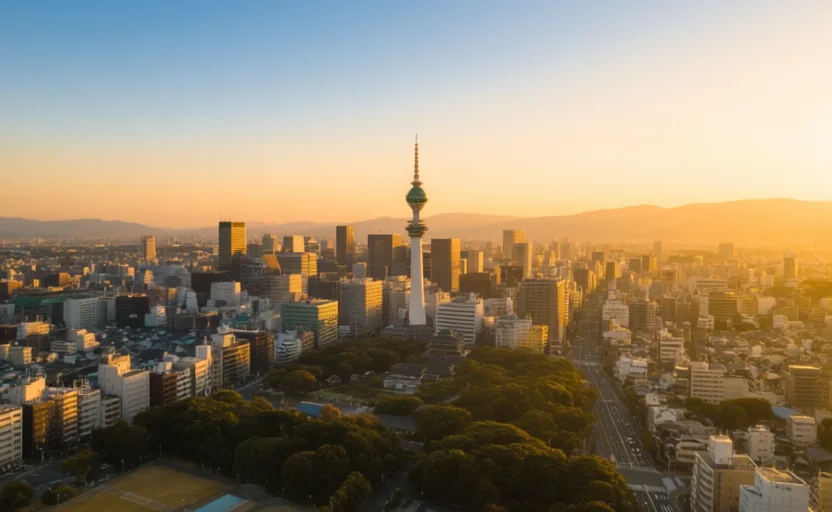 AI city illustration · Artistic impression
What people learn after moving
≈2.33 million in the city; roughly 10 million across the Chūkyō metropolitan area
Japanese, with a distinct Nagoya-ben. Portuguese is genuinely widely used across Aichi thanks to the Brazilian community; English is limited outside international employers
Japanese yen (JPY)
JST (GMT+9) — Japan does not observe daylight saving
AI city illustration · Artistic impressionCost of living in Nagoya
Check your eligibility
Pick your passport to see entry rules and the long-stay routes we have researched.
Pick your passport to see whether you can enter Japan — and what it takes to stay.
Japan issues the residence card at the airport, which is fast and slightly misleading, because the card alone unlocks nothing. What unlocks everything is the move-in notification filed at the correct one of Nagoya's sixteen ward offices within fourteen days. Aichi is unusual in Japanese terms: it holds the second largest foreign population of any prefecture, with a very large Brazilian-Japanese community, and the multilingual support around immigration and daily life is correspondingly better developed than almost anywhere else in the country.
Converting a foreign licence — gaimen kirikae — needs a knowledge check and, unless your country is on the exemption list, a practical test on a closed course judged on Japanese procedural form, and the whole procedure was tightened nationally on 1 October 2025. The three-month presence rule blocks more applications than the test does. What makes this guide matter more in Nagoya than in Tokyo or Osaka is that here you will probably drive: household car ownership in Aichi is among the highest in Japan, plants and suppliers sit off the rail network, and the prefecture held the worst road death record in the country for sixteen straight years to 2018.
Several major Japanese banks will not open a full account until you have six months of residence — internal policy rather than law, and unadvertised. Japan Post Bank and the online banks do not apply it, so they are almost every foreign resident's first account. Nagoya's quirk is that the megabank with the deepest local network here, MUFG, is the successor to Tōkai Bank, which was Nagoya's own bank until the 2000s mergers — so the branch density in Aichi is unlike anywhere else outside Tokyo.
Enrolment is a legal obligation. You pay 30% of most treatment at the counter and the scheme pays the rest, with a monthly ceiling that stops a serious illness becoming a financial catastrophe. Pension enrolment is equally compulsory and partly refundable if you leave. Two things are worth knowing here specifically: Aichi runs a prefecture-funded medical interpretation system that few other prefectures match, and Nagoya's summers are hot enough that heat illness is a genuine seasonal public health problem rather than a talking point.
Japanese mobile was expensive for years until government pressure produced low-cost sub-brands and a healthy MVNO market riding the same towers. You need a residence card and, for most postpaid plans, a Japanese bank account or a Japanese-issued credit card. Home fibre is fast and cheap by international standards — with the caveat that Aichi has an enormous stock of 1960s and 1970s estate housing where the line into the flat is copper regardless of what the building advertises.
Most employees never file a return, because the employer's December year-end adjustment settles it. What catches foreign residents everywhere in Japan is residence tax, assessed on last year's income and billed from the following June, and the non-permanent resident category that shields foreign income until it quietly expires. Nagoya adds one genuine local difference: it is the only ordinance-designated city in Japan that levies individual municipal residence tax at a reduced rate, cutting the income-based portion by five per cent since the 2012 fiscal year.
Each guide has verified costs, timelines, required documents, and the non-obvious gotchas — sourced from official government pages. Last verified August 2026.
Reading a list isn’t learning it. Globe Quest turns these into a trainer — hear each phrase spoken, drill them with spaced repetition, and get scored as you say them out loud.
Nagoya is divided into sixteen wards and you must register at the one covering your address within fourteen days of moving in. That registration produces the jūminhyō certificate, starts your My Number, and is the precondition for health insurance, most bank accounts and a phone contract. Employees of the automotive supply chain frequently live in one municipality and work in another — Toyota, Kariya and Anjō are separate cities, not Nagoya wards — and registering where you work rather than where you sleep is a common and costly mistake.
The package is deposit, key money, agency fee, guarantor company fee, fire insurance and the first month. Aichi runs the Kanto-style shikikin and reikin rather than the Kansai deposit-and-deduction system, and key money is commonly one month rather than two. Three to five months' rent liquid in a Japanese account is a realistic target. Arriving without it is the single most common reason a move to Japan stalls at the last step.
Jūminzei is assessed on the previous calendar year's income and collected from the following June. Your first year is nearly free of it and your second carries the full weight of the first. If you leave partway through a year you can still owe residence tax on money already spent, so settle it or appoint a tax representative before you go rather than discovering it from abroad.
If your employer runs shakai hoken it is handled for you. Freelancers, part-timers and anyone between jobs enrol in National Health Insurance and the National Pension themselves at the ward office, and back-payments can be demanded. The pension carries a lump-sum withdrawal claimable within two years of leaving Japan, worth a real amount after a few years and forgotten by most people who go.
This is the one large Japanese city where owning a car is normal rather than eccentric — the roads are wide, the plants are not on a railway line, and household car ownership is among the country's highest. Aichi recorded the highest number of road deaths of any prefecture for sixteen consecutive years from 2003 to 2018, and although deaths have since fallen sharply — 112 in 2025, the lowest since records began in 1948 — the prefecture still sits third nationally for the sheer number of injury collisions. If you drive here, drive as though nobody is going to give way, because on the hundred-metre boulevards they frequently do not.
The city ranks poorly in Japan's attractiveness surveys, a result Nagoya itself has commissioned and publicised more than once. What that reputation obscures is a genuinely distinct food culture, the country's deepest industrial base, rents materially below Tokyo and Osaka, and an hour's train ride to Kyoto or the Kiso valley. It is an unglamorous city that is very easy to live in, which is a different thing from a boring one.
Toyota Motor, Denso, Aisin, Toyota Industries, JTEKT, Toyota Boshoku
Toyota's headquarters sit in Toyota City half an hour southeast, and the tier-one suppliers cluster around Kariya and Anjō. Aichi has led every Japanese prefecture in the value of manufactured goods shipped for more than forty consecutive years.
Mitsubishi Heavy Industries, Kawasaki Heavy Industries, Subaru, Shinmaywa
The Chubu region builds a large share of the Boeing 787 airframe, including the composite wings, and Mitsubishi Heavy's aerospace works sit at Komaki and Tobishima. It is the densest aerospace cluster in Japan.
Yamazaki Mazak, Okuma, Brother Industries, Makita
Two of the world's largest machine tool makers are headquartered within half an hour of Nagoya. Brother began here as a sewing machine repair business in 1908 and is still a Nagoya company.
Noritake, NGK Insulators, Niterra, LIXIL
Noritake, NGK Insulators, Niterra and TOTO all descend from the Morimura group, a trading house founded in Tokyo in 1876 that put its porcelain works in Nagoya in 1904 — one nineteenth-century merchant house that became four global materials companies, three of them still headquartered here.
JR Central, Meitetsu, Nippon Sharyo, Toyota Tsusho
JR Central runs the Tōkaidō Shinkansen and is headquartered above Nagoya Station. Its Chūō maglev to Tokyo is built from here, though JR Central abandoned the 2027 opening in March 2024 and now says 2034 at the earliest.
Nagoya Port, Toyota Tsusho, Aichi Steel, Chubu Centrair
The Port of Nagoya handles more total cargo tonnage than any other Japanese port, largely because it is where the country's cars leave from. Centrair airport sits on an artificial island 28 minutes from the centre.
Landmark · Naka-ku, north of the centre
The golden shachihoko roof ornaments are the city's emblem, and the palace beside the keep was rebuilt over a decade using historic joinery.
Local tip: The concrete keep has been closed to visitors since 2018 over seismic concerns and the wooden reconstruction has been stalled ever since. The Honmaru Palace next to it is the thing worth your ticket — finished in 2018 from wartime drawings and photographs, and genuinely extraordinary.
Neighborhood · Naka-ku, south of Sakae
Covered arcades around a temple — second-hand electronics, vintage clothing, Brazilian and Vietnamese food, and no polish whatsoever.
Local tip: This is where Nagoya is least like the surveys say it is. The Brazilian and Filipino food here exists because Aichi has the largest Brazilian community in Japan, not because it is a theme. Go on a Sunday when the flea market is out.
Nightlife · Naka-ku, the centre
The main shopping and drinking district, split by one of the hundred-metre boulevards laid out across the burnt-out city after 1945.
Local tip: Those hundred-metre roads were built as firebreaks and are the reason Nagoya feels spacious and slightly empty. The Hisaya-ōdōri park strip was reworked in 2020 and is now where the city actually gathers in the evening, rather than the department stores.
Culture · Atsuta-ku, south
One of the most important shrines in Japan, home of the Kusanagi sword, in a hectare of ancient camphor forest.
Local tip: Older and more significant than the castle, and far less visited by anyone who is not local. The Miya Kishimen stand inside the grounds serves the flat regional noodle in a setting no restaurant can match — it is not a tourist trap, it is where people go after paying respects.
Nature · Chikusa-ku, east on the Higashiyama line
One of Japan's largest zoos, wrapped in a botanical garden and hill park at the end of the subway line.
Local tip: The Higashiyama Sky Tower gives the best view of the Nōbi plain and almost nobody goes up it. The surrounding Motoyama and Yagoto neighbourhoods are the nicest part of residential Nagoya and worth walking on the same trip.
Culture · Midori-ku, 25 minutes on the Meitetsu line
A preserved Edo-period post town on the old Tōkaidō road, and the home of Arimatsu-Narumi shibori tie-dyeing since 1608.
Local tip: Selected as a national Important Preservation District for Groups of Traditional Buildings in 2016 — the only one in the country designated as a textile town — and recognised as Japan Heritage in 2019, yet still barely known even to people who live in Nagoya. Merchant houses with plaster fire walls, working shibori workshops that will teach you in an afternoon, and a June festival with three-storey float puppets. Twenty-five minutes from Meitetsu Nagoya.
Side-by-side cost of living, language, climate and careers — to help you choose.