
Population
75,704 in 2024 (CBS) — the largest city in Israel's Northern District and the civic centre of Arab society in Israel
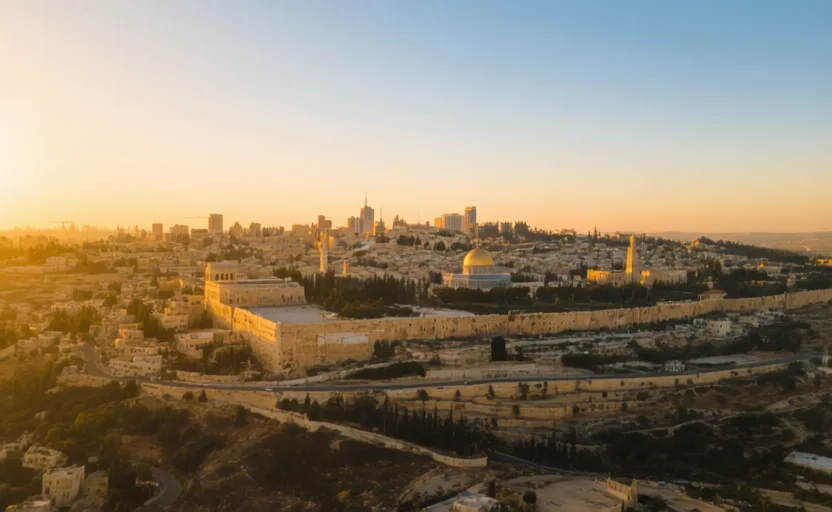 AI city illustration · Artistic impression
What people learn after moving
75,704 in 2024 (CBS) — the largest city in Israel's Northern District and the civic centre of Arab society in Israel
Arabic in daily life; Hebrew for all state business; English in tourism and the tech branches
Israeli new shekel (ILS / ₪)
GMT+2, GMT+3 in summer — Israel observes daylight saving
AI city illustration · Artistic impressionCost of living in Nazareth
Check your eligibility
Pick your passport to see entry rules and the long-stay routes we have researched.
Pick your passport to see whether you can enter Israel — and what it takes to stay.
If you, a parent, a grandparent or your spouse are Jewish, the Law of Return entitles you to make aliyah: citizenship and an Israeli ID number essentially on arrival, arranged free in advance through the Jewish Agency or Nefesh B'Nefesh. Without that claim there is no general immigration route — an Israeli employer must sponsor a B/1 work permit through the Population and Immigration Authority, and the foreign-expert track requires a salary of twice the national average wage. Marrying an Israeli citizen who is not Jewish leads instead into the graduated family-unification procedure, which is slow and, for spouses from the West Bank or Gaza, restricted by the Citizenship and Entry into Israel Law. A B/2 visitor stamp, gated by a pre-travel ETA-IL, carries no work rights. There is no digital-nomad visa.
There is no train. The Rav-Kav smartcard, or an account-based app, covers the urban bus network and the intercity services that are the real spine of life here — most importantly the direct Nazareth–Haifa corridor, which takes about 50 minutes from Paulus VI Street to Haifa Merkaz HaShmona and runs roughly every twenty minutes. The nearest railway station is Afula, about 10 km south on the Valley Railway, and city buses do not stop at its platform, so treat it as a connection rather than a commute. Unlike the rest of Israel, buses and shops in Nazareth operate on Saturday, but the national intercity network still stops for Shabbat. Driving inside the old city is genuinely hard: steep, narrow, one-way stone lanes and almost no parking. You may drive on a foreign licence for one year from entry, then convert at Misrad HaRishui.
Five banks dominate: Hapoalim, Leumi, Discount and Mizrahi-Tefahot on the branch model, plus the digital ONE ZERO. With a Teudat Zehut an account usually opens the same day; a non-resident account goes through compliance and can take several days. The cost that surprises people is fees — a monthly account-management charge plus per-action fees, all negotiable if you ask for the cheapest plan. Nazareth's branches are staffed by Arabic speakers as a matter of course, which is a real advantage over almost anywhere else in the country — but the account agreement itself is a Hebrew legal document, and Arabic service does not change that. US citizens must complete FATCA paperwork with a Social Security Number.
Israel's universal system under the 1995 National Health Insurance Law runs through four health funds — Clalit, Maccabi, Meuhedet and Leumit — funded by a health-tax slice of National Insurance. Register with Bituach Leumi, choose one fund, and you receive the identical statutory benefits basket with small capped copays. B/1 foreign workers are outside the system entirely: the Foreign Workers Law puts the insurance duty on the employer. Nazareth's hospital layer is unlike anywhere else in Israel — its three hospitals are Christian mission foundations rather than state or Clalit institutions: EMMS Nazareth Hospital, founded in 1861 and running about 147 beds with over 500 staff, plus the Holy Family Hospital and St Vincent de Paul, known locally as the French Hospital. They handle a great deal but they are not tertiary centres, so complex cases go to Rambam in Haifa or Emek in Afula. Ambulance is 101.
Israeli mobile is among the cheapest in the OECD since the 2012 market reform: unlimited domestic calls and texts with a large data bundle for roughly ₪27–50 a month. Cellcom, Partner and Pelephone are the big three; Golan Telecom, Hot Mobile, 019 Mobile and Rami Levy compete at the bottom. No lock-in, and numbers port free in minutes. Home internet is an infrastructure layer plus an ISP, increasingly bundled — and in Nazareth the housing stock decides what you can get: newer blocks on the ring roads and in the eastern neighbourhoods have fibre, while thick-walled Ottoman stone buildings in the souq were not built for it and have both slower fixed options and worse indoor mobile signal.
Israel taxes residents on worldwide income, with residency decided by a substantive centre-of-life test backed by day-count presumptions. New immigrants and senior returning residents are exempt from Israeli tax on foreign-source income and foreign capital gains for ten years — but not on Israeli-source income, and anyone becoming resident on or after 1 January 2026 must now disclose foreign assets and income even though they remain untaxed. Rates are progressive with a surtax at the top, capital gains generally 25%, VAT 18%. Locally the complication is jurisdictional rather than statutory: Nazareth and Nof HaGalil are separate municipalities on adjoining ground, each setting its own arnona rates per square metre by classification zone, so the same-looking address a few streets apart can be billed by a different council on a different schedule.
Each guide has verified costs, timelines, required documents, and the non-obvious gotchas — sourced from official government pages. Last verified August 2026.
Reading a list isn’t learning it. Globe Quest turns these into a trainer — hear each phrase spoken, drill them with spaced repetition, and get scored as you say them out loud.
Nazareth trades on Shabbat. Shops, restaurants and the souq are open on Saturday while most of the country is shut, which is why Israelis drive here for the day. The quiet hours are elsewhere: Friday around midday prayers, and Sunday morning for the Christian third of the city. Government offices, banks and the national bus and rail network still follow the Israeli calendar and close Friday afternoon to Saturday evening — so the city's rhythm and the state's rhythm are two different things you have to hold at once.
Daily life in Nazareth happens in Arabic — neighbours, shops, schools, most workplaces inside the city. But the state operates in Hebrew: Bituach Leumi forms, tax filings, tenancy contracts, hospital systems outside the city and almost every job in Haifa or the Jezreel Valley. Israeli Arab schools teach in Arabic with Hebrew as a compulsory second language, so local children grow up bilingual. A foreign arrival who learns only one of the two will be locked out of either the neighbourhood or the bureaucracy.
Israel's rail network does not reach Nazareth. The nearest station is Afula, roughly 10 km south on the Valley Railway to Haifa and Beit She'an, and the buses from Nazareth do not stop at its platform, so it is a connection rather than a park-and-ride. What Nazareth does have is a dense bus network into Haifa — a direct service from Paulus VI Street to Haifa Merkaz HaShmona takes about 50 minutes and runs every twenty. Plan your commute around that corridor, not around a train.
Nof HaGalil, called Nazareth Illit until it was renamed in 2019, is a separate Jewish-majority municipality built on land expropriated from Nazareth in the 1950s. It has its own mayor, its own arnona schedule, its own schools and its own industrial zone, and it sits immediately uphill. An address a ten-minute walk from the basilica may be in a different municipality with different rates, a different school system and a different waiting list. Read the municipality line on the lease, not the postcode.
In 2008 Nazareth had about 35 high-tech engineers. By 2022 that had grown to roughly 1,300, four-fifths of them Arab and a quarter of them women, after Tsofen — a joint Arab and Jewish non-profit based on Paulus VI Street — spent fifteen years bringing branches into the city. Microsoft, Amdocs, Broadcom and Salesforce are among more than fifty companies and offices opened in that period. It is not Tel Aviv's density and nobody claims it is, but it means an engineer can now build a career here rather than commuting to Haifa for one.
Organised crime and gun violence in Arab towns in Israel have risen sharply and are the subject of sustained public campaigning. The Abraham Initiatives, which keeps the most widely cited count, recorded 244 Arab citizens killed in 2023, more than double the previous year. Under-policing of Arab communities is the central charge in that debate and is contested between community organisations and the police. It is not a reason to write Nazareth off, and day-to-day life in the city is ordinary — but it is a real fact about the place and you should read the current figures rather than a travel guide.
The Basilica of the Annunciation and the Franciscan custody, Nazareth Village, the Old City guesthouses and the Jesus Trail
Nazareth is one of the three principal Christian pilgrimage cities in the Holy Land, and the sector is a genuine employer of guides, hoteliers, drivers, restaurateurs and craftspeople rather than a seasonal sideline. It is also the most exposed part of the local economy to regional instability, which flattens arrivals for a season at a time.
Branches of Microsoft, Amdocs, Broadcom and Salesforce; the Nazareth Business Incubator Center; Tsofen
A cluster built deliberately from almost nothing over fifteen years — from about 35 engineers in 2008 to roughly 1,300 by 2022. Roles are largely R&D, QA and support for companies headquartered elsewhere; work is in English and Hebrew and hiring runs through the same Israeli tech market as Haifa's.
EMMS Nazareth Hospital, Holy Family Hospital, St Vincent de Paul (the French Hospital), and the four health funds' city clinics
Unusually for an Israeli city, Nazareth's hospitals are Christian mission foundations rather than state or Clalit institutions. EMMS Nazareth, founded in 1861, runs about 147 beds and employs over 500 people. They are significant employers and they train much of the Galilee's Arab medical workforce.
The Old City souq, Paulus VI Street's commercial strip, and the wholesale trade serving Galilee villages
Nazareth is the market town for Arab communities across the Lower Galilee, and a great deal of the city's employment is in shops, wholesale and family businesses that draw customers from a fifty-kilometre radius rather than from the city itself.
The Arabic-medium school network, teacher training, and a dense concentration of Arab lawyers, accountants and doctors
Nazareth is the professional capital of Arab society in Israel. Law, accountancy, medicine and education are the traditional graduate paths, and the city's practices serve clients across the Galilee and the Triangle.
El-Babour (the Galilee Mill), the Old City restaurants, the bakeries and sweet houses
Nazareth's kitchens have become a destination in their own right over the past two decades, drawing Israeli and international visitors on ordinary weekends. Restaurant work here is year-round and skilled, not just a tourist-season job.
Landmark · Old City, at the centre of everything
The largest church in the Middle East, built in 1969 over the grotto traditionally held to be Mary's house, with an upper church ringed by Madonna panels donated by Catholic communities from dozens of countries.
Local tip: Go for the upper courtyard mosaics rather than the interior — each country's panel renders the Virgin in its own visual tradition, and comparing the Japanese, Thai and Cameroonian ones is the most interesting twenty minutes in the city. Modest dress is enforced.
Neighborhood · The lanes below and around the basilica
A genuinely working covered market of spice merchants, bakers, butchers and sweet shops threaded through Ottoman stone lanes, with restored mansions turned into guesthouses among them.
Local tip: It is at its most itself on a Saturday morning, when Nazareth is open and the rest of the country is not. Come on a weekday if you want to shop rather than queue.
Nature · Southern edge of the city, above the Nazareth ridge
The escarpment on the city's southern rim, with the whole Jezreel Valley below it and Mount Tabor, Gilboa and on clear days the Golan across the horizon.
Local tip: Drive or walk up at the end of the day. It doubles as the city's amphitheatre — major concerts are staged on the slope — and it is the vantage point that explains why Nazareth sits where it does.
Culture · Northern end of Paulus VI Street
The Orthodox tradition places the Annunciation at the spring rather than at the house, and the church built over it still has water running through the crypt beneath the iconostasis.
Local tip: Visit this and the basilica the same morning. Two churches, five hundred metres apart, telling the same story in incompatible ways is the clearest possible introduction to how this city works.
Food · Old City, near the White Mosque
A century-old grain mill turned spice house, sacks open to the floor, selling za'atar, sumac, freekeh and blends milled on the premises.
Local tip: Ask them to make you a za'atar blend rather than buying a packet. It costs the same and it is the single best thing you can put in a suitcase leaving Nazareth.
Culture · Starts in the Old City
A 65 km marked walking route from Nazareth to Capernaum through the Galilee hills, which begins at an 18th-century Ottoman mansion in the souq now run as a guesthouse.
Local tip: You do not have to walk the whole thing. The first day's stage out to Zippori and back is a good Saturday, and the inn's courtyard is where you will meet everyone else who has just moved here.
Side-by-side cost of living, language, climate and careers — to help you choose.