
Population
234,813 in 2024 (CBS) — one of Israel's ten largest cities
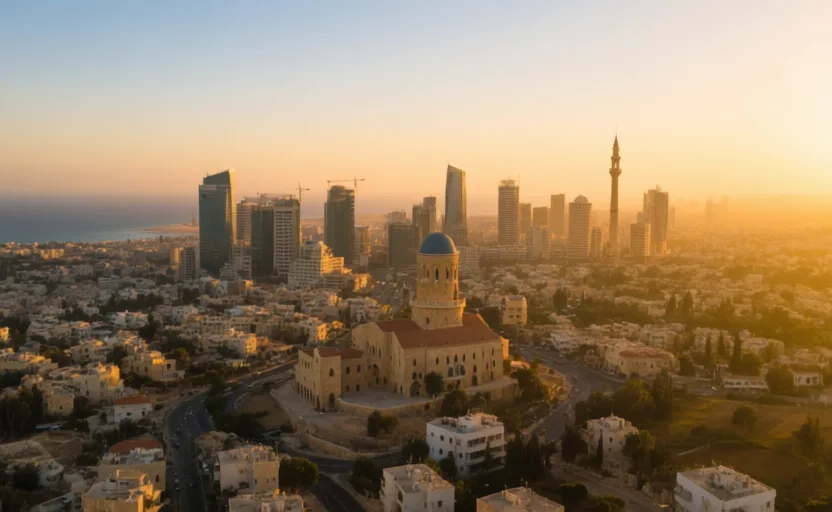 AI city illustration · Artistic impression
What people learn after moving
234,813 in 2024 (CBS) — one of Israel's ten largest cities
Hebrew; French as a genuine service language; Russian spoken by roughly one in four residents; Amharic and English widely present
Israeli new shekel (ILS / ₪)
GMT+2, GMT+3 in summer — Israel observes daylight saving
AI city illustration · Artistic impressionCost of living in Netanya
Check your eligibility
Pick your passport to see entry rules and the long-stay routes we have researched.
Pick your passport to see whether you can enter Israel — and what it takes to stay.
If you, a parent, a grandparent or your spouse are Jewish, the Law of Return entitles you to make aliyah: citizenship and an Israeli ID number essentially on arrival, arranged free in advance through the Jewish Agency or Nefesh B'Nefesh. Without that claim there is no general immigration route — an Israeli employer must sponsor a B/1 work permit through the Population and Immigration Authority, and the foreign-expert track requires a salary of twice the national average wage. A B/2 visitor stamp, gated by a pre-travel ETA-IL, carries no work rights. There is no digital-nomad visa. Netanya's particular character is the density of the aliyah pathway: with immigrants at over 30% of the population and long-established French, former-Soviet and Ethiopian communities, the absorption services, the ulpanim and the professional advisers who handle olim files are all here in strength — including advisers who work in French.
The Rav-Kav smartcard, or an account-based app, covers city buses and Israel Railways. Netanya station sits beside the Netanya Interchange where Highway 2 meets Route 57, with 38 southbound and 35 northbound suburban trains on a weekday down the coastal line to Tel Aviv; Netanya Sapir serves the southern industrial zone. Neither is in the cliff-top centre, so from the promenade neighbourhoods the commute starts with a bus or a car. Inside the city the layout is long and thin along the coast, with the cliff separating the town from the beach — the municipal beach lifts are part of the transport network in practice, not a novelty. Highway 2 runs the coast and Highway 4 runs inland. Everything stops for Shabbat. You may drive on a foreign licence for one year from entry, then convert at Misrad HaRishui.
Five banks dominate: Hapoalim, Leumi, Discount and Mizrahi-Tefahot on the branch model, plus the digital ONE ZERO. With a Teudat Zehut an account usually opens the same day; a non-resident account goes through compliance and can take several days. The cost that surprises people is fees — a monthly account-management charge plus per-action fees, all negotiable if you ask for the cheapest plan or an olim track. Netanya's distinctive feature is that its branches deal with French- and Russian-speaking customers as a matter of routine, and with a very large non-resident property-owning clientele — which means both that you will find someone to explain the terms in your language and that the compliance questions asked of a non-resident here are well practised and thorough.
Israel's universal system under the 1995 National Health Insurance Law runs through four health funds — Clalit, Maccabi, Meuhedet and Leumit — funded by a health-tax slice of National Insurance. Register with Bituach Leumi, choose one fund, and you receive the identical statutory benefits basket with small capped copays. Olim are covered from the day of aliyah with health tax usually waived for roughly the first six months. B/1 foreign workers are outside the system entirely: the Foreign Workers Law puts the insurance duty on the employer. Netanya's hospital is Laniado in Kiryat Sanz, a voluntary hospital founded by the Sanz Rebbe and serving a regional population of over 450,000; anything beyond its scope is referred to the large medical centres in the Tel Aviv area, roughly half an hour down the coastal line. Ambulance is 101.
Israeli mobile is among the cheapest in the OECD since the 2012 market reform: unlimited domestic calls and texts with a large data bundle for roughly ₪27–50 a month. Cellcom, Partner and Pelephone are the big three; Golan Telecom, Hot Mobile, 019 Mobile and Rami Levy compete at the bottom. No lock-in, and numbers port free in minutes. Home internet is an infrastructure layer plus an ISP, increasingly bundled — and Netanya's stock spans 1930s seafront buildings, 1950s absorption housing and towers finished last year, so what reaches your specific address varies enormously. Two Netanya-specific points: international calling matters more here than in most Israeli cities because so many households have family in France, and the cheap plans differ a lot on it; and the reinforced-room question in the housing checklist has a telecom twin, since a mamad's steel door and concrete walls block signal.
Israel taxes residents on worldwide income, with residency decided by a substantive centre-of-life test backed by day-count presumptions. New immigrants and senior returning residents are exempt from Israeli tax on foreign-source income and foreign capital gains for ten years — but not on Israeli-source income, and anyone becoming resident on or after 1 January 2026 must now disclose foreign assets and income even though they remain untaxed. Rates are progressive with a surtax at the top, capital gains generally 25%, VAT 18%. Locally, the Netanya Municipality bills arnona to the occupier at rates set per square metre by classification zone, and the seafront zones are not priced like the eastern ones. The Netanya-specific complication is the second home: a property you do not occupy is still generating an arnona bill, and a foreign owner spending long stretches here needs to know exactly where the residency line falls before crossing it by accident.
Each guide has verified costs, timelines, required documents, and the non-obvious gotchas — sourced from official government pages. Last verified August 2026.
Reading a list isn’t learning it. Globe Quest turns these into a trainer — hear each phrase spoken, drill them with spaced repetition, and get scored as you say them out loud.
Netanya is routinely called Israel's French capital, and the specific numbers you will read — a third of the city, fifty thousand daily French speakers — are not from the Central Bureau of Statistics, which does not publish a French-speaker count by locality. What is documented: the city became one of the primary destinations of French Jewish aliyah through the 2000s and 2010s; Nefesh B'Nefesh puts immigrants at over 30% of the population with large French, former-Soviet and Ethiopian communities; and the Netanya tourism association publishes its site in Hebrew, English, French and Russian and in nothing else. Practically that means you can bank, buy a flat, see a doctor and enrol a child in French here more easily than anywhere else in Israel — and that Hebrew immersion is something you will have to go looking for.
Netanya's centre is on top of a sandstone cliff with roughly 13.5 km of beach at the bottom of it, reached by ramps, stairs and a handful of lifts. A flat two hundred metres from the sea on a map may be two hundred metres and a substantial descent from the sand, and the return trip in August with a cool box is the part people forget. Check, at the viewing, which specific access point you would use and whether its lift is working — they are municipal, they go out of service, and the alternative is a long walk to the next one.
Netanya station sits beside the Netanya Interchange where Highway 2 meets Route 57, with 38 southbound and 35 northbound suburban trains on a weekday — a genuinely frequent service down the coastal line to Tel Aviv. Netanya Sapir serves the southern industrial zone. Neither is in the cliff-top centre, so from the promenade neighbourhoods your commute starts with a bus or a drive. Anyone comparing Netanya with a Tel Aviv suburb on published train times is comparing the wrong number: measure door to door.
The promenade end is hotels, cafés and retirees; the Sapir and Kiryat Eliezer industrial zones in the south and east are manufacturing and logistics, including IKEA's first Israeli store; and Kiryat Sanz by the sea is a Sanz Hasidic neighbourhood built around Laniado Hospital. They are separate worlds within one municipality, and which one you choose determines your neighbours, your shop hours and your children's schooling far more than the rent does.
Over 12,000 Ethiopian Israelis live in Netanya, the largest concentration in the country, alongside the francophone and Russian-speaking populations and a long-established Libyan Jewish community that arrived after 1948. Absorption services, community organisations and the schools reflect that. It is one of the more genuinely plural Israeli cities of its size, and one where an immigrant is unremarkable rather than notable.
Average rent across Netanya was ₪4,729 a month in the first quarter of 2026, against a ₪5,027 national average — so the city as a whole is slightly cheaper than the country. But the average conceals a very wide spread: the new seafront districts in the south are priced like the centre of the country, while the older eastern neighbourhoods are among the better value on the coastal plain. Do not budget from the city average; budget from the neighbourhood.
Cutting and polishing workshops, including in Kiryat Sanz
Netanya was where Israel's diamond industry started — the Ophir plant, opened in 1939, was the first diamond-polishing works in Mandatory Palestine. The trading centre later moved to Ramat Gan, but polishing, cutting and the associated trades kept a real footprint here.
The Pinchas Sapir industrial park in the south and the Kiryat Eliezer zone in the east, including IKEA's first Israeli branch
Two substantial industrial zones with their own railway station in the south. Food, plastics, metals, packaging and distribution, well connected to Highway 2 and Highway 4 and to the port at Ashdod.
Around 19 hotels with roughly 1,450 rooms, the promenade restaurants, and the ten Blue Flag beaches
Netanya has been an Israeli holiday town since the 1930s and remains one, which sustains a year-round hospitality labour market and a lot of French- and Russian-speaking front-of-house work — an unusually accessible first job for a newcomer with the right languages.
Laniado Hospital in Kiryat Sanz
A voluntary hospital founded by the Sanz Rebbe serving a regional population of more than 450,000, and the city's principal hospital. A significant employer of clinical and nursing staff, with a religious institutional character that is worth understanding before you apply.
The Wingate Institute, immediately south of the city
Israel's national centre for physical education and sport sits on the coast at Netanya's southern edge — the national training base, the coaching college and the sports-science establishment, and an employer of coaches, physiologists and sports scientists that has no equivalent elsewhere in the country.
Estate agencies, law firms, accountants and mortgage brokers working in French
A genuine local specialism rather than a curiosity: a large francophone population, much of it buying property, sustains a professional services layer that operates in French. If you have French plus a professional qualification, this is the Israeli city where that combination is worth the most.
Landmark · The centre, above the beach
The pedestrian plaza that is Netanya's real centre, opening onto the longest seafront promenade in Israel — a continuous cliff-top walk with the Mediterranean the whole way.
Local tip: Sit at the square at dusk and listen. In one hour you will hear Hebrew, French, Russian and Amharic in roughly equal measure, which is the fastest possible introduction to who lives here.
Nature · Along the full 13.5 km of coast
Ten beaches carrying the Blue Flag quality mark below the cliff, reached by ramps, stairs and municipal lifts down the sandstone face.
Local tip: Sironit is the busiest and best serviced; walk twenty minutes north or south and the same sand is nearly empty. Check the lift is running before you commit to a beach day with children.
Nature · Southern edge, by Ir Yamim
A protected coastal wetland and kurkar ridge where the Poleg stream meets the sea, with winter flowers and migratory birds — genuine nature at the edge of a city of 235,000.
Local tip: Go in February and March for the irises. It is the reason Ir Yamim and Ramat Poleg feel like they are somewhere rather than just newly built.
Neighborhood · North of the centre, on the sea
A Sanz Hasidic neighbourhood founded by survivors after the Second World War, built around Laniado Hospital and a diamond-polishing works, with its own beach and its own rhythm.
Local tip: Walk through on a Friday afternoon to understand how different one Netanya neighbourhood can be from the next. It has a designated separate beach; respect the posted arrangements.
Culture · Immediately south of the city, on the coast
Israel's national institute for physical education and sport — the national training base, the coaching college and the sports-science campus, in pine woods above the sea.
Local tip: The grounds and the coastal paths around it are open and pleasantly empty, which makes it the best running route in the area regardless of whether you have any business there.
Neighborhood · The southern seafront
Netanya's newest district: towers and low-rise on the coast beside the Poleg reserve, with the city's main mall and the most expensive addresses in it.
Local tip: This is where most francophone and anglophone buyers end up, which makes it comfortable and also makes it the least Israeli part of the city. Spend a week here and a week downtown before deciding which you actually want.
Side-by-side cost of living, language, climate and careers — to help you choose.