
Population
≈180,000 in the city; roughly 760,000 across the Arnhem-Nijmegen region. Around a quarter of residents are enrolled at Radboud or HAN
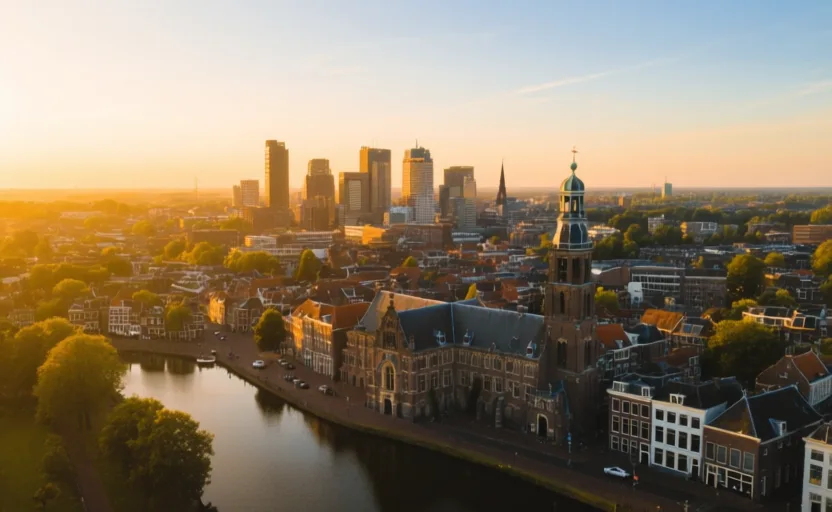 AI city illustration · Artistic impression
What people learn after moving
≈180,000 in the city; roughly 760,000 across the Arnhem-Nijmegen region. Around a quarter of residents are enrolled at Radboud or HAN
Dutch, in a Gelderland rather than a Brabant accent. English is the working language across the Radboud campus and Radboudumc research; German is genuinely useful this close to the border
Euro (EUR)
CET (GMT+1), CEST (GMT+2) from late March to late October
AI city illustration · Artistic impressionCost of living in Nijmegen
Check your eligibility
Pick your passport to see entry rules and the long-stay routes we have researched.
Pick your passport to see whether you can enter Netherlands — and what it takes to stay.
Two routes converge on one number. EU, EEA and Swiss citizens simply register their Nijmegen address and receive a BSN. Everyone else needs a residence permit first, and for professionals that is almost always the employer-filed kennismigrant permit, which only an IND-recognised sponsor can lodge — here that usually means Radboud University, Radboudumc, HAN or one of the semiconductor firms. What is different about Nijmegen is the geography of the paperwork: municipal registration is a gemeente appointment, and IND business routes elsewhere, most often to the Den Bosch or Zwolle desk or to the Wageningen expat centre. Until the BSN exists you cannot legally be paid, insured or fully banked.
The clock that matters starts at your BRP registration date, not your arrival. A non-EU/EEA licence lets you drive here for 185 days from registration; after that you may not drive at all until a Dutch licence is in your hand, even if the application is already with the RDW. EU and EEA licences are not on that clock. Non-EU licences only swap without a test from a designated country, and often only for category B. The large exception: anyone holding the expat ruling, plus their partner and adult children at the same address, can exchange any valid foreign licence with no test at all.
Dutch banks are legally required to hold your BSN, and the BSN comes from gemeente registration — so the account and the registration are chained together. The standard escape is to open a Dutch-IBAN fintech such as bunq before you land, receive your first salary into it, and add the BSN inside the grace period. Then decide whether you also want a traditional bank. What surprises almost everyone is the payment culture: this is a debit-card and iDEAL country, and a foreign credit card will simply be declined in a great many ordinary places.
There is no employer plan and no free service at the point of need. Within four months of becoming insurable you must buy a basisverzekering from a Dutch insurer, and it backdates to the date you became insurable, so a late purchase means paying for months of cover you could not use. The basic package is defined by law and identical at every insurer; only price, service and contracted hospitals differ. On top is a compulsory own-risk excess. Then you need a huisarts, who gatekeeps essentially all other care — and in a city with 45,000 students competing for list places, that is the hard part.
The Netherlands has no SIM-registration regime, so a prepaid SIM is an instant, paperwork-free purchase at any supermarket or phone shop on your first afternoon. A monthly SIM-only contract is much better value but needs a Dutch IBAN for the SEPA direct debit and usually a BSN, so it waits until registration and banking are done. Skip the flagship stores and use an MVNO on the same network. On fixed line, Nijmegen is well covered — but if you are renting a room, the internet is somebody else's contract.
Employees are taxed at source through loonheffing, so the annual return is usually a reconciliation rather than a bill. Income is sorted into three boxes: box 1 for salary and your own home, box 2 for substantial shareholdings, box 3 for savings and investments. Box 3 is the one that shocks people, because it taxes an assumed return on your assets rather than the return you actually got. The expat scheme — still universally called the 30% ruling — has had both its percentage and its salary norm changed repeatedly, so treat any figure you read online as out of date until the Belastingdienst confirms it. Locally, Nijmegen's waste levy has a usage-based component, which is unusual among the bigger Dutch cities and means the bill is partly yours to control.
Each guide has verified costs, timelines, required documents, and the non-obvious gotchas — sourced from official government pages. Last verified August 2026.
Reading a list isn’t learning it. Globe Quest turns these into a trainer — hear each phrase spoken, drill them with spaced repetition, and get scored as you say them out loud.
Nijmegen is not one of the cities with a full IND desk — those are in 's-Hertogenbosch, Amsterdam, The Hague and Zwolle — and it is not an expat-centre city in the way Eindhoven, Utrecht or Groningen are. The IND has operated a service point here, but its availability has been interrupted, so check ind.nl for what is actually open before you plan around it. In practice a knowledge worker moving to Nijmegen books municipal registration with gemeente Nijmegen and handles biometrics and document collection wherever the IND directs them, which may mean Den Bosch, Zwolle or the Welcome Center Food Valley in Wageningen, half an hour up the road. Budget a day, not an afternoon.
Nijmegen requires a permit to let rooms separately in cheaper homes, and the Raad van State has confirmed the municipality may do this — but only for properties below a value threshold, which is why the rules have been rewritten more than once. A great many rooms are advertised without one. An unpermitted conversion is a fragile tenancy: enforcement lands on the landlord and the way it ends is that you move, usually at short notice and usually in a market where there is nothing to move to. Ask directly, ask for it in writing, and treat evasion as an answer.
The Netherlands has no employer plan and no free service at the point of need. You must buy a basisverzekering from a Dutch insurer within four months of becoming insurable, and it backdates to that date, so late buyers pay premiums for months of cover they never used. On top sits a compulsory own-risk excess you fund yourself before the insurer pays for anything other than GP visits. The basic package is fixed by law and identical everywhere, so the only real variables are price, service and which hospitals are contracted.
Roughly a quarter of Nijmegen is enrolled at Radboud or HAN, and the housing market moves to their calendar: rooms come free in June and July, the crush is in August and September, and February is the quiet second window. Then there is the third week of July, when the Four Days Marches and the Vierdaagsefeesten put tens of thousands of walkers and a week of free festival into a city of 180,000. Moving house that week is a mistake — the centre is closed, the trains are full and no removal firm will thank you.
Kleve is about 20 km east and the border is closer than Arnhem. That has practical consequences: cross-border commuting is common, fuel and some groceries have historically been cheaper on the German side, and Radboud's medical and physics collaborations run east as much as west. It also means the labour market here is genuinely binational at the professional level, which is unusual in the Netherlands and worth exploiting if your German is any good.
Nijmegen claims the oldest city rights in the Netherlands — the Romans built Ulpia Noviomagus Batavorum here — and almost none of that survives above ground in the centre, because Allied aircraft bombed it by mistake in February 1944, killing around 800 people, and Market Garden fought over the Waal bridge that September. What is left is a reconstructed core with a medieval fragment at the Valkhof and the Benedenstad, and a city that takes its war history seriously rather than picturesquely.
Radboud University, HAN University of Applied Sciences, Donders Institute, Max Planck Institute for Psycholinguistics
Radboud has seven faculties and over 24,000 students, and the Donders Institute makes Nijmegen one of the strongest cognitive-neuroscience clusters in Europe. The Max Planck language institute here is the only one of its kind.
Radboudumc, Canisius Wilhelmina Ziekenhuis, Sint Maartenskliniek, Health Valley Netherlands
Radboudumc is one of the country's eight university medical centres and the largest employer in the region; the Sint Maartenskliniek is a national referral centre for orthopaedics and rheumatology.
NXP Semiconductors, Ampleon, Nexperia, Sencio
NXP's Nijmegen site is one of the larger chip plants in Europe with around 1,700 staff, though the company has signalled a shift away from 200mm wafer production that puts the fab's long-term future in question — worth asking about directly if the job is on the manufacturing side.
Novio Tech Campus tenants, Synthon, MicroDish, Lead Pharma
The Novio Tech Campus grew on the old Philips semiconductor site and now mixes semiconductor and life-science firms; Synthon is a substantial generics developer headquartered here.
Gemeente Nijmegen, Waterschap Rivierenland, Rijkswaterstaat, Staatsbosbeheer
Nijmegen was European Green Capital in 2018 and the Room for the River works that created the Spiegelwaal side channel are a national reference project — flood engineering is an actual local industry, not a metaphor.
Port of Nijmegen operators, Bijsterhuizen and De Grift estates, cross-border haulage
The Waal is the busiest river in the Netherlands and the inland port serves both the Ruhr corridor and Rotterdam. The industrial estates west of the city are the region's freight and light-manufacturing belt.
Landmark · Centrum, above the Waal
The hill where Charlemagne's palace stood, holding a sixteen-sided eleventh-century chapel and the best view of the river in the city.
Local tip: The Valkhof museum below it has the Roman material — this was a legionary base long before it was an imperial palace. Go up at dusk when the Waal bridge lights come on; the terrace at the top of the park is where the city watches its own river.
Nature · Between the centre and Lent
A side channel dug through the north bank in the 2010s to give the Waal room in flood, which incidentally created an island and the country's most-visited piece of flood engineering.
Local tip: Walk out over the Zaligebrug — a stepping-stone bridge that deliberately floods and closes several times a year — and back over the Waalbrug. The urban beach on the island is where Nijmegen goes in July, and it is free.
Nature · East, towards the German border
A floodplain nature reserve of dykes, oxbow lakes, konik horses and cattle, starting where the eastern edge of the city stops.
Local tip: Cycle out along the Ooijse Bandijk to the Bisonbaai for swimming, or keep going to Millingen and take the ferry. The polder floods properly most winters, which is the point of it, and the water level is the local conversation from December to February.
Neighborhood · Below the centre, on the river
The lower town — the surviving medieval street pattern, restored after decades of neglect, running along the quay under the Valkhof.
Local tip: The Stevenskerk tower is worth the climb for the only 360-degree view. On the quay, the ferry to Lent is the shortest and cheapest boat trip you will take, and it runs into the evening in summer.
Culture · South, on the moraine ridge
A wooded university and hospital campus on the hill, with its own railway station and the Botanical Garden at the top.
Local tip: The Berchmanianum and the Huygens building are open to visitors, and the campus is a genuinely pleasant walk rather than a business park. LUX in the centre — one of the largest arthouse cinemas in the country — is where the campus goes at night.
Nature · South-east, towards Groesbeek
The Seven Hills road, an actual range of glacial hills running to Groesbeek — the reason Nijmegen has a distance-running culture no other Dutch city has.
Local tip: The Zevenheuvelenloop in November is a 15 km race with a world-record pedigree. Out of season it is the best road cycling within reach of any Dutch city, and the Canadian war cemetery at Groesbeek is on the same ride.
Side-by-side cost of living, language, climate and careers — to help you choose.