
Population
≈630,000 in the comune, ≈1.2 million in the metropolitan city — Italy's fifth-largest city and the largest on the islands
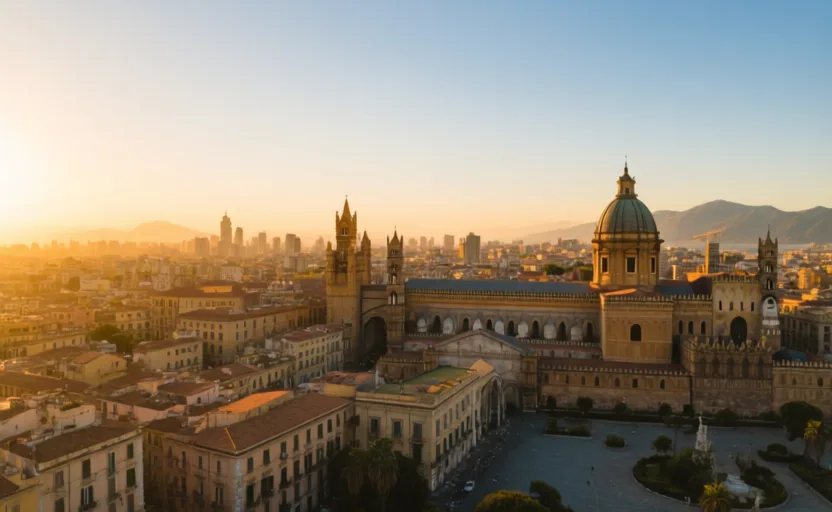 AI city illustration · Artistic impression
What people learn after moving
≈630,000 in the comune, ≈1.2 million in the metropolitan city — Italy's fifth-largest city and the largest on the islands
Italian, with Sicilian very widely spoken and classed by UNESCO as a distinct language rather than a dialect. English is limited outside tourism, the university and ISMETT
Euro (EUR)
CET (GMT+1), CEST (GMT+2) with daylight saving from late March to late October
AI city illustration · Artistic impressionCost of living in Palermo
Check your eligibility
Pick your passport to see entry rules and the long-stay routes we have researched.
Pick your passport to see whether you can enter Italy — and what it takes to stay.
The chain is the national one — nulla osta for sponsored work, a type-D visa, entry, then a permesso di soggiorno application filed on paper at a post office within eight working days. Sicily's special statute changes nothing about it: the questura and the prefettura are organs of the Italian state, not of the Regione Siciliana. What is local is the documentary base underneath. Palermo has a substantial informal rental and labour market, and a lease that is not registered with the Agenzia delle Entrate cannot support residence registration — which is the gate to the health card, the driving-licence clock and the evidence you need at renewal.
EU licences work indefinitely. Licences from countries with a reciprocity agreement convert administratively; everyone else sits the Italian theory and practical exams, in Italian, within twelve months of registering residence. Palermo then adds its own conditions: a central ZTL, a new evening ZTL over Mondello, and construction of three tram alignments across the city running to roughly 2028. Traffic here is already the part of daily life newcomers complain about most, and it is going to get worse before the network opens.
You need a codice fiscale for any account, and banks distinguish between resident and non-resident accounts with the latter costing more. A digital bank is the fastest route to a working Italian IBAN. The specifically Palermitan point is that traceable payments are worth more to you than to a local: in a city with a large informal economy, a bank record of salary and rent is what evidences income and address for a permit renewal, a family reunification or any credit application.
SSN registration is compulsory and free for employees, the self-employed and their families, and voluntary for students, elective residents and some permit holders — who since 1 January 2024 pay an income-based contribution with minimums of €700 for students, €1,200 for au pairs and €2,000 for most other adults. Sicily's difference is organisational rather than legal: as an autonomous region it runs its own service through nine Aziende Sanitarie Provinciali, so in Palermo you register with an ASP, not an ASL, and every guide written for the mainland uses the wrong word.
Italian mobile is cheap and every SIM, prepaid included, must be registered against an identity document and a codice fiscale. Fibre coverage across Palermo's twentieth-century districts — Libertà, Malaspina, Notarbartolo, the northern expansion — is good. In the Albergheria, Capo and Kalsa quarters it is far less predictable, because the buildings are old, heavily subdivided and sometimes only reachable by a copper run down a lane a van cannot enter. Check the exact civic number, not the street.
Residence for tax follows anagrafe registration or having your habitual abode or centre of interests in Italy for more than 183 days in the calendar year, and residents are taxed on worldwide income. Palermo's local arithmetic is the reverse of most of Italy: Sicily's regional surcharge sits at the national floor of 1.23% while the city's own surcharge is 1.03% for 2026 — above the 0.8% ceiling that binds most comuni, and with no exempt band. The other thing worth knowing before you choose an address is that the 7% flat tax for foreign pensioners covers Sicily but excludes any comune above 30,000 inhabitants, a threshold that moved up from 20,000 in April 2026.
Each guide has verified costs, timelines, required documents, and the non-obvious gotchas — sourced from official government pages. Last verified August 2026.
Reading a list isn’t learning it. Globe Quest turns these into a trainer — hear each phrase spoken, drill them with spaced repetition, and get scored as you say them out loud.
Sicily is an autonomous region with a special statute, and it runs its own health service through the Assessorato regionale della Salute and nine Aziende Sanitarie Provinciali. In Palermo you register with ASP Palermo, constituted on 1 September 2009, at the district office covering your address. Every guide written for Milan, Rome or Bologna says ASL, which is the right word almost everywhere else in Italy and the wrong one here — the counters, the forms and the booking system are all branded ASP. The entitlement is national and identical; only the letterhead and the queue are Sicilian.
The addizionale comunale IRPEF is normally capped at 0.8%, or 0.9% for a provincial capital. Palermo levies 1.03% for 2026 under delibera 137 published on 22 July 2026, up from 1.014% in 2025 and 1.002% in 2024, and with no exempt income band at the bottom. Set against that, Sicily's regional surcharge is the national floor of 1.23% flat — where Campania and Lazio charge 3.33% and Puglia now reaches the same. The combined local load on a Palermo salary is therefore around 2.26% and among the gentler in Italy, but it is stacked the opposite way round from everywhere else: high city, low region. Payroll software configured from a template gets this wrong.
Palermo spent much of 2024 and 2025 under turnazione — mains water supplied to each district on a rotating schedule rather than continuously — during the Sicilian drought. The utility suspended the rota in February 2026 after two months of sustained rain, and the Regione Siciliana has said reserves plus the desalination plants at Trapani, Porto Empedocle and Gela cover normal use through 2026. What has not changed is the building stock: almost every flat has a rooftop serbatoio and an autoclave pump, and the state of both is a real quality-of-life variable. Ask at the viewing when the tank was last cleaned and whether the block has ever run dry. It is an ordinary question here and a landlord will not find it strange.
Article 24-ter TUIR lets a foreign pensioner who has not been Italian tax-resident for the previous five years pay a 7% substitute tax on all foreign-source income for nine tax periods, provided they take residence in a qualifying comune in one of eight southern regions, Sicily included. The catch is size: the comune had to be under 20,000 inhabitants, and Law 34 of 11 March 2026 raised that to 30,000 with effect from 7 April 2026. Palermo, at over half a million people, has never qualified and never will. Plenty of comuni in the province do, and the change brought a further tier of them inside — so the regime is a reason to look at the province rather than the city, and moving into Palermo itself forfeits it entirely.
Palermo already runs four tram lines on the periphery. Contracts for tratte A, B and C are awarded and works are under way — tratta C, which runs from viale Regione Siciliana along via Ernesto Basile and corso Tukory to the central station, opened its site in 2026 under a programme completing around 2028. The comune authorised mobile worksites for preliminary surveys across all three routes by ordinance 706 of 29 April 2026. The finished network will be genuinely transformative; the intervening years mean rolling road closures, rerouted buses and dust on some of the busiest corridors in the city. If you are choosing between two flats, check which one is on a tram alignment.
Organised crime in Palermo is a real phenomenon with a real history, and it is overwhelmingly a business problem rather than a personal-safety one. Extortion — the pizzo — falls on shopkeepers, builders and small firms, not on salaried arrivals or remote workers; the anti-racket movement that grew out of the 2004 Addiopizzo campaign publishes lists of businesses that refuse to pay, and you can simply shop from them. Violent crime against foreigners is not the risk here. Pickpocketing in the markets and around the station, scooter-borne bag snatching, and an informal economy that will happily offer you an unregistered lease or cash-in-hand work are the things that will actually touch your life.
Regione Siciliana, Assemblea Regionale Siciliana, Comune di Palermo, ASP Palermo
Sicily's autonomous government is headquartered here and is the island's largest single employer. It hires almost entirely through Italian public competitions — concorsi — which are open to EU citizens and, for many roles, to long-term residents.
Università degli Studi di Palermo, Policlinico Paolo Giaccone, ARNAS Civico, ISMETT, Fondazione Ri.MED
ISMETT is a transplant institute run in partnership with UPMC of Pittsburgh and operates in English as well as Italian — one of the few genuinely international employers in the city.
Fincantieri Palermo, Autorità di Sistema Portuale del Mare di Sicilia Occidentale, Grimaldi, Tirrenia
The Fincantieri yard sits inside the city and does repair and conversion work alongside the passenger port; ferries run to Naples, Genoa, Tunis and Cagliari.
Hotel groups across the Arab-Norman circuit, Sicilia Film Commission, cruise operators
Arrivals have grown fast since the Arab-Norman monuments were inscribed by UNESCO in 2015, and the city is now a heavily used filming location. It is the easiest sector to find work in and the most seasonal.
Cantine and consortia across western Sicily, citrus and olive producers, fish processing at the coast
Western Sicily's wine and olive economy runs through Palermo's professional services and export logistics rather than its factories — most of the physical production is in Trapani and Agrigento provinces.
Engineering, Aubay, Sopra Steria and similar delivery centres, plus a small founder scene around the university
Several Italian and French IT services groups run delivery offices here on a lower cost base. It is a real employment route for developers, but the pay is Sicilian and the interesting work is often decided elsewhere.
Landmark · Albergheria
The seat of the Sicilian parliament, with a twelfth-century royal chapel inside that fuses Norman architecture, Byzantine mosaic and an Islamic muqarnas ceiling.
Local tip: The chapel closes to visitors when the Assemblea Regionale is sitting, so check before you go. Go early: the mosaics need the low morning light coming through the south windows, and the tour groups arrive after ten.
Food · Albergheria, Capo, Vucciria
Three street markets with a thousand years of continuity behind their layout, each with a different character and a different half of the day.
Local tip: Ballarò is the working food market and is at its best before noon. Vucciria has largely become a night-drinking quarter rather than a market. Capo is the compromise — real produce, and open later than Ballarò.
Nature · 11km north-west of the centre
A crescent of white sand between two limestone headlands, with a Liberty-style bathing pavilion on stilts in the middle of the bay.
Local tip: Buses 806 and the summer services get gridlocked; the sea is best on a weekday morning. The comune has introduced an evening ZTL over the borgata from 20:00 to midnight, extended to 01:00 on the eve of holidays, so plan not to drive in for dinner.
Culture · Piazza Verdi
The largest opera house in Italy and the third largest in Europe, closed for twenty-three years and reopened in 1997.
Local tip: The under-30 and student tickets are startlingly cheap and released close to the performance. The daytime guided tour gets you onto the stage and up to the roof terrace, which is the best free-ish view of the old city.
Culture · Cuba / Calatafimi
Eight thousand mummified Palermitans in corridors under a Capuchin monastery, arranged by profession and social rank.
Local tip: It is genuinely unsettling rather than kitsch, and photography is prohibited. Pair it with a walk up to the Zisa — the twelfth-century Norman-Arab summer palace ten minutes away — which almost nobody visits and which explains the city better than anything else.
Neighborhood · In a hollow behind the Palazzo Reale
A small quarter sunk in a depression a few hundred metres from the cathedral, invisible from the streets around it and rebuilt around a community farm, a circus school and a set of murals.
Local tip: One of the clearest examples anywhere in Italy of a neighbourhood organising its own regeneration. Go on a Sunday morning when the farm and the borgata are busy, and go with someone who lives there if you can.
Side-by-side cost of living, language, climate and careers — to help you choose.