Population
≈1.1 million (city); ≈2 million (metro)
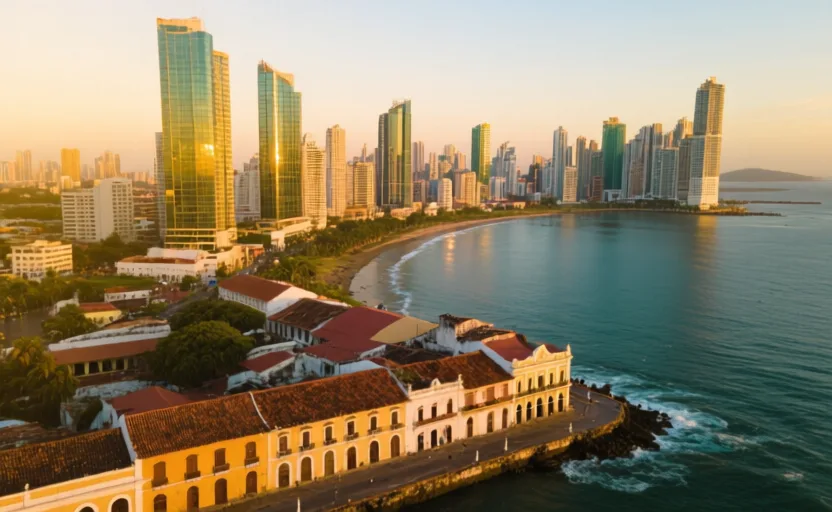 AI city illustration · Artistic impression
What people learn after moving
≈1.1 million (city); ≈2 million (metro)
Spanish; English common in banking, law and the former Canal Zone
US dollar — the balboa is pegged 1:1 and circulates only as coins
EST (GMT−5); no daylight saving
AI city illustration · Artistic impressionCost of living in Panama City
Check your eligibility
Pick your passport to see entry rules and the long-stay routes we have researched.
Pick your passport to see whether you can enter Panama — and what it takes to stay.
The Friendly Nations Visa is now a two-step process, and this is the single most important thing to know: you receive two years of provisional residency first, then apply separately for permanent residency once those two years elapse. Qualification runs through one of three economic routes — property, a fixed bank deposit, or a Panamanian employment contract. The E-cédula ID card only comes after permanent residency is granted.
Conversion runs through the Autoridad del Tránsito y Transporte Terrestre. Once you hold residency you exchange your foreign licence, which requires a blood-type certificate, a medical and sight check, and — for licences not in Spanish — an official translation. Panama drives on the right.
Panamanian banks apply notably strict due diligence, a legacy of the country's history with international scrutiny. Expect professional and banking reference letters, a CV, documented proof of the source of your funds, and often an in-person interview. Accounts are dollar-denominated, so there is no currency conversion involved.
Panama runs a two-track system. The Caja de Seguro Social covers employees through payroll contributions and provides access to public facilities. Private healthcare in Panama City is genuinely good and inexpensive by North American standards, with several hospitals holding US affiliations — which is why most foreign residents insure privately and never use the public system.
Two main operators, Más Móvil and Tigo, following market consolidation. Prepaid SIMs are sold widely and registered against a passport. Postpaid contracts generally require a residency card and a local bank account, which places them behind the harder steps.
Panama taxes income sourced in Panama and generally does not tax foreign-source income. Panamanian-source income is taxed progressively with a meaningful exempt threshold. Your taxpayer registration is the RUC, administered by the Dirección General de Ingresos. The trap is misjudging what counts as Panamanian-source.
Each guide has verified costs, timelines, required documents, and the non-obvious gotchas — sourced from official government pages. Last verified July 2026.
Reading a list isn’t learning it. Globe Quest turns these into a trainer — hear each phrase spoken, drill them with spaced repetition, and get scored as you say them out loud.
The balboa is pegged 1:1 and only exists as coins — all notes are US dollars. There is no currency risk, no conversion friction, and no devaluation exposure. For anyone earning in dollars this is one of the strongest practical arguments for Panama over any other Latin American base.
Panama operates a territorial tax system: income earned outside Panama is generally not subject to Panamanian income tax. This is the actual reason people structure their lives here, and it is a genuine feature of the law rather than a loophole. Take professional advice on your own country's rules, which may still apply.
Panamanian banks apply strict due diligence — expect to provide reference letters, professional CVs, proof of income source and sometimes an in-person interview. Budget weeks, not days, and start it before you need it. This surprises people who found the residency straightforward.
December to April is dry, breezy and pleasant. May to November brings heavy afternoon rain almost daily. Neither is unpleasant, but they demand different clothing, different plans and different assumptions about how long a journey takes.
Panama City has the only metro system in Central America and it is clean, cheap and fast. Living near a line transforms the city, because road traffic on the corridors is severe at peak hours.
English is common in banking, law and the Canal zone, but daily life — utilities, landlords, government offices — runs in Spanish. You can manage without it initially, but Panama is less English-forgiving than Medellín or San José.
Banco General, Banistmo, Global Bank, international private banks
Panama has long been a regional banking centre, with a large offshore and private-banking sector concentrated in the Área Bancaria.
Panama Canal Authority, Maersk, MSC, Colón Free Zone operators
The Canal and the Colón Free Zone make Panama the logistics hub of the Americas, and the single largest driver of the economy.
Copa Airlines, Dell, Procter & Gamble, Maersk regional offices
The SEM multinational-headquarters regime offers tax and immigration incentives, and has drawn a genuine cluster of Latin American regional offices.
Major Panamanian law firms, corporate service providers
A large professional-services sector built around company formation, shipping registration and cross-border structuring.
Domestic developers, international investors
The skyline is the visible result — residential and commercial development is a major employer and a common route to residency.
Hospitality groups, relocation and retirement advisers
Panama actively courts retirees through the pensionado programme, and an entire service industry exists around it.
Neighborhood · Old city, on the peninsula
Restored Spanish colonial streets of rooftop bars, boutique hotels and ruined churches, with the modern skyline framed across the bay.
Local tip: Go up to a rooftop bar at sunset for the view back across the water to the towers. It's the single best thing to do in the city and costs the price of a drink.
Landmark · North-west of the city
The visitor centre where you watch Panamax ships lifted between oceans, a few metres away.
Local tip: Check the ship transit schedule before going and time your visit for a large vessel. Without one in the lock it's a museum; with one it's extraordinary.
Nature · Along the bay
A landscaped waterfront strip of cycle paths, gyms and playing fields running along the seafront to Casco Viejo.
Local tip: Sundays see part of it closed to traffic. Walk or cycle it at dusk when the skyline lights up and the whole city is out.
Nature · Between the city and the Canal
A rainforest hill inside the city with sloths, toucans and a summit view over the Canal entrance and the skyline.
Local tip: Walk up early morning for wildlife and cool air. Genuine rainforest fifteen minutes from the financial district is a Panama-specific pleasure.
Food · Waterfront, near Casco Viejo
The fish market, where the upstairs restaurants and outside stalls serve ceviche by the cup for a couple of dollars.
Local tip: Buy ceviche from a stall rather than the restaurant, eat it standing up, and pair it with a cold beer. This is the city's best-value meal by a distance.
Nature · Within the city limits
A protected tropical forest reserve inside the capital, with marked trails and a canopy viewpoint.
Local tip: Almost no visitors bother, which is why you'll have monkeys and trails largely to yourself on a weekday morning. It's ten minutes from the towers.
Side-by-side cost of living, language, climate and careers — to help you choose.