
Population
~120,000 registered in Pattaya City; far higher in practice across the Banglamung conurbation
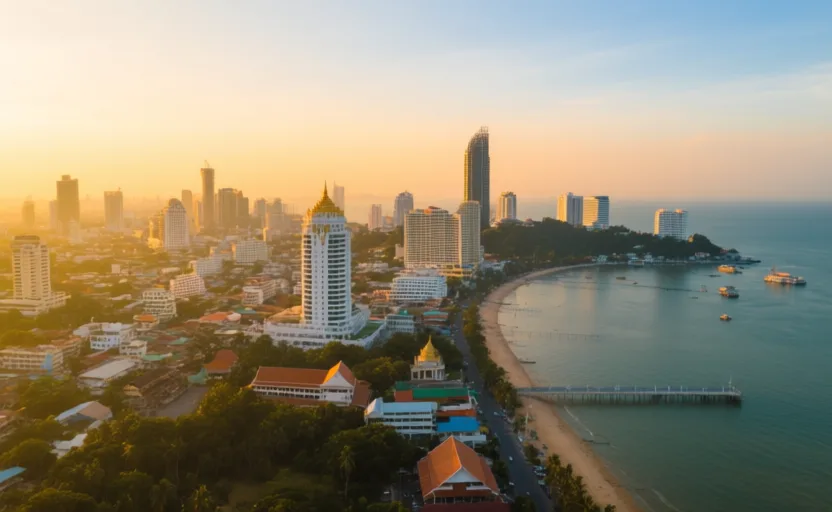 AI city illustration · Artistic impression
What people learn after moving
~120,000 registered in Pattaya City; far higher in practice across the Banglamung conurbation
Thai (official); English very widely used, and Russian and German common in parts of the city
Thai Baht (THB / ฿)
ICT (GMT+7), no daylight saving
AI city illustration · Artistic impressionCost of living in Pattaya
Check your eligibility
Pick your passport to see entry rules and the long-stay routes we have researched.
Pick your passport to see whether you can enter Thailand — and what it takes to stay.
Most long-stay foreigners in Pattaya are on one of three things: an annual retirement extension for the over-fifties, a DTV or LTR if they work remotely or qualify on income, or a Non-B and work permit through an employer in the industrial corridor. The EEC adds something no other Thai city offers to the same extent — a flat 17% personal income tax rate for qualifying executives, specialists and researchers working for targeted-industry businesses in the corridor. Whatever you hold, the TM30 is your landlord's duty and the TM47 90-day report is yours.
Pattaya's baht buses run fixed loops at a flat fare and cover the whole strip from Naklua through central Pattaya to Jomtien, supplemented by Grab and Bolt. Learning them properly removes most of the need for a vehicle. If you do ride, the licensing and insurance consequences of doing it on the wrong paperwork are severe, and motorbike injuries are the leading cause of serious harm to foreigners here.
Bring a passport, a long-stay visa or extension and proof you live here, and expect the answer to vary by branch. For anyone on a retirement extension the account has a second function entirely: it holds the balance your annual extension is assessed against, and Immigration reads the passbook history rather than the closing figure. Pick a bank whose branch you can reach easily and whose passbook updates reliably, because you will be presenting it once a year for the rest of your stay.
Pattaya has good private hospitals with English-speaking specialists and a government hospital in Banglamung, and the whole system is far cheaper than Bangkok's flagship private sector. The hard part here is not access but insurance: this is a city with a large ageing foreign population, and private medical cover becomes expensive or unobtainable exactly when people need it most. Anyone planning to retire here needs a plan for that, not an assumption.
Buy a SIM at an official AIS, True or dtac store with your original passport, add a data package immediately, and you are done. For home internet, Pattaya's high-rise density means most buildings are well served, but the provider is often fixed by the building's arrangement. The specific local issue is power and connectivity during heavy rain, which is a real consideration if you work to overseas deadlines.
You become a Thai tax resident at 180 days in a calendar year, and residency is what brings remitted foreign income into scope under Revenue Department orders Por. 161/2566 and Por. 162/2566. For Pattaya's retirees that is the live question, because a pension remitted into Thailand is exactly the kind of income those orders reach. For professionals in the EEC, the corridor offers a flat 17% rate that is unavailable almost everywhere else in the country.
Each guide has verified costs, timelines, required documents, and the non-obvious gotchas — sourced from official government pages. Last verified August 2026.
Reading a list isn’t learning it. Globe Quest turns these into a trainer — hear each phrase spoken, drill them with spaced repetition, and get scored as you say them out loud.
Pattaya has Thailand's largest concentration of visa agents, because it has the country's largest retiree population. Most are legitimate paperwork services. A minority offer to arrange the 800,000 baht bank balance for you — a loan that appears in your account for the required period and then leaves. That is document fraud, it is prosecuted, and people have been blacklisted from Thailand for it. Use an agent to queue and to translate, never to create a financial position you do not have.
Pattaya City is one of only two localities in Thailand — the other is Bangkok — governed under its own statute, with a directly organised city administration rather than the standard municipal structure. In practice that means local rules on construction, beach use, noise and licensing are set locally and enforced locally, and can differ from the surrounding Chonburi districts. If you are told 'that's the rule in Thailand', check whether it is actually the rule in Pattaya.
Rent for a comparable condominium runs well below Bangkok, and everyday costs follow. That gap is why Pattaya works for people on a fixed pension who would be squeezed in the capital. The trade-off is that you are two hours from Bangkok's hospitals, embassies and international schools, and the local job market outside tourism and the industrial corridor is thin.
Converted pickups run fixed loops along Beach Road, Second Road and out to Jomtien and Naklua at a flat fare, and once you understand the routes they are faster and far cheaper than anything else. You flag one down, ride, press the buzzer and pay at the window. Grab and Bolt operate as well. Most foreign injuries in Pattaya involve a motorbike, so learning the baht buses first is a genuinely good safety decision.
Heavy rain overwhelms the drainage on parts of Beach Road, Second Road and the lower sois, and water can be knee-deep within twenty minutes and gone within two hours. It is highly localised — one soi floods, the next does not. Ask the building's security staff and the shops on the street rather than the agent, and be especially careful with ground-floor and basement-parking units.
Pattaya sits on the Gulf of Thailand, so it does not get Phuket's monsoon surf. The cool, dry months from November to February are the high season and the pleasantest; March to May is very hot; the rainy season from roughly May to October brings heavy but usually short downpours. The sea is calm most of the year, which is one of the reasons the retiree population settled here rather than on the Andaman side.
International and domestic hotel groups, restaurants, entertainment venues
The dominant local employer and the reason the city exists in its current form. Highly seasonal, with the November-to-February peak setting the annual rhythm.
Automotive, electronics, petrochemical and aerospace operations across Chonburi and Rayong
Chonburi is one of the three EEC provinces, and the corridor's targeted-industry incentives are the reason a genuine professional expatriate population lives here alongside the retirees.
Local and Bangkok-based developers, building juristic offices, rental managers
Pattaya built an enormous condominium stock, which is why foreign quota is more often available here than in Bangkok — and why the market has a persistent oversupply.
Visa agents, healthcare providers, insurers, care and assisted-living operators
An entire service economy has grown around Thailand's largest concentration of foreign retirees. It contains both the country's most experienced practitioners and its least scrupulous.
Bangkok Hospital Pattaya, Pattaya Memorial, Banglamung Hospital
An internationally oriented private hospital sector serving both the resident foreign population and medical travellers, backed by a government hospital in Banglamung.
Laem Chabang port operations, U-Tapao airport, EEC logistics operators
Thailand's main deep-sea port is just north of the city and U-Tapao serves the corridor, giving Pattaya a working-industrial side that visitors never see.
Nature · South Pattaya
A long, calm, tree-lined stretch south of the headland where most of the city's long-term foreign residents actually live and swim.
Local tip: The southern end past Soi 5 is quieter and cleaner than the northern stretch. Early morning is when the resident population is out.
Landmark · Naklua
An entirely wooden temple-palace on the shore, hand-carved and still unfinished after four decades, with no metal fasteners anywhere in it.
Local tip: Go on a weekday morning. The carving detail is the point and it is impossible to appreciate in a crowd.
Nature · Offshore, 45 minutes by ferry
A small island off Pattaya with clear water and half a dozen beaches — the escape valve when the mainland beaches disappoint.
Local tip: Take the public ferry from Bali Hai pier rather than a speedboat tout, and walk or ride to Samae or Thien beach instead of stopping at the first one.
Neighborhood · Between Pattaya and Jomtien
The green headland separating the two bays — quiet residential streets, a temple, a viewpoint and small coves.
Local tip: The best-value residential area in the city for anyone who wants quiet without leaving it. Walk up to the viewpoint at sunset.
Food · 20 km south of Pattaya
A working fishing village with seafood restaurants on the pier, a slow main street and none of Pattaya's noise.
Local tip: This is where Pattaya residents go for a Sunday lunch. Order whatever came in that morning rather than from the laminated menu.
Culture · Sattahip district, south of the city
A 130-metre Buddha outlined in gold on a sheer cliff face, with vineyards and a lake beside it.
Local tip: Almost no short-stay visitors come this far south and it is the most striking thing within an hour of the city. Combine it with Bang Saray for the day.
Side-by-side cost of living, language, climate and careers — to help you choose.