
Population
~2.6 million (Pretoria); ~4.0 million (City of Tshwane metro)
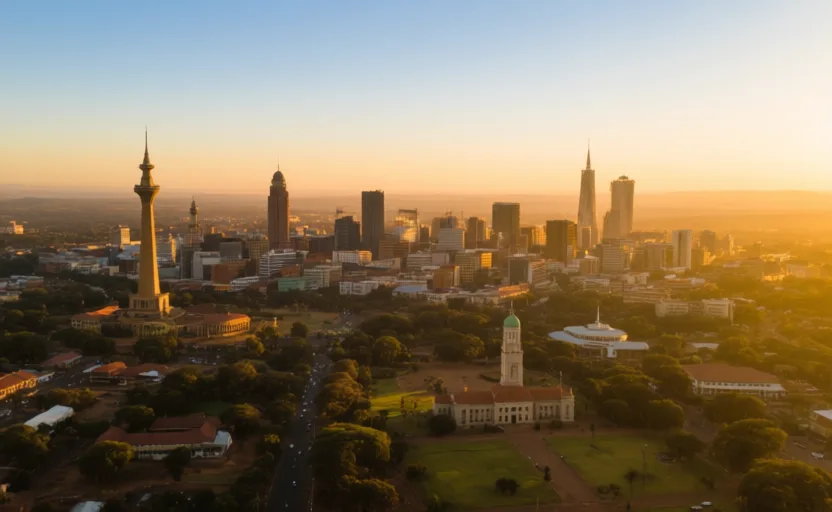 AI city illustration · Artistic impression
What people learn after moving
~2.6 million (Pretoria); ~4.0 million (City of Tshwane metro)
Seat of the executive — the administrative capital of South Africa
~1,339 m — about 400 m lower and noticeably warmer than Johannesburg
Sepedi, Afrikaans, isiZulu, Setswana, English (English in business)
AI city illustration · Artistic impressionCost of living in Pretoria
Check your eligibility
Pick your passport to see entry rules and the long-stay routes we have researched.
Pick your passport to see whether you can enter South Africa — and what it takes to stay.
The routes are national. Most Western passports get up to 90 days on arrival with no right to work of any kind. Beyond that, the Critical Skills Work Visa awards a full 100 points automatically to anyone whose occupation appears on the list published in October 2024, runs up to five years and leads directly to permanent residence under section 27(b). The General Work Visa runs on the same 100-point framework but you must assemble the points from qualifications, salary, experience, language and employer status. The Remote Work Visa needs foreign-sourced income of roughly ZAR 650,796 a year — the figure in the Home Affairs notice, and widely misquoted — and runs up to three years. Where Pretoria differs is physical: Home Affairs head office is here, DIRCO's legalisation section is here, SAQA is in Hatfield, and the SAPS Criminal Record Centre that issues every South African police clearance is on Francis Baard Street. That proximity is worth real days on documents and embassy appointments — and nothing at all on adjudication speed, which is centralised and queued regardless of where you live.
Pretoria drives, but it drives more easily than Johannesburg: shorter distances, a legible grid in the older suburbs, and less of the sprawl. South Africa drives on the LEFT. You may use a valid foreign licence provided it is printed in English and carries your photograph and signature; otherwise carry an International Driving Permit alongside it. Once resident you must convert — a foreign licence cannot be renewed from inside South Africa, and permanent residents have five years. Conversion means first getting a traffic register number from a registering authority, then a DLTC visit with form DL1 and an eye test; there is no practical driving test. Two things shape movement here specifically. The Gautrain runs Hatfield–Pretoria–Centurion–Midrand–Sandton, which makes commuting to Johannesburg without the N1 genuinely practical. And the Gauteng e-toll gantries stopped charging on 11 April 2024, so ignore anything that tells you to buy an e-tag for the N1 or N4.
Every South African bank must verify identity and, usually, residential address before it opens an account — the Financial Intelligence Centre Act requires it, and front-line staff cannot waive it. Identity is your passport. The address is the problem, because a document under three months old in your name does not exist in week one. Three answers work: a signed lease, a letter from a landlord or employer, or a free sworn affidavit commissioned at any SAPS station. Or avoid the question: Standard Bank's published FICA requirements for adult foreign nationals list no proof-of-address document, and TymeBank asks for none, opening an account at a supermarket kiosk in about ten minutes with a card printed on the spot. Pretoria adds one wrinkle worth knowing: staff of diplomatic missions and international organisations are usually onboarded through a bank's diplomatic desk against a DIRCO-issued identity card rather than the ordinary process, which is faster if it applies to you and irrelevant if it does not.
South Africa runs a two-tier health system and almost every professional newcomer uses the private tier. That means choosing between a South African medical scheme — regulated by the Council for Medical Schemes, community-rated, obliged to accept you, and obliged to cover Prescribed Minimum Benefits in full at its designated providers — and an international expat policy that travels with you. Pretoria's private hospital market is good and less congested than Johannesburg's: Netcare Unitas and Netcare Pretoria East, Life Groenkloof and Life Wilgers, and Mediclinic Midstream and Kloof cover the eastern suburbs and Centurion. On the public side, Steve Biko Academic Hospital is the University of Pretoria's teaching hospital and a national referral centre, with Kalafong and Tshwane District behind it. Two Pretoria-specific practical notes: Onderstepoort is the country's only veterinary faculty, which matters enormously if you are relocating with animals, and the National Institute for Communicable Diseases is here, which is where travel-health advice for the region actually originates.
A SIM costs a couple of rand; activating it is the errand. RICA requires every SIM to be registered against a verified identity and a South African address before it will carry traffic, which means a newcomer hits the proof-of-address problem on day one rather than in week three. Buy prepaid rather than a contract, because contracts require a South African ID and a local credit record. Vodacom and MTN have the strongest coverage across Tshwane; Cell C and Telkom are cheaper and thinner, though Telkom's fixed and fibre business is headquartered in Centurion. Data is expensive by global standards, so convert airtime into a bundle before browsing. Home fibre coverage in the eastern suburbs and Centurion is excellent, with Openserve, Vumatel, Frogfoot, MetroFibre and Herotel in the ground and a competitive ISP market on top — but in a complex or estate the body corporate's wayleave decides which of them you may actually use.
South Africa taxes tax residents on worldwide income and non-residents only on South African-source income, at progressive rates from 18% to 45%. Residency arises either from being 'ordinarily resident' — South Africa is where you naturally return — or from failing a purely mechanical physical-presence day count. The tax year runs 1 March to the end of February, which derails anyone planning on a calendar year. Residents working abroad get the first R1.25 million of foreign employment income exempt under section 10(1)(o)(ii), subject to strict day tests. Two Pretoria-specific layers sit on top. Accredited diplomatic and consular staff are generally exempt from South African income tax on official emoluments under the Vienna Conventions and the Diplomatic Immunities and Privileges Act, but that exemption does not automatically extend to locally engaged staff or to a spouse's local employment. And there is no city income tax, but the City of Tshwane's own tariffs reset every 1 July: for 2026/27 that meant roughly 8.8% on electricity, about 5% on property rates, and a monthly basic charge of around R142.50 on prepaid electricity connections.
Each guide has verified costs, timelines, required documents, and the non-obvious gotchas — sourced from official government pages. Last verified August 2026.
Reading a list isn’t learning it. Globe Quest turns these into a trainer — hear each phrase spoken, drill them with spaced repetition, and get scored as you say them out loud.
Pretoria is where the paperwork lives: Home Affairs head office in the Hallmark Building on Johannes Ramokhoase Street, the SAPS Criminal Record Centre that issues every South African police clearance, DIRCO's legalisation section, SAQA in Hatfield, SARS head office in Nieuw Muckleneuk and well over a hundred embassies. That genuinely saves you courier time and lets you attend an embassy appointment on a Tuesday morning without a flight. What it does not do is speed up adjudication — visa decisions are centralised and queued, and walking into head office to ask about your file achieves nothing. Use the proximity for documents and appointments; use the concession and patience for outcomes.
The eastern suburbs — Waterkloof, Brooklyn, Lynnwood, Menlo Park, Faerie Glen — feel markedly calmer than most of Johannesburg, with more walking, more open gates and lower ambient anxiety. The CBD and Sunnyside are a different city: dense, cheap, and where a lot of newcomers land badly because the rent looked good online. Look up the SAPS precinct covering any address before you commit, and treat 'Pretoria' as at least three separate risk environments rather than one.
Hatfield to Sandton takes roughly forty minutes on the Gautrain, with stations at Hatfield, Pretoria and Centurion. A lot of people live in Pretoria on Pretoria rents and work in Johannesburg on Johannesburg salaries, and this is how. Buy a Gold Card, use the free feeder buses at either end, and park at Centurion if you drive to the station. Driving the N1 at peak instead takes over an hour and is the most congested stretch of freeway in the country.
The City of Tshwane is its own electricity distributor, and its tariffs are set with its own budget every 1 July. For 2026/27 it approved roughly 8.8% on electricity and about 5% on property rates, and — the item that surprises tenants — a monthly basic charge of around R142.50 that sits on the account before you buy a single unit on a prepaid meter. If you have moved from Johannesburg, none of the City Power numbers you learned there apply. Ask what the lease passes through.
Pretoria sits about 400 metres lower than Johannesburg in a bowl in the Magaliesberg foothills, 55 km away. Winters are short, dry and mostly frost-free; summers are hot, humid by Highveld standards, and broken by heavy late-afternoon thunderstorms from October to March. Practically: you will want air conditioning here more than a heater, the pool season is genuinely long, and hail is a real risk to a car left outside in December.
Roughly seventy thousand jacarandas bloom across the city in late October and early November and the effect on the older suburbs is absurd. University of Pretoria students will tell you that a flower falling on your head during exams means you will pass. Worth knowing: jacarandas are an introduced species listed under South Africa's alien and invasive species rules, so the historic avenues are a heritage inheritance rather than something being expanded — check the current listing with the environment department before planting one in a garden.
The Presidency, ~40 national departments, the Union Buildings
Pretoria is the seat of the executive, which makes national government the city's largest single employer and the reason so much of the professional economy is advisory.
130+ embassies and high commissions, UN agencies
The embassy belt runs through Arcadia, Hatfield, Brooklyn and Waterkloof — one of the largest concentrations of diplomatic missions anywhere.
BMW Rosslyn, Nissan Rosslyn, Ford Silverton
Three assembly plants inside the metro make Tshwane one of South Africa's two automotive heartlands, with a deep tier-one supplier base around them.
University of Pretoria, UNISA, TUT, CSIR, Onderstepoort
UNISA is Africa's largest distance-learning university and the CSIR is the continent's biggest research and development organisation — both headquartered here.
Denel, Armscor, SANDF headquarters, SANSA
The national defence procurement and engineering complex sits in and around Pretoria, along with much of the country's aerospace and satellite capability.
Telkom, Momentum Metropolitan, PPS, Sanlam corporate
Centurion, halfway to Johannesburg, has become a corporate campus belt in its own right — cheaper than Sandton with the same Gautrain line.
Landmark · Arcadia
Herbert Baker's sandstone crescent above terraced gardens, the seat of the Presidency, with a nine-metre Mandela statue on the lawn.
Local tip: The gardens are free and open — go at sunset for the view over the city. The building itself is not open to the public, so do not plan around a tour.
Culture · Salvokop
A memorial and museum on a hill facing the Voortrekker Monument, telling three hundred years of South African conflict from the other side.
Local tip: Take the guided walk along the Wall of Names rather than self-touring, and do it on the same day as the Voortrekker Monument — seen together they make an argument neither makes alone.
Landmark · Groenkloof
A vast granite block commemorating the 1830s Great Trek, with a marble frieze and a cenotaph lit by the sun at noon each 16 December.
Local tip: Climb to the roof for the best panorama of the city. The surrounding nature reserve has good walking trails that most visitors never notice.
Nature · South-eastern Tshwane
Thirty-eight square kilometres of highveld grassland inside the city limits, holding rhino, buffalo, cheetah, eland and over three hundred bird species.
Local tip: Twenty-five minutes from the CBD and you are self-driving past white rhino. Go at opening time in winter for the best sightings, and take the hide at the dam.
Neighborhood · Hatfield / Arcadia / Brooklyn
The student and diplomatic quarter — the University of Pretoria, a Gautrain station, embassy walls, and the city's densest run of bars and cafés.
Local tip: Hatfield Square and Burnett Street are where the student nightlife is; the quieter, better eating is a few blocks south around Brooklyn and Duncan Street.
Food · West of the CBD
The historic Indian and Asian trading quarter — spice merchants, fabric shops, temples and mosques, and samoosas made in front of you.
Local tip: Go on a weekday morning, go with someone who knows it, and buy your spices here rather than at a supermarket; it is a fraction of the price and incomparably better.
Side-by-side cost of living, language, climate and careers — to help you choose.