
Population
≈10.4 million in the municipality. Qingdao is a sub-provincial city with separate state planning status, which gives it more autonomy than an ordinary prefecture-level city
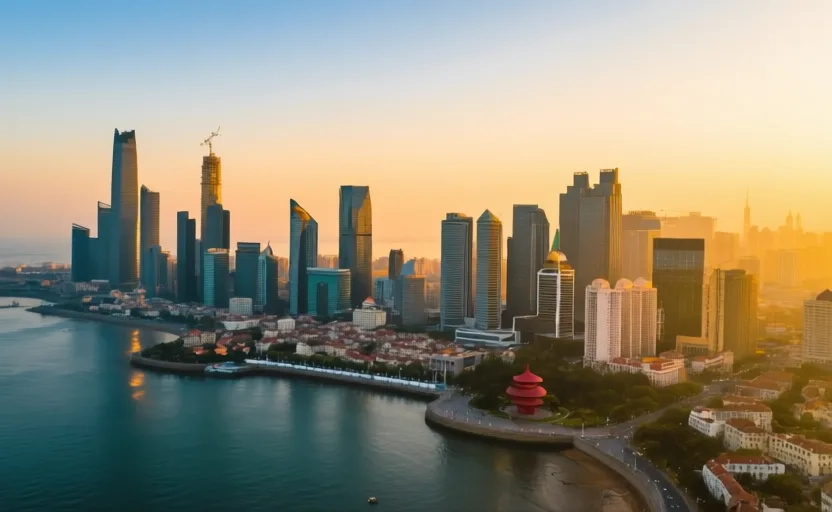 AI city illustration · Artistic impression
What people learn after moving
≈10.4 million in the municipality. Qingdao is a sub-provincial city with separate state planning status, which gives it more autonomy than an ordinary prefecture-level city
Mandarin in a distinctive Jiaoliao dialect. Korean is widely spoken in Chengyang and around the Korean business community; English is limited outside the international employers
Renminbi / Chinese yuan (CNY, ¥)
CST (GMT+8). No daylight saving
AI city illustration · Artistic impressionCost of living in Qingdao
Check your eligibility
Pick your passport to see entry rules and the long-stay routes we have researched.
Pick your passport to see whether you can enter China — and what it takes to stay.
The national sequence is fixed: Notification Letter of Foreigner's Work Permit obtained by your employer, Z visa at a Chinese mission abroad, entry, work permit card, then a residence permit within 30 days of entry — plus police registration within 24 hours of moving into a private flat. Qingdao's foreign employment is concentrated in Korean, Japanese and Chinese manufacturing, shipping and marine science, which shapes the practical experience: employers here process these applications constantly and are usually competent at them, but the process itself is entirely national.
A foreign licence is not valid in mainland China and the International Driving Permit is not recognised. Conversion means a translation, a medical and the hundred-question written theory test, with practical tests waived for ordinary car categories. Qingdao does not ration plates, so you can buy a car and register it. What it does have is steep hills, a coastline, a bay crossed by both a bridge and an undersea tunnel, and a summer fog season that genuinely affects driving conditions.
Alipay and WeChat Pay accept foreign Visa and Mastercard up to USD 5,000 per transaction and USD 50,000 a year after verification, which covers a visit. Living here needs a local account, and the account needs a Chinese mobile number registered against your passport. Qingdao's advantage over other second-tier cities is that decades of Korean, Japanese and shipping business mean the central branches are genuinely used to foreign customers. Its complication is the same as Guangzhou's: in a trade city, personal accounts that look like business accounts attract scrutiny.
Qingdao has solid provincial hospitals — the Affiliated Hospital of Qingdao University foremost among them — with the usual Chinese structure of cheap Mandarin-language ordinary outpatient departments and international wings at higher cost. What it does not have is the tertiary depth of Beijing or Shanghai. The genuinely local considerations are the substantial Korean medical service layer that has grown up around the Korean community in Chengyang, and the fact that Seoul is a ninety-minute flight away and is a real option for people whose insurance permits it.
A SIM takes twenty minutes and a passport, and should be your first errand because the number gates the bank account and the payment apps. The blocked-services position is the same as everywhere on the mainland — and here it has a specific commercial edge, because a great many people in Qingdao work for Korean, Japanese or European parent companies whose systems, and whose colleagues' messaging apps, sit outside China. KakaoTalk and LINE in particular behave unreliably from a mainland connection, which is a live issue for a Korean or Japanese team.
The national rules apply: monthly withholding, an annual reconciliation between March and June, a 183-day residence test, and a six-year rule on worldwide income that resets with a single absence of more than thirty consecutive days. Foreign nationals elect annually between the expatriate fringe-benefit exemptions and the standard itemised deductions. What deserves particular attention in Qingdao is the day count: with Korea and Japan an hour or two away, a great many people here travel constantly in short bursts, which affects the 183-day test and does nothing at all for the six-year reset.
Each guide has verified costs, timelines, required documents, and the non-obvious gotchas — sourced from official government pages. Last verified August 2026.
Reading a list isn’t learning it. Globe Quest turns these into a trainer — hear each phrase spoken, drill them with spaced repetition, and get scored as you say them out loud.
China's municipal central heating network stops at the Huai river line, drawn in the 1950s. Shanghai, Hangzhou, Suzhou, Nanjing, Chengdu, Guangzhou and Shenzhen are all south of it and have none — residents heat one room with an air conditioner and spend the winter cold indoors. Qingdao is north of it, so buildings are connected to municipal heating that runs roughly from mid-November to the end of March. Winters here are windier and colder outdoors than Shanghai's, and dramatically more comfortable indoors. Check when viewing whether a flat is on the municipal system, who pays the heating charge and whether it is included in the rent — it is one of the few genuinely material questions in a Chinese lease.
Article 39 of the Exit and Entry Administration Law requires anyone staying outside a hotel to register with the local public security organ within 24 hours of arrival. Hotels file it invisibly; private landlords do not. Take passport, visa, lease and landlord to the neighbourhood station and keep the slip, because it is requested again at your residence permit application and every renewal. The fine is up to RMB 2,000; the real cost is being blocked at a counter when you cannot produce it.
Qingdao is a short flight or an overnight ferry from South Korea and has hosted Korean manufacturing investment since the early 1990s. The result is one of the largest Korean populations in China, concentrated in Chengyang district near the old airport corridor, with Korean schools, supermarkets, churches, clinics and a service economy built around them. For a Korean speaker this is the most comfortable Chinese city outside the capital. For everyone else it means an unusually deep layer of non-Chinese services in a second-tier city — and, practically, that a great many of the international jobs here are attached to Korean or Japanese manufacturers.
The Yellow Sea moderates everything. Summers are markedly cooler and more bearable than the Yangtze delta furnace cities — this is where people from Shanghai come in August — and winters are colder and much windier than the latitude suggests, with a wind chill off the sea that catches newcomers. The distinctive local phenomenon is the summer sea fog, thick advection fog that rolls in off the water mostly in June and July, closes the coast road, delays flights and can persist for days. Budget for wind rather than snow, and for fog rather than rain.
Qingdao Port is one of the largest container ports in the world and runs a highly automated terminal; Haier and Hisense are both headquartered here; CRRC Sifang builds a large share of China's high-speed trains in the city; and the Ocean University of China anchors a serious marine science cluster. The foreign employment here is weighted toward manufacturing, shipping, quality and marine engineering rather than finance or consumer tech. It is a strong market for an engineer or a supply chain professional and a thin one for almost anything else.
Qingdao was a German leased territory from 1898 to 1914, and the old town in Shinan district still has the red-roofed European core, St Michael's Cathedral, the former governor's residence and the street plan that came with them. Tsingtao Brewery was founded in 1903 and remains a working institution rather than a heritage exhibit. The Qingdao International Beer Festival each August is among the largest in Asia and reshapes the city for a fortnight — hotel prices rise, the West Coast site fills, and if you are not going you should plan around it.
Qingdao Port, COSCO Shipping, Maersk and Hapag-Lloyd operations
Qingdao Port is among the world's largest container ports and operates one of the most automated terminals anywhere, which makes the city a genuine centre of shipping and logistics employment.
Haier, Hisense, Aucma
Haier and Hisense are both headquartered in Qingdao and are among the largest appliance and television manufacturers in the world. Their supply chains employ a very large share of the city.
CRRC Qingdao Sifang, Qingdao Shipyard
CRRC Sifang builds a substantial part of China's high-speed rolling stock in Qingdao, making the city a centre of transport engineering with a deep supplier base.
Tsingtao Brewery, Qingdao seafood and marine food processing
Tsingtao Brewery was founded in 1903 during the German period and is one of China's most recognised brands internationally. Marine food processing is a major sector in its own right.
Ocean University of China, the Institute of Oceanology, Qingdao Marine Science and Technology Pilot National Laboratory
Qingdao holds China's most important concentration of marine science research, which is why the city has an unusually international scientific community for its size.
Korean electronics and component suppliers, Japanese machinery firms in Chengyang and the West Coast New Area
Three decades of Korean and Japanese investment have built a manufacturing base with a substantial foreign management and engineering population attached to it.
Neighborhood · Shinan, eastern old town
A district of early twentieth-century villas in a dozen national architectural styles, each street planted with a different flowering tree.
Local tip: Each of the eight streets is named after a Chinese frontier pass and lined with a single species — peach on one, crab apple on another — so the district blooms in sequence through spring. Walk it in April, when the sequence is visible, and go down to the small coves at the bottom rather than staying on the road.
Culture · Shibei, on Dengzhou Road
The original 1903 brewery buildings, still part of a working plant, with the machinery, the archive and unfiltered beer at the end.
Local tip: The tour ends with raw unfiltered beer that is not sold anywhere else, and the street outside — Beer Street — is where locals actually drink. Buy zhāpí in a plastic bag from a barrel shop and eat clams with it; this is the genuine local ritual and it costs almost nothing.
Nature · ≈40 km east of the city, on the coast
A granite coastal massif rising directly out of the Yellow Sea, with Daoist temples on its slopes and the spring water the brewery was founded on.
Local tip: The Taiqing Palace route on the southern side is the one with the temples and the sea views, and it is far better than the northern approaches. Go on a clear day outside the fog season — in June and July the summit is frequently inside a cloud and you will see nothing at all.
Landmark · Shinan, western end
The German concession core — St Michael's Cathedral, the former governor's residence, and a street plan that predates the rest of the city.
Local tip: The cathedral square is the photograph; the interesting part is the lanes north of Zhongshan Road, where German-era commercial buildings are still ordinary shops and flats. The old town was neglected for decades and is now being restored, so it changes noticeably year to year.
Food · Shinan, near Zhongshan Road
A dense old market courtyard of seafood stalls and small kitchens, where you buy the fish and hand it over to be cooked.
Local tip: The system is that you buy your seafood from the stalls and take it to a restaurant in the same courtyard, which cooks it for a fee. Agree the cooking price before you hand anything over. This is how Qingdao eats seafood, and it is dramatically cheaper than any restaurant menu.
Nature · Laoshan district, eastern Qingdao
A rocky headland and a long coastal walkway running east from the modern city toward the mountain.
Local tip: The coastal path east of the Olympic sailing centre is used almost entirely by residents, and on a clear winter morning with the wind off the sea and Laoshan ahead of you it is the best walk in Shandong. Almost every visitor stops at the old town beaches and never comes this far east.
Side-by-side cost of living, language, climate and careers — to help you choose.