Population
≈2 million in the Distrito Metropolitano de Quito, spread along a plateau roughly 40 km long and only a few kilometres wide
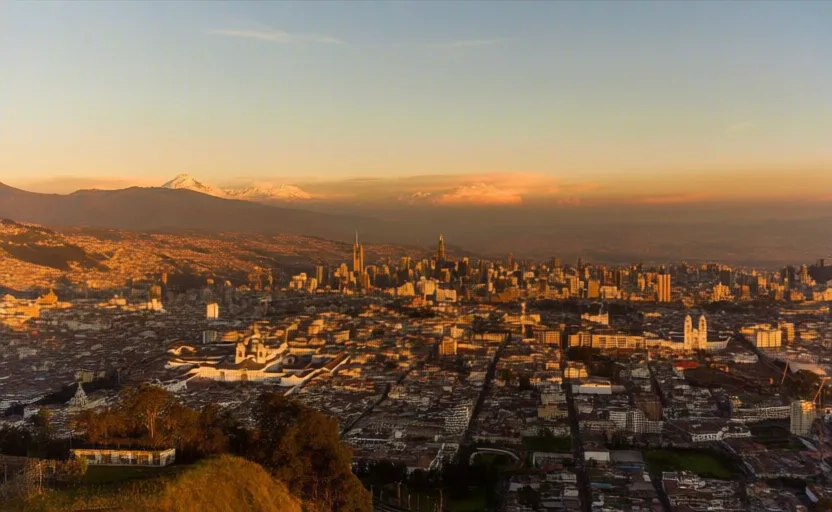 AI city illustration · Artistic impression
What people learn after moving
≈2 million in the Distrito Metropolitano de Quito, spread along a plateau roughly 40 km long and only a few kilometres wide
Spanish, with Kichwa co-official in intercultural contexts. English is common in the diplomatic and tourism sectors and limited elsewhere
US dollar — Ecuador has been dollarised since 2000. US notes and coins circulate alongside Ecuadorian centavo coins
ECT (GMT−5) — no daylight saving, and on the equator the day is twelve hours long all year
AI city illustration · Artistic impressionCost of living in Quito
Check your eligibility
Pick your passport to see entry rules and the long-stay routes we have researched.
Pick your passport to see whether you can enter Ecuador — and what it takes to stay.
Ecuador grants temporary residence for two years, renewable, across several categories — professional, rentista, investor, worker, student, remote worker — and permanent residence after 21 months of continuous temporary residence. Applications can be filed at a consulate or inside the country. The thresholds are expressed as multiples of the salario básico unificado, which is USD 482 for 2026. The rule that catches people is not any of this: it is the limit on time spent outside Ecuador.
Foreign licences are usable for a limited period; residents need an Ecuadorian licence, obtained through the ANT with a medical and psychometric assessment and, for most nationalities, a course and examination rather than a straight exchange. Quito adds a plate-based weekday restriction in the metropolitan district, and the altitude has real effects on both engines and drivers.
Ecuador uses the US dollar, which removes exchange risk, conversion spreads and the whole apparatus of currency management from your life. What it adds instead is the Impuesto a la Salida de Divisas — a tax on money leaving the country — and a banking culture that is conservative about opening accounts for people without a cédula. Banco Pichincha is the largest bank; the cooperativas de ahorro y crédito are a genuine alternative with better rates and thinner technology.
Employees are enrolled in the IESS by their employer from the first day of work — a legal obligation, not a benefit. Everyone else can affiliate voluntarily by declaring a contribution base and paying a percentage of it. On top of that sit private insurers and the private hospitals in the north of the city. The health issue specific to Quito is altitude, which affects your first fortnight and your ongoing exposure to ultraviolet radiation permanently.
Three operators cover the market: Claro has the largest mobile network, Movistar competes closely, and the state-owned CNT is strongest on fixed lines and fibre. SIM registration against an identity document is required. Fibre coverage in the flat northern districts and the valleys is good; the steep hillside neighbourhoods that give Quito its views are exactly where coverage thins.
Ecuador taxes its residents on worldwide income — which distinguishes it sharply from territorial neighbours like Costa Rica and Panama, and is the single most misunderstood point among people comparing the region. Residence for tax purposes turns principally on days present. Employees are withheld at source; anyone invoicing needs a RUC. Ecuador also levies the Impuesto a la Salida de Divisas on money leaving the country, which has no equivalent in most systems.
Each guide has verified costs, timelines, required documents, and the non-obvious gotchas — sourced from official government pages. Last verified August 2026.
Reading a list isn’t learning it. Globe Quest turns these into a trainer — hear each phrase spoken, drill them with spaced repetition, and get scored as you say them out loud.
A temporary resident may be outside Ecuador for no more than ninety days in a year, cumulative across the visa's validity. Permanent residents have historically been limited to 180 days out per year during their first two years, with a much longer allowance afterwards. These are not guidelines — exceeding them is a ground for losing the status, and Ecuador is the country in the region where residence is most commonly lost this way. The reforming law published on 24 October 2025 rewrote the article on losing permanent residence, so confirm the current wording before planning an extended trip. Keep a spreadsheet of every entry and exit from the day you land.
Since 2000 the currency has been the US dollar. There is no exchange rate to monitor, no spread when your salary arrives, no devaluation eating your savings, and no parallel market. Every price and every threshold you read — the USD 482 basic salary, the USD 1,446 rentista requirement, the USD 48,200 investor threshold — is a real dollar figure that means the same thing next year. For anyone who has lived in Argentina, Venezuela or Peru this is the single largest quality-of-life difference and it is rarely the first thing people mention.
The professional route is the main way qualified people move to Ecuador independently of an employer, and it turns entirely on having your foreign degree recognised and registered by SENESCYT. Degrees from institutions on SENESCYT's recognised list register straightforwardly; everything else needs an individual recognition process that can take many months, and some qualifications are simply not accepted. Start the registration before you resign anything, and treat the visa as the easy part.
Quito is the second-highest capital city in the world. Expect breathlessness on stairs, disturbed sleep, headaches and a low tolerance for alcohol in the first week or two; give yourself two or three quiet days on arrival rather than scheduling meetings. The equatorial sun at this altitude is genuinely fierce even when the air is cool — sunburn happens on overcast days. Anyone with a cardiac or pulmonary condition should raise it with a doctor before travelling, and anyone planning to go higher, to Cotopaxi or Quilotoa, should acclimatise here first.
Cumbayá, Tumbaco and the eastern valleys sit at around 2,300–2,400 metres, and the difference in warmth, sun and air is dramatic — people describe going down as a holiday. The Ruta Viva makes it a half-hour drive from the northern city, and the airport is out that way too. A great many families with children end up living down there and commuting up. If you find Quito's climate hard in your first month, do not conclude Ecuador is not for you before you have spent a weekend in the valleys.
On the equator the day length barely varies: sunrise around six, sunset around six, all year. What varies is rain — a drier stretch roughly June to September and a wetter one from October — and the daily swing. A Quito day routinely goes from cold at dawn to warm sun at noon to a hard afternoon shower to cold again by seven. Layers are not a suggestion here, and almost no building has heating. Locals dress for four seasons in one day because that is literally what happens.
Petroecuador, Schlumberger, Halliburton, Sinopec, Enap Sipetrol
Ecuador is an oil exporter and the industry's corporate, engineering and contracting layer sits in northern Quito even though the fields are in the Amazon. It remains one of the largest sources of professional employment in the city.
Ministries and the Asamblea Nacional, UNASUR legacy institutions, UN agencies, IDB, embassies
Quito is the seat of government and the diplomatic capital, and the concentration of ministries, multilaterals and NGOs makes the public and development sectors unusually large employers here compared with Guayaquil.
Banco Pichincha, Produbanco, Banco Guayaquil, Banco Internacional, cooperativas de ahorro y crédito
Banco Pichincha is Ecuador's largest bank and is headquartered here. Alongside the banks sits an unusually large cooperative savings sector, which serves a big share of the population and operates under its own regulator.
Expoflores members, Hilsea, Florecal, Nevado Roses
The high-altitude plateau around Quito, particularly Cayambe and Tabacundo, produces the roses that made Ecuador one of the world's leading cut-flower exporters — a genuinely Quito-region industry built on twelve-hour equatorial days.
Kruger Corporation, Yuxi Global, Tata Consultancy Services, Uber and Rappi regional operations
A modest but real software and services sector, boosted by dollarisation removing currency risk for foreign clients. Salaries are low by international standards, which is why nearshore contracting has grown.
Metropolitan Touring, Quito Turismo, Galápagos operators, Casa Gangotena
Quito is the gateway to the Galápagos and to the Andean circuit, and the historic centre supports a substantial hotel and tour-operator sector. Much of the Galápagos industry is administered from here rather than from the islands.
Landmark · The colonial core, south of the modern centre
The largest and best-preserved historic centre in the Americas, and one of the first two sites ever inscribed on the UNESCO World Heritage list in 1978.
Local tip: La Compañía de Jesús, with an interior covered in gold leaf, and San Francisco are the two that stop people in their tracks. Go on a Sunday morning when the streets around the Plaza Grande are closed to traffic — the centre becomes a completely different, calmer place.
Neighborhood · Down the hillside east of the centre, below González Suárez
A steep, narrow, artistic quarter tumbling down the valley wall, with a seventeenth-century sanctuary at the bottom and views into the valleys.
Local tip: The walk down from the Hotel Quito is spectacular and the walk back up at 2,800 metres is not — take a taxi home. The bars along the Camino de Orellana have the best views in the city, and the neighbourhood has kept a genuine artistic community rather than becoming a set.
Nature · West of the city, up Pichincha
A cable car from about 3,100 metres to 4,050 metres on the flank of Pichincha, with the whole city laid out below.
Local tip: Do not go in your first three days — the top is above 4,000 metres and altitude that fresh is genuinely unpleasant. Go on a clear morning, because the cloud comes in most afternoons. The walk on toward Rucu Pichincha from the top station is a real hike, not a stroll, and people underestimate it every week.
Food · Centro Histórico and Santa Clara
Working produce markets where the fruit of three climates — coast, sierra and Amazon — arrives on the same morning.
Local tip: The upstairs food counters at the Mercado Central serve hornado and caldo de bola to people who work nearby, at a fraction of restaurant prices. Mercado de Santa Clara is the one northern residents actually use. Go before ten and bring small notes.
Culture · Between the centre and the eastern hillside
The city's creative quarter — the Ocho y Medio arthouse cinema, independent galleries, small restaurants and a strong neighbourhood identity.
Local tip: This is where Quito's cultural life actually happens, as opposed to La Mariscal, which most residents now avoid at night. The Ocho y Medio cinema is the anchor and its café is where you will meet people. The weekend market at Parque La Floresta is small and genuinely local.
Nature · On the ridge above Bellavista, north-east of the centre
Nearly six square kilometres of eucalyptus forest and trails on the hillside above the city — one of the largest urban parks in South America.
Local tip: It is bigger than Central Park several times over and most foreign residents in Quito have never been. Trails run for kilometres through eucalyptus with views down into the Tumbaco valley on one side and the city on the other. Free, open daily, and almost empty on a weekday morning. Take water — you are running at 2,900 metres.
Side-by-side cost of living, language, climate and careers — to help you choose.