
Population
≈2.75 million in the comune — the largest municipality in the EU by area — and ≈4.2 million in the metropolitan city
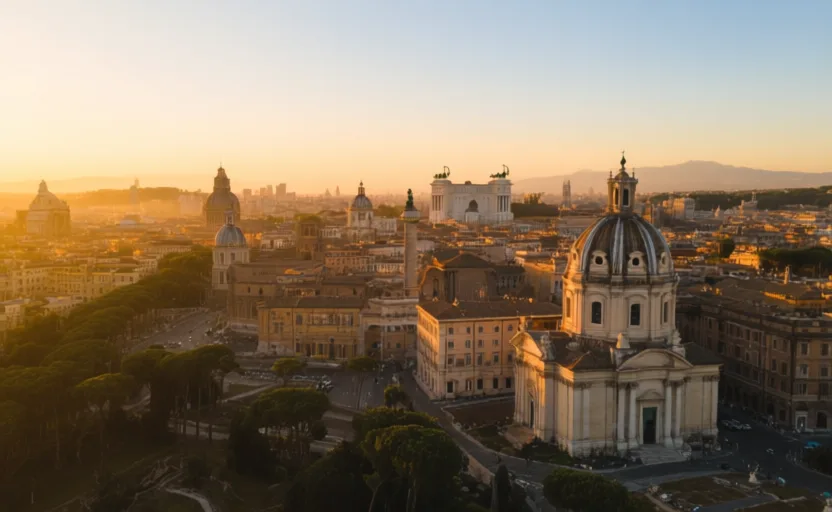 AI city illustration · Artistic impression
What people learn after moving
≈2.75 million in the comune — the largest municipality in the EU by area — and ≈4.2 million in the metropolitan city
Italian. English is common in the international-organisation and tourism layers and rare in public offices
Euro (EUR)
CET (GMT+1), CEST (GMT+2) with daylight saving from late March to late October
AI city illustration · Artistic impressionCost of living in Rome
Check your eligibility
Pick your passport to see entry rules and the long-stay routes we have researched.
Pick your passport to see whether you can enter Italy — and what it takes to stay.
The sequence is national — nulla osta, type-D visa, entry, then the permesso di soggiorno application filed on paper within eight working days at a post office — but Rome's execution of it is the slowest in Italy, because the Questura here carries the largest caseload of any province. Learning to live on the postal receipt, which is legally sufficient, is the practical skill. Residence registration runs separately through your municipio and includes a municipal police visit to confirm you live where you say you do.
EU licences work indefinitely. Licences from countries with a reciprocity agreement convert administratively; everything else means the Italian theory and practical exams, in Italian, within one year of registering residence. Rome then layers several distinct limited-traffic zones over the historic centre plus a city-wide low-emission Fascia Verde, all camera-enforced. Rome is also the large Italian city where a car is most tempting and least useful — three metro lines for 1,285 square kilometres.
You need a codice fiscale to open anything, and Italian banks distinguish between resident and non-resident accounts, the latter costing more. The fastest route to a working Italian IBAN in Rome is a digital bank while a traditional branch appointment is pending. The more consequential piece of admin is SPID, the national digital identity — without it, everything from the tax portal to specialist medical bookings to your municipio's services means queueing in person.
SSN registration is compulsory and free for employees, the self-employed and their families, and voluntary for students, elective residents and some permit holders — who since 1 January 2024 pay an income-based contribution with a €2,000 annual minimum for most adults rather than the old flat fee. Registering assigns you a medico di base, who is the gatekeeper for every referral and prescription. Lazio's waiting lists are longer than Lombardy's, and knowing how to work the CUP system matters.
Italian mobile is cheap and there is no anonymous SIM: every card, prepaid included, must be registered to an identity document and a codice fiscale. Fixed connectivity in Rome is good in the modern quartieri and patchy in the historic centre, where façade and interior protections plus condominium politics can make a fibre installation genuinely hard. Ask about the connection before you sign the lease, not after.
Residence for tax follows anagrafe registration or having your habitual abode or centre of interests in Italy for more than 183 days in the calendar year, and residents are taxed on worldwide income. Rome adds a municipal IRPEF surcharge at the top of the permitted range under its debt repayment arrangement, on top of Lazio's regional surcharge. The impatriate regime was substantially rewritten for anyone moving from 2024, and Rome's large population of international-organisation staff sits under an entirely separate treaty regime that is frequently confused with it.
Each guide has verified costs, timelines, required documents, and the non-obvious gotchas — sourced from official government pages. Last verified August 2026.
Reading a list isn’t learning it. Globe Quest turns these into a trainer — hear each phrase spoken, drill them with spaced repetition, and get scored as you say them out loud.
The Ufficio Immigrazione in Rome handles the largest caseload of any Italian province, and the gap between filing the postal kit and holding the physical permesso di soggiorno routinely runs many months, sometimes past a year. The postal receipt is legally sufficient proof of lawful stay and is what banks, employers and the comune should accept — but you will meet counter staff who ask for the card. Keep the receipt, the appointment slip and a copy of the kit together, and learn the phrase 'ricevuta postale di richiesta del permesso di soggiorno'. Travel outside Italy on a receipt alone is the real constraint: re-entry is generally possible via a direct flight to Italy, but transiting another Schengen state is risky.
The tax code is free, same-day and unlocks everything. Residence registration then goes through the anagrafe of your municipio — Rome has fifteen, each with its own counters and its own queue culture, and the difference between a well-run one and a struggling one is measured in weeks. Registration takes effect from the day you declare it and the comune has 45 days to verify. Book online through Roma Capitale's portal rather than turning up; walk-in slots at the busier municipi disappear before the doors open.
Rome is not one housing market. Prati is calm, bourgeois and well served; Pigneto and Centocelle are a third cheaper and a different city socially; the centro storico is beautiful, expensive, noisy and increasingly emptied of residents by short lets; EUR is 1930s rationalist office country with good transport and no soul after eight. Commutes vary from fifteen minutes to an hour for the same nominal distance because the metro is only three lines. Visit at 8am on a Tuesday and again at 11pm on a Saturday before signing anything.
Rome operates several limited-traffic zones — the centro storico, the Tridente, Trastevere, San Lorenzo, Testaccio — each with its own active hours, plus the Fascia Verde, a large low-emission zone covering most of the city inside the ring road. They are camera-enforced with no barriers, the signage is easy to miss on a first pass, and a single wrong turn produces a fine per crossing. Foreign plates are pursued through international recovery agents months later. If you drive, check the current hours on Roma Mobilità before every trip into the centre — they change seasonally and for events.
For transfers of residence from 2024, D.Lgs. 209/2023 exempts 50% of qualifying employment or professional income up to €600,000 a year for five tax periods, conditional on a high qualification, three prior years of non-residence and a four-year commitment to stay. The old 70% and 90% figures still dominate search results and are wrong for anyone moving now. Separately, staff of the UN agencies headquartered in Rome — FAO, WFP and IFAD — hold a distinct tax status under international agreements that has nothing to do with the impatriate regime; do not read guidance for one as guidance for the other.
On top of national IRPEF and Lazio's regional surcharge, Rome levies a municipal addizionale at the maximum the law allows, tied to the city's long-running debt repayment plan. Two people on identical salaries, one in Rome and one in a comune that levies little or nothing, take home visibly different amounts. It is a small percentage but it is the kind of thing nobody mentions in a job negotiation, and it applies from the year in which you are resident on 1 January.
Italian ministries, Camera and Senato, Corte dei Conti, Bank of Italy, Agenzia delle Entrate
Rome is a capital in the fullest sense: national government, the regional government of Lazio and the city are all here, and public employment underpins the local economy in a way it does in no other Italian city.
FAO, WFP, IFAD, NATO Defense College, the Holy See, around 140 embassies
Rome hosts the UN's three food and agriculture agencies plus dual accreditation to Italy and the Holy See, giving it one of the largest diplomatic communities in the world and a genuinely English-speaking professional layer.
Leonardo, Thales Alenia Space, Avio, Telespazio, Elettronica
Lazio is Italy's aerospace heartland, with Leonardo headquartered in Rome and satellite and launcher work concentrated along the Tiburtina corridor and at Colleferro.
Eni, Enel, Terna, Snam, Acea
Several of Italy's largest listed companies by revenue are headquartered in Rome rather than Milan, and the energy transition has made these among the city's best-paying private employers.
Cinecittà, Rai, Sky Italia, Netflix Italian productions
Cinecittà has been rebuilt and expanded with recovery-fund money and is booked heavily by international productions; Rai's headquarters and much of Italian television production sit in the north of the city.
Parco Archeologico del Colosseo, Musei Vaticani, hotel groups, tour operators
Around thirty million visitors a year sustain an enormous hospitality sector, with the 2025 Jubilee having driven a further wave of hotel investment and public works across the centre.
Landmark · Centro storico
The amphitheatre and the archaeological spine of the ancient city running to the Palatine.
Local tip: Residents of Rome can buy an annual pass to the archaeological park for the price of about two tickets, which turns the Forum into a place you walk through on a Sunday rather than a day out. Tickets are timed and the underground and arena levels sell out weeks ahead.
Neighborhood · West bank, south of the Vatican
Ochre lanes, ivy, and the old working-class quarter that became the city's most photographed neighbourhood.
Local tip: West of Viale di Trastevere is the tourist half. East of it, toward Piazza San Cosimato, is where people actually live and where the morning market still runs. The Gianicolo hill above has the best free view in Rome and a cannon fired at noon every day.
Food · South of the centre, on the Tiber
The old slaughterhouse district and the birthplace of Roman offal cooking, now the city's most serious food neighbourhood.
Local tip: The covered market is the point — go before one o'clock. Monte Testaccio behind it is an artificial hill made entirely of two thousand years of broken Roman amphorae, and the clubs are built into its base.
Nature · West, above Trastevere
Rome's largest park — 184 hectares of umbrella pines, meadows and a formal garden, and almost entirely local.
Local tip: Visitors go to Villa Borghese; Romans run here. Enter from Via di San Pancrazio for the formal gardens or Via Vitellia for the open ground. Sundays it fills with families and stays quiet the rest of the week.
Neighborhood · South, along the Tiber
Industrial archaeology turned nightlife district, next to a 1920s garden-city experiment of courtyards and staircases.
Local tip: The Centrale Montemartini museum puts classical sculpture among the turbines of a decommissioned power station and is the best-value museum in Rome. Garbatella next door is a listed housing experiment and one of the few genuinely intact community neighbourhoods left inside the ring road.
Culture · Trieste, north-east of Villa Borghese
A tiny 1920s fantasy district of Art Nouveau, medieval pastiche and Assyrian ornament, built around one square.
Local tip: Four streets in total, entered under an iron arch on Via Dora, and most visitors to Rome never hear of it. Free, always open, and best in late afternoon light. Combine it with the Villa Torlonia park ten minutes away.
Side-by-side cost of living, language, climate and careers — to help you choose.