
Population
≈525,000 in the city, in a Sacramento-Roseville metro of about 2.4 million — the sixth largest city in California and its capital
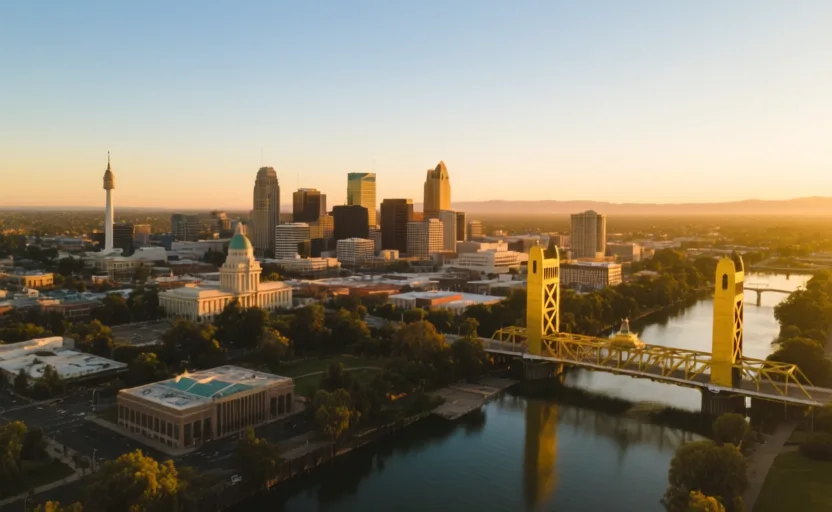 AI city illustration · Artistic impression
What people learn after moving
≈525,000 in the city, in a Sacramento-Roseville metro of about 2.4 million — the sixth largest city in California and its capital
English and Spanish, plus one of the most linguistically diverse populations in the United States — substantial Hmong, Punjabi, Russian, Ukrainian, Cantonese, Vietnamese, Tagalog and Farsi-speaking communities
United States dollar (USD)
PST (GMT-8); PDT (GMT-7) from mid-March to early November
AI city illustration · Artistic impressionCost of living in Sacramento
Check your eligibility
Pick your passport to see entry rules and the long-stay routes we have researched.
Pick your passport to see whether you can enter United States — and what it takes to stay.
There is no post-arrival registration in the US: your I-94 record is your status. In the first weeks you need a Social Security number if work-authorised, or an ITIN if not. California's distinctive pressure is timing — the DMV gives 20 days to register a vehicle you brought with you and expects a licence sooner. California is also one of the states that issues a driving credential to residents who cannot document lawful presence, marked as not valid for federal identification, which Texas will not do at all. Sacramento's practical advantage over the Bay Area is office density: the DMV is headquartered here and there are field offices across the county and into Yolo, Placer and El Dorado, so appointment waits are usually shorter than in San José.
California gives you 20 days from becoming a resident to register a vehicle you brought with you, and expects a licence sooner than that. Registering an out-of-state vehicle generally requires a smog certification from a licensed station, and California's registration includes a value-based vehicle licence fee that makes it markedly more expensive than most states. Two local driving conditions have no equivalent in the Bay Area: tule fog, the dense Central Valley ground fog of December and January that has historically caused the state's worst pile-ups, and the Sierra passes, where chain controls and closures on I-80 and US-50 are routine in winter and where an unprepared car is a genuine problem.
You can open a US account without a Social Security number: federal rules let a bank use your passport number and country of issuance, or an ITIN, as the identifying number. Sacramento's local advantage is its credit unions — several of the largest in California grew out of state employment and their membership routes are far broader than the names suggest, which makes them the most accessible car and personal finance for someone with no credit file. On the utility side there is nothing to shop for: SMUD is the community-owned electricity supplier and everyone in the city gets it. What you should do instead is understand its time-of-use rate structure, because in a climate that runs air conditioning from June to September, shifting load out of the late-afternoon peak is worth real money.
Coverage comes from an employer, from Medi-Cal, or from Covered California — the state-run marketplace, which is where individual plans are bought here rather than HealthCare.gov. California expanded Medi-Cal substantially, including extending full-scope eligibility to income-qualifying adults in age bands the rest of the country does not cover, so there is a genuine safety net underneath a low income here in a way there is not in Texas. The state's 2025 budget made changes to Medi-Cal enrolment and cost-sharing for some adult groups, so check the current position with the Department of Health Care Services rather than an older guide. Sacramento's own advantage is UC Davis Medical Center: the academic hospital and the only Level I trauma centre, adult and paediatric, for a very large inland catchment.
The US has no SIM registration requirement, so getting connected is trivially easy: buy a prepaid SIM or eSIM and it works immediately. The friction is postpaid contracts, which run a credit check you cannot pass on arrival. Locally, the thing to set up in week one is alerting. Sacramento County runs its own emergency notification system for evacuation orders and flood warnings, and you have to opt in — it is not automatic like the federal wireless alerts. Register your address with it, keep the federal alerts switched on as well, and note that public safety power shutoffs during high fire risk are a routine part of Northern California life, though far less common inside the city than in the foothills.
California has the highest top marginal state income tax rate in the United States, reaching 13.3% including the mental health services surcharge on very high incomes, and State Disability Insurance has been deducted from every dollar of wages since the wage ceiling was removed in 2024. None of that is different in Sacramento — it is state law. What is different from the Bay Area is everything the rate is applied to and everything sitting alongside it: sales tax is 8.750% in the City of Sacramento and 7.750% in the unincorporated county, against 9%-plus across most of Santa Clara County, and Proposition 13 pins your property's taxable value to a purchase price that is a fraction of a Bay Area one. Check separately for Mello-Roos special taxes, which are widespread in the newer suburbs, and for the flood control assessment, which is specific to this valley.
Each guide has verified costs, timelines, required documents, and the non-obvious gotchas — sourced from official government pages. Last verified August 2026.
Reading a list isn’t learning it. Globe Quest turns these into a trainer — hear each phrase spoken, drill them with spaced repetition, and get scored as you say them out loud.
Sacramento sits at the confluence of the Sacramento and American rivers, partly below the level of high water, and is routinely described as one of the most flood-vulnerable large cities in the United States. The Natomas basin was under a federal building moratorium from 2008 until 2015 after its levees were decertified, and Folsom Dam's auxiliary spillway was only completed in 2017. Property owners pay a Sacramento Area Flood Control Agency assessment, and lenders require flood insurance in mapped high-risk zones. Look the address up on FEMA's flood map service centre before you sign anything, and ask specifically what the flood insurance costs.
The DMV gives 20 days to register a vehicle you brought into the state, and expects a California licence sooner than that. Registering an out-of-state vehicle generally requires a smog certification first, done at a licensed station rather than at the DMV, and California's registration includes a value-based vehicle licence fee that makes it substantially more expensive than most states. Sacramento has more DMV field offices within a short drive than most California metros, and the DMV's own headquarters is here — but the appointment queue is still the binding constraint, so book on day one and gather documents afterwards.
SMUD is a publicly owned, not-for-profit utility governed by a board elected by the people it serves — not the investor-owned utility that supplies most of Northern California. Residents moving from the Bay Area consistently report the summer bill as one of the largest single savings of the move. There is nothing to choose and no plan to shop for, unlike deregulated Texas; you simply get SMUD. What you should do is look at their time-of-use rate structure, because in a climate where air conditioning runs from June to September, shifting load out of the late-afternoon peak is worth real money.
The State of California is the largest employer in the region, and state civil service does not work like private hiring: most classifications require passing an examination, which places you on an eligibility list, from which departments then interview. You apply for the exam and the job separately, and the sequencing catches newcomers out badly. Most classifications require legal authorisation to work but not US citizenship — check the specification for the class you want rather than assuming either way.
California pegs a property's taxable value to its purchase price and limits growth to roughly 2% a year until it sells, when it is reassessed. Your neighbour's bill therefore tells you nothing about yours, and you should budget from the purchase price. Then check separately for Mello-Roos special taxes, which fund infrastructure in newer developments and are widespread in Natomas, Elk Grove, Rancho Cordova and Folsom. They sit on top of ordinary property tax, they are disclosed at sale, and they are easy to miss in a rental listing while still being priced into the rent.
Sacramento's record high is 116°F (47°C), set in September 2022, and stretches above 40°C are ordinary. The Delta breeze makes the evenings liveable and the humidity is low, which is why locals insist it is nothing like Houston — but the daytime heat is a real health risk. Late summer and autumn also bring wildfire smoke from the Sierra and the coast ranges, which has repeatedly produced some of the worst air quality readings in the world for days at a time. A decent air purifier and a set of N95 masks are standard local equipment, not paranoia.
The State of California, the Legislature, CalPERS, CalSTRS, the Judicial Council, Sacramento County, the City of Sacramento
The state is by a wide margin the largest employer in the region, and the concentration of departments, agencies, boards and the two pension funds gives Sacramento an unusually stable and unusually bureaucratic employment base. Around it sits a whole industry of lobbying, policy consulting, associations and government affairs — the closest thing California has to a Washington economy.
UC Davis Health, Sutter Health (headquartered in Sacramento), Kaiser Permanente, Dignity Health, Shriners Children's Northern California
UC Davis Medical Center is the region's academic hospital and runs the only Level I trauma centre — adult and paediatric — for a very large inland catchment, so serious cases from across northern California route here. Sutter Health, one of the largest non-profit systems in the state, is headquartered in the city. Health care is the largest private employment sector in the metro.
Intel's Folsom campus, L3Harris (formerly Aerojet Rocketdyne) at Rancho Cordova, Centene and Health Net, Oracle's regional operations, a large Bay Area-remote workforce
Intel's Folsom site is its largest in California and is a genuine engineering centre rather than a satellite office. Aerojet Rocketdyne built rocket propulsion at Rancho Cordova for decades and is now part of L3Harris. The fastest-growing part of this sector is people employed by Bay Area companies who live here — a migration pattern that reshaped the housing market from 2020 onward.
Blue Diamond Growers (headquartered here), Raley's, Nugget Markets, Pacific Coast Producers, the rice, tomato, almond and wine industries of the Sacramento Valley and Delta
Sacramento sits in one of the most productive agricultural regions on earth, and Blue Diamond — the world's largest almond processor — is headquartered in the city. The Farm-to-Fork designation is downstream of a real supply chain: this is one of the few American cities where the restaurants and the growers are in the same county.
UC Davis and UC Davis Health, California State University Sacramento, the Los Rios Community College District, McGeorge School of Law
UC Davis is twenty minutes west and is a global centre for agricultural, veterinary and viticultural science, with its medical school and health system in Sacramento itself. Sacramento State and the four-campus Los Rios district make higher education one of the larger employment blocks in the metro and the main pipeline into the state civil service.
SMUD, the California Energy Commission, the California Air Resources Board, the Independent System Operator, a regional EV and battery supply chain
SMUD is one of the largest community-owned electric utilities in the United States and has committed to an aggressive decarbonisation timetable, which makes it a genuine employer of energy engineers rather than just a billing entity. Because the state's energy and air regulators are headquartered here, Sacramento carries an unusual concentration of energy and climate policy jobs for a city its size.
Landmark · Downtown, between 10th and 15th
An 1874 neoclassical capitol with a restored 19th-century museum wing inside, set in a forty-acre park planted as an arboretum of trees from around the world.
Local tip: The building is open to the public and free, and you can sit in the galleries when either house is in session — which is a genuinely interesting hour and something almost no resident has done. Capitol Park's trolley-era tree collection is labelled; the camellia grove in February is the local secret.
Culture · Riverfront, west end of downtown
Boardwalks and gold-rush-era buildings on the Sacramento River, with one of the largest railroad museums in the world — restored locomotives, a full-size roundhouse collection and the story of the transcontinental line that started here.
Local tip: The waterfront itself is touristy; the railroad museum is world-class and worth an afternoon even if you do not care about trains. Walk out onto the golden Tower Bridge at sunset and then eat in West Sacramento on the other side, which is where the newer restaurants have gone.
Neighborhood · East of downtown, roughly 16th to 29th
The city's densest and most walkable district — Victorian and craftsman houses on a numbered-and-lettered grid, with restaurants, bars, galleries and independent shops layered along the alphabet streets.
Local tip: Second Saturday is the monthly art walk and the single best way to meet people in your first month here. The Sunday farmers' market under the W-X freeway is one of the best in the country precisely because of what grows within an hour's drive.
Nature · Along the American River, downtown to Folsom Lake
Roughly 32 miles of riverside parkland with the paved Jedediah Smith Memorial Trail running its length, plus swimming holes, salmon runs, rafting put-ins and a genuinely wild stretch of river inside a city.
Local tip: Rafting from Sunrise to Sacramento Bar on a summer Saturday is the local rite of passage. For the rest of the year, the trail is the best cycling infrastructure in inland California — you can ride from downtown to Folsom Lake without meeting a car.
Culture · Downtown, near the river at 3rd and O
The oldest art museum in the American West, founded in 1885, in a restored Victorian mansion joined to a large modern pavilion — strong on California art and on Californian ceramics in particular.
Local tip: Pay-what-you-wish on the first Sunday of the month, and the Friday evening ArtMix events are a real social fixture rather than a museum-marketing exercise. The original Victorian ballroom upstairs is the thing to see.
Nature · South-west of the city, along CA-160
The Sacramento-San Joaquin Delta — a thousand miles of sloughs, levee roads, pear orchards and drawbridges, with Locke, the only town in America built by Chinese immigrants for Chinese immigrants, still standing on its levee.
Local tip: Drive CA-160 south along the levee on a weekday and stop in Locke and Walnut Grove. It is forty minutes from Midtown, almost nobody goes, and it is the most genuinely unusual landscape within reach of the city.
Side-by-side cost of living, language, climate and careers — to help you choose.