
Population
≈340,000 in the canton itself; roughly 2 million across the Greater Metropolitan Area of the Central Valley
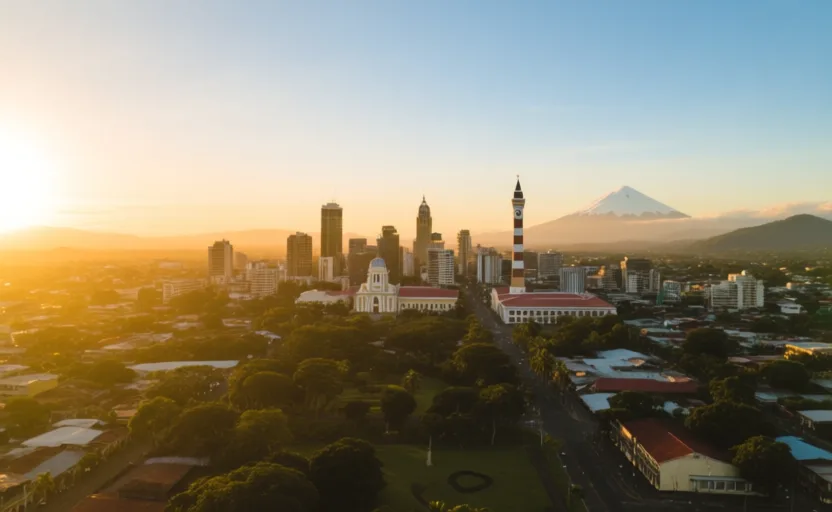 AI city illustration · Artistic impression
What people learn after moving
≈340,000 in the canton itself; roughly 2 million across the Greater Metropolitan Area of the Central Valley
Spanish. English is widely spoken in the free zones, Escazú and the tourism sector, and much less so elsewhere
Costa Rican colón (CRC). US dollars are widely accepted and property, rents and larger services are frequently priced in them
CST (GMT−6) — Costa Rica does not observe daylight saving
AI city illustration · Artistic impressionCost of living in San Jose
Check your eligibility
Pick your passport to see entry rules and the long-stay routes we have researched.
Pick your passport to see whether you can enter Costa Rica — and what it takes to stay.
Costa Rica's categories are unusually legible — pensionado on USD 1,000 a month of lifetime pension, rentista on USD 2,500 a month of guaranteed income, inversionista on USD 150,000 invested, plus a Ley 10008 remote-work stay and a difficult employer route. Three years of temporary residence opens permanent residence. The two things that surprise people are how long the DGME takes and that CAJA enrolment is a legal condition of the status rather than an optional health plan.
A tourist may drive on a foreign licence for the period of lawful stay; a resident must obtain a Costa Rican licence, which for most nationalities is an exchange with a medical examination rather than a full test. Vehicle ownership carries two recurring obligations that dominate the cost: the marchamo, an annual circulation charge bundled with compulsory insurance and paid in December, and the periodic RTV roadworthiness inspection. Central San José also operates a plate-based weekday driving restriction.
A DIMEX is what opens a full Costa Rican bank account; some institutions will open a limited account for a non-resident with a passport, but the useful products need residence. State banks — Banco Nacional and Banco de Costa Rica — have the widest branch networks and handle most government payments; private banks like BAC Credomatic offer better digital service. Accounts in colones and dollars sit side by side and most residents hold both.
Enrolment in the CAJA is compulsory for residents and is checked at every residence renewal. Contributions are assessed on declared income rather than charged as a flat premium. What you get is comprehensive cover with waiting lists for non-urgent care, which is why a large share of residents in the Central Valley also use private hospitals — CIMA in Escazú, Clínica Bíblica and Hospital Metropolitano — paying directly or through insurance.
Costa Rica opened its telecoms market in 2011 and now has genuine competition between Kölbi (the state operator ICE), Liberty and Claro. Prepaid works on a passport; postpaid and fixed services want a DIMEX. Fibre coverage in the Central Valley is good in the flat urban districts and noticeably patchier as you climb the valley sides into Escazú's and Santa Ana's hillside developments.
Costa Rica taxes on the territorial principle: income arising from services rendered, capital used, property located and rights exploited in Costa Rica is taxable, and income genuinely sourced abroad generally is not. That is a real and durable advantage, and it is routinely overstated into a claim that foreigners here pay no tax. Employment income is withheld at source; independent income requires registration and filing; and property held through a company brings annual obligations of its own.
Each guide has verified costs, timelines, required documents, and the non-obvious gotchas — sourced from official government pages. Last verified August 2026.
Reading a list isn’t learning it. Globe Quest turns these into a trainer — hear each phrase spoken, drill them with spaced repetition, and get scored as you say them out loud.
Costa Rica requires every resident to be registered with and contributing to the Caja Costarricense de Seguro Social. It is checked when your residence is approved and again at every renewal — an unpaid CAJA account will stall a renewal outright. Contributions are calculated on your declared income rather than being a flat premium, so a retiree declaring a USD 2,500 monthly income pays substantially more than a modest fixed amount. Budget for it as a permanent monthly line, and note that it buys you real healthcare rather than being a pure tax.
Costa Rica taxes on the territorial principle under Ley 7092: income from services rendered, capital used and property located in Costa Rica is taxable, and income genuinely sourced abroad generally is not. That is a real advantage. What it is not is a blanket exemption. Income you earn from Costa Rican clients or a Costa Rican company is Costa Rican-source however it is paid, the territorial rule has been narrowed in specific cases involving passive income in international structures, and holding property through a company brings its own annual filings. Get the source of each income stream determined properly rather than assuming the shorthand covers you.
The 2021 law that lowered the investor threshold to USD 150,000 also attached genuine benefits — one-off duty-free import of household goods, up to two vehicles free of import taxes and VAT, a 20% reduction in property transfer tax, and exemption from income tax on the sums declared to qualify. Those benefits were available to people who applied within the law's first five years, and applicants who got in keep them for ten years from the grant. Confirm directly with the DGME whether the window is still open before you plan a container shipment or a car import around it.
Costa Rica has postal codes on paper and essentially nobody uses them. Directions are given as a distance and a compass direction from a known landmark: '200 metres north and 50 east of the church in Escazú'. One hundred metres means one block, whatever its actual length. Landmarks sometimes no longer exist — the antiguo higuerón, a fig tree in San Pedro cut down decades ago, is still a reference point. Deliveries, taxis, utilities and your bank will all ask for a description like this. Write yours down and keep it in your phone.
San José sits at roughly 1,150 metres, which in the tropics means daytime temperatures in the mid-twenties and nights in the high teens, all year, with no air conditioning and no heating required. It is one of the most comfortable urban climates anywhere. From May to November expect clear mornings and a hard afternoon downpour — plan meetings before two o'clock, and note that the humidity means mould in poorly ventilated flats is a genuine and common problem.
Imported goods, cars and electronics carry heavy duties, electricity is expensive despite being almost entirely renewable, and Escazú and Santa Ana are priced for an international clientele. Groceries in a supermarket cost close to North American prices; groceries at the weekly feria del agricultor do not. People arrive having budgeted for Nicaragua or Guatemala and find themselves closer to Portugal. The compensation is a functioning state, drinkable tap water and no army since 1948.
Boston Scientific, Abbott, Establishment Labs, Medtronic, Okay Industries
Costa Rica is one of the world's largest exporters of medical devices per head, concentrated in the free zones around Heredia, Alajuela and Cartago. Establishment Labs is a Costa Rican company that listed on Nasdaq.
Intel, Amazon, Microsoft, IBM, Hewlett Packard Enterprise, Emerson
Intel has manufactured and engineered in Costa Rica since 1997 and its assembly and test operation is one of the country's largest single exporters. The shared-service and engineering centres around Heredia and Belén employ tens of thousands.
Marriott, Hyatt, Costa Rican eco-lodge operators, Volaris, Avianca
Tourism is a leading source of foreign exchange, and Costa Rica's national-park system and certification schemes made it the reference case for ecotourism worldwide. San José is the hub rather than the destination.
Dole, Chiquita, Del Monte, Coopedota, Hacienda Alsacia (Starbucks)
Bananas, pineapples and speciality coffee dominate exports. The Tarrazú and West Valley coffee regions are within two hours of San José and the industry's commercial layer sits in the capital.
Banco Nacional, Banco de Costa Rica, BAC Credomatic, Scotiabank, Promerica
A banking sector split between large state banks and private groups, with BAC Credomatic operating across Central America from a San José base. The Bolsa Nacional de Valores is small but functioning.
ICE, Compañía Nacional de Fuerza y Luz, Coopelesca
Costa Rica generates almost all of its electricity from hydro, geothermal, wind and solar, and has run for extended stretches entirely without fossil fuels. ICE, the state utility, is also a major telecoms operator through Kölbi.
Food · East of the centre, beyond Parque Nacional
A residential grid of old houses turned into the country's densest concentration of restaurants, bars and coffee.
Local tip: The Paseo Gastronómico La Luz is the marketed strip; the better places are on the numbered calles either side of it. Come on a Thursday — Friday and Saturday fill with the whole Central Valley and the queues are real. Almost everything here occupies a converted 1940s family house, which is the charm.
Landmark · Central San José
An 1897 opera house built with a coffee-export levy, with a marble foyer and ceiling paintings entirely out of scale with the city outside.
Local tip: The café inside is open to anyone and is the most civilised coffee in central San José. Under the plaza is the Museo del Oro Precolombino, whose collection of pre-Columbian goldwork is world class and consistently the thing visitors remember.
Culture · Immediately north of the centre
The coffee barons' district — wooden and stone mansions from the turn of the twentieth century, now consulates, small hotels and galleries.
Local tip: The best walking in San José, and almost nobody does it. Wander north from the Parque Morazán on foot and read the plaques; several houses are open as hotels and will let you look at the interiors. Do it in daylight and it is a completely different city from the one people describe.
Nature · West of the centre, at the end of Paseo Colón
The city's big park, on the site of the old international airport — lake, running paths, football pitches and the national art museum in the former terminal.
Local tip: The Museo de Arte Costarricense occupies the original airport terminal building and is free. The park fills with families on Sundays and with runners at six in the morning; between those two hours it is the calmest large green space in the Central Valley.
Neighborhood · West of the city, up the valley side
The expatriate and corporate belt — malls, international schools, private hospitals, and hillside views over the whole valley.
Local tip: San Rafael de Escazú is the polished, expensive part; the old town of Escazú centro, a few minutes uphill, is still a Costa Rican village with a church, a soda and a Saturday feria. Living in one and shopping in the other is the trick most long-term residents learn.
Nature · 45 minutes north-east on the Guápiles highway
Primary rainforest and cloud forest, with the road cutting straight through it — 475 square kilometres beginning almost at the edge of the metropolitan area.
Local tip: You can be standing in genuinely primary rainforest less than an hour after leaving downtown San José, which is a claim almost no capital city can make. The Quebrada González sector on the Guápiles side has short marked trails and far fewer visitors than the volcano parks. Go early; the cloud comes in by midday and the road through the park is notorious in bad weather.
Side-by-side cost of living, language, climate and careers — to help you choose.