Population
≈200,000 in the municipality; close to 300,000 across San Pedro de Macorís province
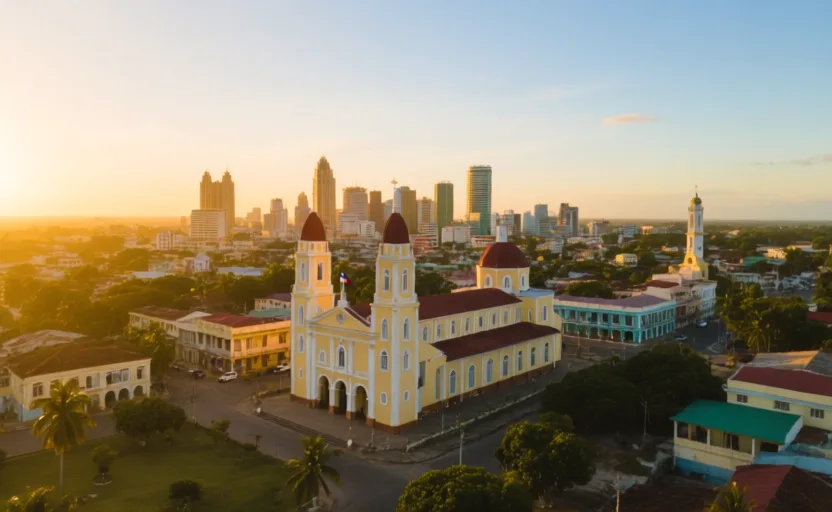 AI city illustration · Artistic impression
What people learn after moving
≈200,000 in the municipality; close to 300,000 across San Pedro de Macorís province
Spanish. Two English pockets — the cocolo community's inherited Caribbean English and the international students at UCE — but assume Spanish everywhere else
Dominican peso (DOP, written RD$). The city is a peso market; only Juan Dolio, 20 minutes west, is quoted in dollars
AST (GMT−4), no daylight saving — level with New York in summer, an hour ahead of it in winter
AI city illustration · Artistic impressionCost of living in San Pedro de Macorís
Check your eligibility
Pick your passport to see entry rules and the long-stay routes we have researched.
Pick your passport to see whether you can enter Dominican Republic — and what it takes to stay.
Dominican residency runs in a fixed order and the first step happens outside the country. You apply at a Dominican consulate for a Visado de Residencia (RS) — single entry, 60 days — whose only purpose is to let you file for residency once you land. Inside those 60 days you file for residencia temporal; the ordinary category is RT-9, the employment-sponsored one is RT-3, and there is a student category for people enrolled at a recognised Dominican institution. All are granted a year at a time, and after the first card plus four renewals you may apply for residencia permanente. Ley 171-07 is the shortcut for retirees and rentistas: a foreign pension of US$1,500 a month or foreign investment income of US$2,000 a month gets permanent residency within 45 working days. The document that actually unlocks Dominican life is the JCE cédula, applied for after residency is granted. In San Pedro the practical variable is distance: there is no embassy here and the DGM's decision desks are in the capital.
San Pedro is a city you can cross in fifteen minutes and a province you cannot navigate without transport. Inside the city, conchos run fixed corridors for a flat fare of a few tens of pesos and motoconchos do everything else; Uber coverage is thinner and less reliable than in Santo Domingo or Santiago, so cash and local numbers matter more. Out of the city, the Autovía del Este is the fast tolled road west to Santo Domingo — about an hour — and east to La Romana and Higüey, with the older Carretera Mella as the slower free alternative. Most foreign residents here end up driving, because the beach, the capital, the airport and the free-zone parks are all a road journey. INTRANT will homologate a valid foreign licence rather than make you start again, but the process needs a certification from your own embassy in the Dominican Republic, apostilled by MIREX — and every embassy is in Santo Domingo.
The cédula is the gate. With one, opening an account at Banco Popular, Banreservas, BHD or Scotiabank is straightforward; without one you are relying on branch discretion, because anti-money-laundering rules under Ley 155-17 key on identity and migratory status. Expect to be asked for a passport with the entry stamp, a DGM certification of migratory status, proof of income, a reference letter from your bank at home, and evidence of a link to the country. The San Pedro difference is that the branches here handle far fewer foreign files than a Piantini branch does, so the adviser's familiarity — not the bank's policy — decides how the appointment goes. Two practical consequences: bring more paperwork than you think you need, and be willing to open in Santo Domingo and use the local branch afterwards. Cash also matters more here. Card acceptance drops off sharply outside the supermarkets and the malls, and conchos, motoconchos, colmados and comedores are cash only.
Health cover runs through the Seguro Familiar de Salud within the Sistema Dominicano de Seguridad Social, created by Ley 87-01, and foreigners with legal residency are entitled to it. In formal employment the employer enrols you through the Tesorería de la Seguridad Social: 3.04% of salary from you and 7.09% from the employer for health, plus 2.87% and 7.10% for pensions, capped at multiples of the national minimum salary. You then choose an ARS from those authorised by SISALRIL, and almost everyone who can adds a complementary plan on top of the plan básico. What is specific to San Pedro is geography. Routine and urgent care are locally available — the city has a public regional hospital and private clinics, and the 9-1-1 system covers the eastern provinces including this one — but tertiary and highly specialised care is in Santo Domingo, an hour west along the Autovía del Este. That should shape your choice of ARS and complementary plan more than anything else: pick one whose network includes the capital hospitals you would want, not just the local clinic.
Three operators matter: Claro, Altice and Viva. Claro has the widest coverage across the eastern provinces and is the sensible default; Altice is competitive in the city; Viva is the cheapest and thinnest. The regulatory change to know is that INDOTEL's Resolución 064-2025 forced every operator to validate the identity behind every prepaid line by 30 September 2025, with suspension for those that missed it — so a SIM now requires an official document at activation and a line in someone else's name is a line you can lose. For home internet the picture is better than the country's reputation suggests: EDEESTE recorded 9.33 interruptions per client in June 2026, the lowest of the three distributors and roughly half the Cibao's rate, so a fibre connection here has a genuinely better chance of staying up. The constraint is coverage rather than power — fibre thins out quickly outside the central and newer sectors, so confirm availability at the specific address before you sign a lease on the strength of it.
The Dominican Republic taxes on a broadly territorial basis. Residents pay income tax on Dominican-source income; foreign-source income is only in scope where it comes from investments and financial gains — and Article 271 of the Código Tributario says a person who becomes resident is not taxed on foreign-source income until the third tax year of residency. Tax residency begins after more than 182 days in the country in a fiscal year. The 2026 personal brackets exempt the first RD$416,220 of annual income and then charge 15%, 20% and 25% in bands. ITBIS, the VAT, is 18%. Property owners pay IPI at 1% on the portion of their total property value above RD$10,695,494 for 2026. Two things are worth knowing specifically here. The free-zone regime under Ley 8-90 exempts qualifying companies, never their employees. And if you are buying near Juan Dolio, CONFOTUR tourism-project exemptions may apply to the property — a real benefit, and one that belongs to the development rather than to you.
Each guide has verified costs, timelines, required documents, and the non-obvious gotchas — sourced from official government pages. Last verified August 2026.
Reading a list isn’t learning it. Globe Quest turns these into a trainer — hear each phrase spoken, drill them with spaced repetition, and get scored as you say them out loud.
This is the single most misleading thing about the city. Juan Dolio is a beach resort strip in the same province, twenty minutes west, and it is a dollar-priced market: a furnished two-bed there runs roughly US$1,250–2,900 a month and a beachfront three-bed can be US$4,000. San Pedro de Macorís city is a peso market where apartments start around RD$8,000 and a three-bedroom near the free zone is about RD$16,000. That is not a small gap — it is roughly a tenfold difference at the top end. When a relocation article quotes 'San Pedro de Macorís' costs in US dollars, check which of the two it has actually priced.
The country's electricity problem is real, but it is not evenly distributed. The Superintendencia de Electricidad's June 2026 figures put EDEESTE — the distributor for the east — at 9.33 interruptions per client, against 15.56 for EDESUR in the capital and 19.51 for EDENORTE in the Cibao. That is roughly half the Santiago rate. You still want an inversor, and you should still ask whether the internet router and the water pump are on it, but the calculation here is meaningfully better than anywhere else on this site in the Dominican Republic.
San Pedro's English speakers are largely the cocolo community — descendants of migrants from Tortola, St Kitts, Nevis, Anguilla and the other English-speaking Lesser Antilles who came for the sugar mills from the late nineteenth century. Their inherited English is not the call-centre English of a Santo Domingo free zone, and it does not mean you can live here without Spanish. The other English pocket is the international student body at the Universidad Central del Este. Outside those two, assume Spanish.
There is no embassy here, the DGM's decision desks are in Santo Domingo, and the specialist hospital referral is the capital too. San Pedro is roughly an hour to an hour and a quarter west along the Autovía del Este, which is fast and tolled, or slower and free on the older Carretera Mella. Practically: batch the capital trips. If you need an embassy certification for a driving licence, a queried immigration file and a specialist appointment, do them on the same day rather than three separate ones.
The city was built by sugar and it is still shaped by the ingenios — Consuelo, Porvenir, Angelina — and the bateyes around them. The industrial free zone, opened in the early 1970s, is the modern formal employer; it once held tens of thousands of workers and is much smaller now, which is the honest version of the local labour market. The Universidad Central del Este, founded in 1970, is the third leg and the reason the city has a young transient population at all. If you are arriving without a job, those are the three places to look, and none of them recruits the way a capital employer does.
San Pedro sits on the south-eastern coast at the mouth of the Higuamo, low and exposed, and hurricane season runs 1 June to 30 November with the peak in September and October. Storm surge and river flooding are the local hazards rather than wind alone. Know your building's elevation and whether the windows are shuttered or impact-rated, keep a fortnight of water and a charged power bank, and treat a COE alert as the instruction everyone else is acting on. The rest of the year the coastal position is the city's best feature.
Zona Franca Industrial de San Pedro de Macorís tenants — textiles, footwear, light assembly and packaging
Opened in the early 1970s and once one of the country's largest free zones with tens of thousands of workers; substantially smaller today but still the city's biggest formal employer.
Ingenios Consuelo, Porvenir, Angelina and Santa Fe; molasses, alcohol and by-product processing
The industry that built the city and still the frame for its geography — mill towns, bateyes and a port on the Higuamo organised around cane.
Universidad Central del Este (UCE), founded 1970
A large private university with a medical school that recruits internationally; it is why San Pedro has a foreign student population at all and it drives a good share of the local rental market.
Cement and building-materials plants and their supply chain
Alongside textiles, the industrial base Britannica identifies for the city — heavy, local and tied to the port rather than to exports through Santo Domingo.
Puerto de San Pedro de Macorís and the free-zone freight it serves
A working river port handling sugar, molasses and free-zone cargo, and the reason the city faces its river rather than its beach.
Juan Dolio and Guayacanes hotels, condominiums and beach clubs
The resort strip twenty minutes west is in the same province and is a genuine employer, but it is a separate labour and property market priced in dollars; do not read its numbers as the city's.
Landmark · The seafront and the mouth of the Higuamo
The city's promenade where the river meets the Caribbean, with the port on one side and the old sugar-boom facades on the other.
Local tip: Go at dusk when the heat breaks and the whole city walks it. The stretch nearest the river mouth has the food stalls; the far end is quieter and better for actually seeing the water.
Landmark · Parque Duarte, central
The Gothic-revival parish church on the main square, built with sugar money and the most recognisable building in the city.
Local tip: The square around it is where the guloyas gather on the feast of San Pedro at the end of June. Otherwise it is the shadiest place to sit in the centre at midday.
Culture · North of the centre
Home of the Estrellas Orientales, in a city that has sent an extraordinary number of players to the major leagues for its size — the shortstop pipeline is a real civic fact.
Local tip: The Dominican winter league runs mid-October to a January final and tickets are a fraction of a capital game's. Go for an Estrellas–Licey fixture and sit where the drums are.
Culture · Citywide, at Christmas, San Pedro's feast day and carnival
Plumed dancers, fife and drum, and a St George and the Dragon story carried from the English-speaking Lesser Antilles by the sugar-mill migrants — inscribed by UNESCO on the Representative List of Intangible Cultural Heritage in 2008.
Local tip: The reliable dates are Christmas week and the end of June around San Pedro's feast. Ask at the Casa de la Cultura rather than trusting a listings site; the groups are small and their schedule is community-set.
Culture · About 15 minutes north of the city
A working sugar-mill town and the settlements around it — the clearest window in the country into how the industry that built this coast actually organised people.
Local tip: Go with someone local rather than alone. These are people's homes and communities, not an attraction, and the difference between a visit and a tour is who takes you.
Nature · 20 minutes west along the coast
The province's beach strip — calm reef-protected water, a long sand shelf and the hotel and condominium market that supplies most of the region's foreign residents.
Local tip: Guayacanes at the eastern end is the local beach and Juan Dolio proper is the developed one. Weekdays are empty; on a Sunday the whole of San Pedro and half of Santo Domingo are there.
Side-by-side cost of living, language, climate and careers — to help you choose.