
Population
≈190,000 in the city, with roughly 400,000 across the surrounding Donostialdea comarca — small by Spanish standards and hemmed in by hills and sea
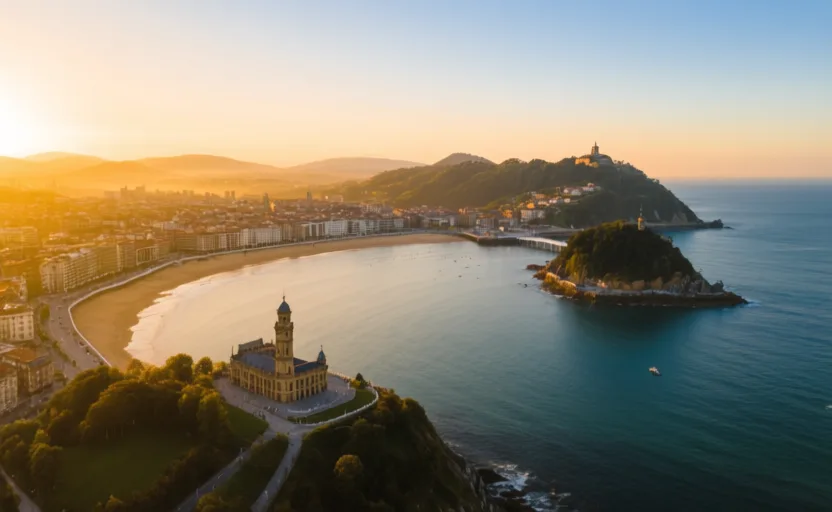 AI city illustration · Artistic impression
What people learn after moving
≈190,000 in the city, with roughly 400,000 across the surrounding Donostialdea comarca — small by Spanish standards and hemmed in by hills and sea
Castilian Spanish and Euskara, both co-official. Gipuzkoa is the most Basque-speaking province: Euskara is the medium of most schooling here and a certified level is a hard requirement for many public sector posts
Euro (EUR)
CET (GMT+1); CEST (GMT+2) from late March to late October
AI city illustration · Artistic impressionCost of living in San Sebastián
Check your eligibility
Pick your passport to see entry rules and the long-stay routes we have researched.
Pick your passport to see whether you can enter Spain — and what it takes to stay.
Spanish residency is a sequence: a NIE number, then municipal registration on the padrón, then a TIE card, then social security, then a health card. In the Basque Country the padrón does double duty, because it also establishes that you belong to the Gipuzkoa foral tax administration rather than the Spanish state agency, and gives you access to Osakidetza. Immigration itself is unchanged; almost everything downstream of it is.
EU and EEA licences are exchangeable straightforwardly. For everyone else it depends on whether Spain has a bilateral agreement with the issuing country — if it does you exchange without a test, if not you take the full Spanish exams in Spanish. The six-month clock starts when you become resident. Donostia is small, dense and comprehensively walkable, with the Mugi card covering buses, the Euskotren and Renfe across Gipuzkoa; parking is scarce and expensive and most central residents do not own a car.
Spanish banks distinguish sharply between resident and non-resident accounts, and the non-resident version carries higher fees and a certificate that must be renewed. With a NIE and a padrón certificate you qualify for a resident account. In Gipuzkoa the local cooperative banks — Kutxabank and Laboral Kutxa — hold very large market shares and dense branch networks, and Laboral Kutxa in particular is rooted in the Mondragón cooperative movement that shapes the provincial economy.
Osakidetza consistently rates at or near the top of Spanish regional health service comparisons on access, waiting times and outcomes. The route in is the standard Spanish one — padrón, then social security registration, then the health card — but what you get at the end is materially better than the Spanish average. The Hospital Universitario Donostia is the referral centre for the whole province. The card is Basque, the entitlement is Spanish, and the two are administered by different bodies.
Spain requires every SIM to be registered against an identity document, so there is no anonymous pay-as-you-go. A prepaid SIM can be activated on a passport, which is what to do on arrival. Contract tariffs — better value and usually bundled with fibre — need a NIE and a Spanish bank account. Fibre in Donostia is good. The local wrinkles are the folded terrain of Gipuzkoa, which makes coverage vary sharply between valleys, and the French border, close enough that your phone will hop networks at the beach.
If you live in Donostia you are a taxpayer of the Diputación Foral de Gipuzkoa, not of the Spanish Agencia Tributaria. The province sets its own rates, bands, deductions and deadlines under its own Norma Foral, runs its own filing platform, and levies its own Impuesto sobre la Riqueza y las Grandes Fortunas in place of the state's Patrimonio — plus its own version of the solidarity tax on large fortunes, enacted as Norma Foral 3/2023. Spanish tax guidance written for Madrid, Valencia or Málaga describes a system you are not in.
Each guide has verified costs, timelines, required documents, and the non-obvious gotchas — sourced from official government pages. Last verified August 2026.
Reading a list isn’t learning it. Globe Quest turns these into a trainer — hear each phrase spoken, drill them with spaced repetition, and get scored as you say them out loud.
San Sebastián is repeatedly the priciest provincial capital in the country to buy in — idealista put it above EUR 6,400 per square metre in spring 2026, well clear of Madrid and Barcelona — and among the top three for rent. The reason is not fashion. The city is wedged between the Bay of Biscay and steep hills with almost nowhere left to build, on a municipal footprint a fraction of Zaragoza's. Supply cannot respond to demand here in the way it can anywhere else in Spain. Budget on the assumption that housing is your single dominant cost, and look seriously at Errenteria, Lasarte, Hernani and Irun before ruling them out.
Under the Concierto Económico, Gipuzkoa sets and collects income tax, corporate tax and its own Impuesto sobre la Riqueza y las Grandes Fortunas through the foral treasury. You do not file with the Agencia Tributaria. The rates, deductions, deadlines, forms and online platform are all different from the rest of Spain, and Spanish tax advice written for Madrid or Málaga is not merely imprecise here — it is addressed to a different authority. Find an asesor who works in Gipuzkoa specifically, and do it before your first filing rather than after.
Nobody expects a newcomer to speak Basque and Spanish works everywhere in daily life. But Gipuzkoa is the most Basque-speaking province, the D model — schooling conducted in Euskara — is the dominant choice for children here, and public sector posts in teaching, health and local government routinely carry a certified language profile as a hard requirement. If you have children who will be schooled here, the model you choose has consequences that run for years. If you want a public sector career, start learning immediately rather than eventually.
Spain's 2023 housing law lets autonomous communities declare zonas de mercado residencial tensionado, in which the rent on a new contract cannot exceed the previous one on the same property, indexed. Only Catalonia, the Basque Country, Navarre and Galicia have done so, and the Basque list has been expanding through 2025 and 2026. Given San Sebastián's prices it is an obvious candidate, but the declarations are made municipality by municipality and published by the Ministerio de Vivienda. Check the current register for your exact address before signing — it changes what a landlord can lawfully ask.
This is one of the wettest cities in the country, with rain spread through the year rather than concentrated, and often as sirimiri that simply does not stop. Winter Atlantic storms and the occasional galerna — a sudden violent squall off the sea — are part of the calendar. What you get in exchange is a summer that is genuinely comfortable when Seville is at 44°C, a landscape that stays green, and a coast that is dramatic rather than merely warm. If you are moving to Spain for reliable sun, do not move here.
The Euskotren topo runs from the city centre to Hendaye in about half an hour, Biarritz and Bayonne are inside an hour by road, and the Bayonne–San Sebastián Eurocity is a real cross-border labour market rather than a slogan. Working on one side of the border and living on the other is ordinary here — but it means two tax authorities, a bilateral treaty and, in some cases, cross-border worker status. That is a question for a specialist adviser before you accept the job, not after your first payslip.
Arzak, Akelarre, Mugaritz, Martín Berasategui, Basque Culinary Center
The city and its immediate surroundings hold one of the highest concentrations of Michelin stars per head anywhere in the world, and the Basque Culinary Center is a full university faculty of gastronomy.
Donostia International Physics Center, CIC nanoGUNE, CIC biomaGUNE, Biodonostia, Tecnalia
An unusually deep research cluster for a city of under 200,000, built around the Miramón technology park and the UPV/EHU and Tecnun campuses — materials, nanoscience and biomedicine in particular.
Danobat, Soraluce, CAF (Beasain), Orona, Irizar, Ampo
Gipuzkoa is one of Europe's densest capital-goods clusters, much of it structured as worker cooperatives, with trains, lifts, coaches and machine tools exported worldwide from towns within half an hour of the city.
Ibermática, Vicomtech, LKS Next, Ttarttalo studios, Miramón park tenants
A small but real software sector anchored on the technology park and the applied-research centres, with strong specialisation in computer vision, industrial AI and health tech rather than consumer startups.
Zinemaldia (San Sebastián Film Festival), Kursaal, Jazzaldia, Musika Hamabostaldia
A high-value, low-volume tourism economy plus one of Europe's major A-list film festivals every September, which fills the city and its hotels for a fortnight.
Osakidetza, Hospital Universitario Donostia, Diputación Foral de Gipuzkoa, Ayuntamiento
The Basque health service and the foral and municipal administrations are among the largest employers in the city — and the roles that most often carry a certified Euskara requirement.
Nature · The bay, and the hill closing its eastern end
The scallop-shaped bay that made the city's name, with a promenade of white railings and a wooded fortified hill at one end.
Local tip: Walk up Monte Urgull rather than taking the funicular up Igueldo on your first day — it is free, it takes twenty minutes, and the view down over the bay from beside the Christ statue is the one that explains the city's shape. The path round the seaward side is almost empty and comes out at the aquarium.
Food · Between Monte Urgull and the river
A tight grid of streets behind the harbour holding one of the highest densities of pintxo bars anywhere.
Local tip: One or two pintxos per bar, then move — bars specialise, and staying put means eating the worse half of a menu. Ask what the house does rather than pointing at the counter, order the gilda somewhere that makes it fresh, and start after 8:30pm or you will be alone with the tourists.
Neighborhood · East bank, across the Urumea
The city's surf beach and the grid behind it — younger, less formal and increasingly where people actually live rather than visit.
Local tip: Zurriola is a proper Atlantic beach with real waves, unlike the sheltered Concha, and the surf schools run year-round. Gros has the better everyday pintxo bars — Bergara and the streets around Plaza Cataluña — and locals eat there precisely because the Parte Vieja is full.
Landmark · West end of the bay
A hill closing the far side of La Concha, reached by a 1912 funicular, with a wonderfully dated amusement park on top.
Local tip: The funicular is over a century old and the park at the top is charmingly unmodernised. Go at sunset for the classic view back along the bay, then walk down the road on the seaward side to Peine del Viento — Chillida's iron sculptures set into the rocks, which are at their best in a storm rather than in sunshine.
Food · 8 km inland, up the Urumea valley
A valley of cider houses that open for the txotx season from January to April, serving a fixed menu at long shared tables.
Local tip: The ritual is the point: the menu is cod omelette, cod with peppers, a chuleta and then cheese with quince and walnuts, and you get up and fill your glass from the barrel when someone shouts txotx. Book, go with a group, and take the bus — the whole thing is designed around not driving home.
Culture · Mouth of the river, Gros side
Rafael Moneo's two translucent glass cubes on the river mouth, the city's concert hall and the home of the film festival.
Local tip: The building is best seen lit from the Zurriola bridge after dark, when the cubes glow. Its programme — Jazzaldia in July, the Musika Hamabostaldia in August, Zinemaldia in September — means the city has a serious cultural calendar running right through the season most Spanish cities go quiet.
Side-by-side cost of living, language, climate and careers — to help you choose.