
Population
≈570,000 in the district; the oldest surviving Spanish city in Colombia, founded on 29 July 1525
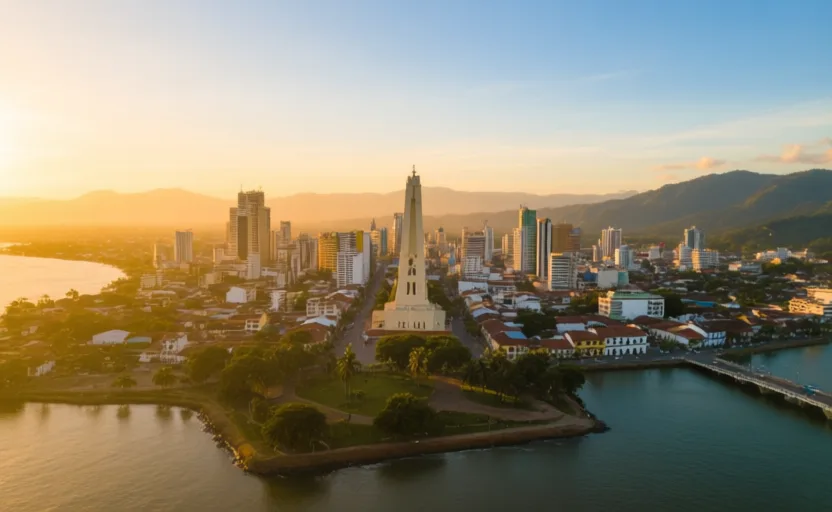 AI city illustration · Artistic impression
What people learn after moving
≈570,000 in the district; the oldest surviving Spanish city in Colombia, founded on 29 July 1525
Spanish, in a costeño accent that drops the final s — softer and slightly slower than Barranquilla's
Colombian peso (COP)
COT (GMT−5), no daylight saving
AI city illustration · Artistic impressionCost of living in Santa Marta
Check your eligibility
Pick your passport to see entry rules and the long-stay routes we have researched.
Pick your passport to see whether you can enter Colombia — and what it takes to stay.
Colombia sorts long stays into three classes: V (Visitante, including the digital-nomad visa), M (Migrante — work, marriage, pensionado, investment) and R (Residente). You apply online through the Cancillería portal, with a published thirty-day decision window and usually no consular interview. The step people underestimate comes after approval: any visa valid more than three months must be registered with Migración Colombia within fifteen calendar days, producing the cédula de extranjería that unlocks banking, EPS affiliation, leases and utility contracts. A tourist stamp gives 90 days, extendable to 180 days maximum per calendar year, and confers no right to reside or work. Santa Marta's own pattern is that a large share of foreigners here arrive through property or a small tourism business rather than through a job, which pushes them toward the investment route to an M visa — and that route depends on the purchase being made through Colombia's formal exchange market and registered with the Banco de la República. Get that wrong and both the visa and the eventual repatriation of your money become problems.
Santa Marta has no mass-transit system: public transport is conventional buses, busetas and microbuses on operator routes, plus taxis and the ride apps. Decreto Distrital 237 of 23 January 2026 set the urban fare at COP 2,950 without air conditioning and COP 3,050 with it, the taxi minimum at COP 8,600 and the unit at COP 121 — and required the authorised tariff to be visibly displayed in the vehicle, which is your protection against improvisation. The city is long and thin, running from the historic centre south through Gaira and El Rodadero to Pozos Colorados and Bello Horizonte, so distances are larger than the map suggests and most residents end up with a car or a scooter. Two roads matter beyond the city: the Troncal del Caribe east toward Tayrona and La Guajira, which is the only route out that way and closes for landslides in the rains, and the winding climb up to Minca, which is not a road to learn on.
The cédula de extranjería is the gate: with one you can open an account at Bancolombia, Davivienda, BBVA, Banco de Bogotá or Banco Agrario, and without one you generally cannot, because anti-money-laundering rules key on it. Until then you run on a foreign card, cash and Wise. Two national things matter more than the choice of bank. Bre-B, the Banco de la República's interoperable instant-payments scheme, has been live since 2025 and lets you pay any participating bank or wallet using a registered llave. And the 4x1000 (GMF) takes 0.4% of most withdrawals and transfers unless you nominate one account as exempt — which you have to ask for. On top of that, Santa Marta adds the exchange-control layer: money brought in to buy property must move through the formal exchange market and be registered as foreign investment, or you cannot lawfully send the proceeds back out later.
Colombia's contributory system runs through EPS insurers. Employees contribute 4% of salary with employers adding 8.5%; the self-employed pay the full 12.5% of a declared income base that cannot fall below one minimum wage — roughly COP 219,000 a month in 2026. Affiliation needs a cédula, and some visa classes, notably M-Pensionado and several V categories, cannot affiliate at all. The usual foreign setup is EPS plus a medicina prepagada plan for fast specialist access. The sector is mid-reform with several large insurers under Superintendencia intervention and 2026 rules restricting an EPS from operating where it holds too small a share of a department's members, so verify your insurer is functioning in Magdalena. Two local realities shape the rest. Complex care is generally referred to Barranquilla, about ninety minutes west along the coast. And the district's water problems have direct health consequences — stored water breeds mosquitoes, and intermittent supply is a gastrointestinal risk — which is why the housing question and the health question are the same question here.
A prepaid (prepago) SIM takes fifteen minutes, costs almost nothing and needs only your passport, which the clerk registers because the law requires the line to be in a name. The trap is the handset, not the line: Colombia runs a national IMEI database against phone theft, and a device bought abroad that is never registered gets cut off after roughly three to four weeks. Claro has the broadest coverage, Movistar and Tigo sit between, WOM is cheapest. Home fibre is straightforward along the coastal corridor from the centre through Gaira and El Rodadero to Bello Horizonte, and thin to non-existent in the Sierra foothills and out toward Minca and Tayrona — which matters, because those are exactly the places people romantically decide to live. The other local reality is resilience rather than speed: with an intervened electricity utility and an unreliable water supply, working from home here means planning for interruptions, not just for bandwidth.
Colombia taxes residents on worldwide income, and residency is a day count: 183 days or more within any rolling 365-day period. A digital-nomad visa does not exempt you and neither does being paid abroad. Rates are progressive to 39% and every threshold is expressed in UVT, a peso unit DIAN republishes each December. You register a free RUT with DIAN, then file the declaración de renta between August and October on a date fixed by the last two digits of your NIT. Santa Marta adds two layers. The district levies ICA on business and independent professional activity carried on here, filed with the district hacienda rather than DIAN. And if you let a property for stays under thirty days — which is what a very large share of foreign buyers here intend — that is a tourism activity: it requires registration in the Registro Nacional de Turismo, your building's horizontal-property by-laws must expressly permit accommodation, and the income and its consumption taxes follow from that.
Each guide has verified costs, timelines, required documents, and the non-obvious gotchas — sourced from official government pages. Last verified August 2026.
Reading a list isn’t learning it. Globe Quest turns these into a trainer — hear each phrase spoken, drill them with spaced repetition, and get scored as you say them out loud.
Santa Marta's supply problem is structural, not a bad month. Essmar declared a yellow alert as the intakes fell — the Mamatoco plant dropped from 750 to 560 litres per second and El Roble from 500 to 450 — the Río Manzanares has lost more than 70% of its flow, and the district declared a public calamity over the drought. In the 2026 high season some neighbourhoods went up to fifteen days without service, and Ideam has warned of a possible El Niño between late 2026 and early 2027 that would make it worse. Before you sign anything, ask the building three questions: how large is the storage tank, is there a working pump, and does the administration have a standing arrangement for a carrotanque. A flat without answers is a flat you will regret.
The Rodadero, Bello Horizonte, Pozos Colorados and the historic centre are priced against nightly tourist yield and holiday-home demand; Mamatoco, Los Alcázares, Gaira and the eastern barrios are an ordinary Colombian city at ordinary Colombian prices. The difference for the same square metres is roughly double. Neither market is wrong, but you need to know which one you are shopping in, because the contract, the deposit expectations and the neighbours all change with it.
The park shuts to visitors for three periods in 2026 — 1 to 15 February, 1 to 15 June, and 19 October to 2 November — at the request of the Kogui, Arhuaco, Wiwa and Kankuamo peoples, for spiritual renewal and to rest the ecosystem. Entry tariffs are set by Parques Nacionales under Resolución 551 of 19 December 2025 and rose between 2.9% and 6.1% from 1 January 2026: a non-resident foreigner pays COP 81,000 in low season and COP 96,500 in high, while Colombians, resident foreigners and CAN citizens over 25 pay COP 36,500 and COP 43,000. Yellow fever vaccination at least ten days before entry is required. Plan visiting friends around the closures rather than discovering them at the gate.
The Sierra Nevada de Santa Marta rises to nearly 5,700 m barely 40 km from the sea and is the ancestral territory of four indigenous peoples who describe themselves as the elder brothers of humanity. Access to much of it is controlled, the Ciudad Perdida trek runs only with authorised operators, and the park closures are a consequence of that authority rather than an inconvenience attached to it. Living here well means treating that as the governing fact rather than as local colour, and it is also the practical reason certain routes and sites simply are not open to you.
Air-e, which supplies Magdalena, Atlántico and La Guajira, has been under Superintendencia de Servicios Públicos intervention since 2024, and its tariff is set under that supervision. It was held at COP 796 per kilowatt-hour at the start of 2026 and rose 5.5% to COP 840.15 in June. Layer the estrato on top — estratos 5 and 6 pay a solidarity surcharge — and then layer on year-round air conditioning, and electricity becomes the second-largest line in your budget after rent. Ask for a bill from a hot month before you commit.
Magdalena ran at 36.6 homicides per 100,000 over the three years to August 2025 on the Universidad Externado's analysis — a departmental figure worse than Atlántico's, and one that reflects the wider region rather than the tourist corridor. In practice, what a resident encounters in Santa Marta is petty theft, motorbike snatching, drug offers on the Rodadero beach and the tourist-pricing hustle, not the violence behind the department's numbers. Live in the corridor most people live in, use apps rather than street cabs at night, and treat Taganga after dark with more care than its backpacker reputation suggests.
Hotels across El Rodadero, Bello Horizonte and the centre; Tayrona and Ciudad Perdida operators; Minca ecolodges
The dominant sector and the one that sets the housing market. The city passed its 500th anniversary in 2025 and the July 2026 Fiesta del Mar alone drew more than 117,000 visitors with hotel occupancy peaking near 78%.
Puerto de Santa Marta, coal and container terminals, freight forwarders
Colombia's deepest natural Caribbean port, which is why it needs no permanent dredging campaign the way Barranquilla's river channel does. Imports rose 12% and exports 17% in the first half of 2026 against the same period a year earlier.
Terminals in and around the Santa Marta–Ciénaga corridor
Magdalena's coal export corridor is a large employer and a permanent local environmental controversy — the rail line and the loading operations run alongside the tourist coast, which is exactly the tension the district has to manage.
Banana and oil palm operations in the Magdalena plain, Sierra coffee and cacao cooperatives
Bananas from the Zona Bananera and single-origin coffee from the Sierra foothills around Minca are the region's two agricultural exports, and the coffee side increasingly sells direct to visitors rather than through the commodity chain.
Universidad del Magdalena, Universidad Sergio Arboleda (Santa Marta campus)
The Universidad del Magdalena is the region's main public university and the source of most local marine-science, tourism and environmental-management graduates.
Bello Horizonte and Pozos Colorados developers, short-let management companies
A long coastal building cycle driven by second homes and holiday-let investment rather than by local demand — which is precisely why the ordinary rental market and the tourist market have diverged so far.
Neighborhood · Central Santa Marta
The oldest surviving Spanish street grid in Colombia, founded in 1525 — low colonial houses, the cathedral, and a pedestrianised square that fills every evening.
Local tip: Eat around Calle 19 and the Parque de los Novios after seven, and walk down to the malecón for the sunset over the bay with Isla El Morro in it. The centre is far better at night than by day.
Culture · Mamatoco, east of the centre
The colonial estate where Simón Bolívar died on 17 December 1830, now a museum and botanical garden with vast samán trees and the Altar de la Patria.
Local tip: Go early on a weekday. The gardens are the point rather than the house, and at eight in the morning they are empty and cool.
Nature · Sierra Nevada foothills, 45 minutes south
A small village at 600 m in the coffee foothills — waterfalls, birding, cacao and coffee fincas, and a temperature roughly ten degrees below the coast.
Local tip: Go up for the night rather than the day, and stay above the village. Locals from Santa Marta use Minca exactly the way you would use a hill station, which is the correct way to use it.
Neighborhood · Fishing bay 15 minutes north
A horseshoe fishing village turned diving and backpacker hub, with boats to Playa Grande and some of the cheapest open-water certification in the Americas.
Local tip: Come for the diving and the fish lunch on the beach, go back over the hill before it gets late. Its reputation is mixed for reasons, and the road in and out is the constraint.
Nature · 35 km east along the coast
Jungle running straight into the Caribbean, with boulder-strewn bays, howler monkeys and archaeological terraces — and three annual closures at the request of the Sierra peoples.
Local tip: Enter at Calabazo rather than El Zaino for the longer, emptier walk in via Pueblito. Check the closure calendar and your yellow fever certificate before you set out.
Nature · Inside the Tayrona boundary, reached from the city side
A calm, wide bay inside the park's western end, reachable in half an hour from the city on a rough road, with a separate and much cheaper entrance fee.
Local tip: Bahía Concha entry was set at COP 15,000 for 2026 — a fraction of the main park — and on a weekday morning it is close to empty. Take your own water and shade; there is little of either.
Side-by-side cost of living, language, climate and careers — to help you choose.