Population
≈1.0 million in the Distrito Nacional; ≈3.5 million across Greater Santo Domingo
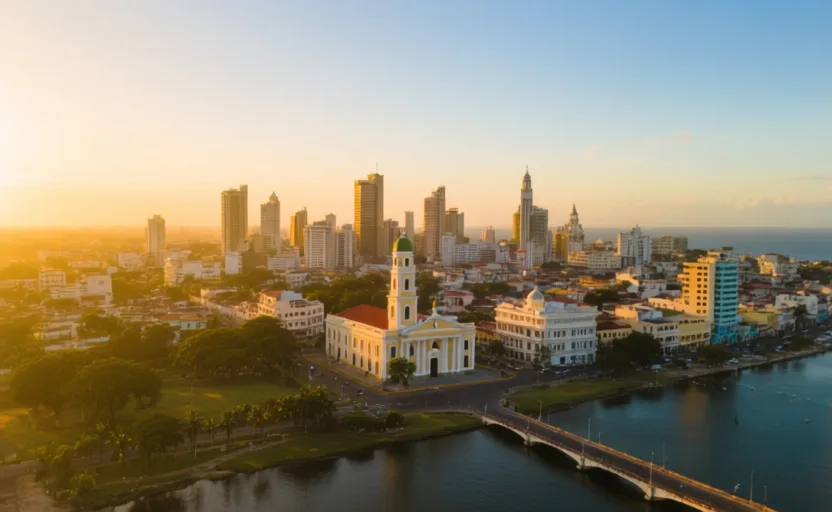 AI city illustration · Artistic impression
What people learn after moving
≈1.0 million in the Distrito Nacional; ≈3.5 million across Greater Santo Domingo
Spanish, in a fast Caribbean accent that drops final -s and swallows -r; English is common in banking, the free zones and the call centres
Dominican peso (DOP, written RD$) — but rents above roughly US$700 are usually quoted in dollars
AST (GMT−4), no daylight saving — level with New York in summer, an hour ahead of it in winter
AI city illustration · Artistic impressionCost of living in Santo Domingo
Check your eligibility
Pick your passport to see entry rules and the long-stay routes we have researched.
Pick your passport to see whether you can enter Dominican Republic — and what it takes to stay.
Dominican residency runs in a fixed order and the first step happens outside the country. You apply at a Dominican consulate for a Visado de Residencia (RS), a single-entry visa valid 60 days whose entire purpose is to let you file for residency after you land. Inside those 60 days you file with the DGM in Santo Domingo for residencia temporal — the ordinary category is RT-9 — which is granted for one year at a time. After the first card and four renewals you may apply for residencia permanente, which is issued for one year and then in four-year cards. Separately, Ley 171-07 gives pensioners and rentistas with foreign income a fast track: permanent residency within 45 working days rather than five years of renewals. Whichever route you take, the document that actually unlocks Dominican life is the cédula de identidad for foreigners, issued by the JCE once your residency is approved — no bank account, lease, notarial act or utility contract works properly without it.
Santo Domingo is the only Dominican city with a metro — two lines plus a cable car — and since July 2026 it has an integrated fare: RD$20 for a Metro-only trip, or a maximum of RD$35 if you connect within 90 minutes to the Teleférico, an OMSA bus or one of the bus corridors. That covers a useful north–south and east–west spine but not the whole city, so most people combine it with Uber, with conchos (shared route cars that run fixed corridors) and with motoconchos. If you want to drive, INTRANT will homologate a valid foreign licence rather than make you start from scratch, but the paperwork is unusual: it needs a certification from your own embassy or consulate in the Dominican Republic confirming the licence is genuine and stating its category, apostilled by the Ministerio de Relaciones Exteriores.
The cédula is the gate. With one, opening an account at Banco Popular, Banreservas, BHD or Scotiabank is straightforward; without one you are relying on the branch manager's discretion, because anti-money-laundering rules under Ley 155-17 key on identity and on your migratory status. Expect to be asked for a passport with the entry stamp, a certification of migratory status from the DGM, proof of income, a reference letter from your bank at home, and evidence of a link to the country — a lease, a title deed or a company registration. Most foreigners end up holding two accounts, a peso one for salary and rent and a dollar one for savings, because Dominican banks offer both natively and the peso has weakened against the dollar every year for a decade. Until the cédula lands, live on a low-fee foreign card and Wise, and always decline the ATM's own currency conversion.
Health cover runs through the Seguro Familiar de Salud within the Sistema Dominicano de Seguridad Social, created by Ley 87-01. Foreigners with legal residency are entitled to it. If you are formally employed, your employer enrols you through the Tesorería de la Seguridad Social and the contribution is split: 3.04% of salary from you and 7.09% from the employer for health, plus 2.87% and 7.10% for pensions, all capped at multiples of the national minimum salary. You then pick an ARS — a health insurer — from those authorised by SISALRIL, with the state ARS SeNaSa as the default and Humano, Universal, Palic and MAPFRE Salud the main private ones. The plan básico covers a defined catalogue with copays; almost everyone who can afford it adds a plan complementario for private rooms, better hospital networks and international cover. Self-employed foreigners cannot easily join the contributory regime and buy private cover instead — SeNaSa's Larimar plan is the state option aimed at foreigners.
Three operators matter: Claro, Altice and Viva. Claro has the widest national coverage and is the default outside the capital; Altice is competitive in Greater Santo Domingo and bundles fibre well; Viva is the cheapest and the thinnest. The important change is regulatory: INDOTEL's Resolución 064-2025 forced every operator to validate the identity behind every prepaid line by 30 September 2025, and unvalidated lines were suspended. Registration is now real rather than nominal, which means buying a SIM requires an official identity document — cédula, passport or residency card — and a line bought in someone else's name is a line you can lose. For home internet, fibre from Claro or Altice is widely available in the Distrito Nacional at genuinely usable speeds; the constraint is not bandwidth but power, so the question to ask about any flat is whether the router and ONT sit on the building's inversor.
The Dominican Republic taxes on a broadly territorial basis and that is the headline fact. Residents pay income tax on Dominican-source income; foreign-source income is only in scope where it comes from investments and financial gains — and even then, Article 271 of the Código Tributario says a person who becomes resident is not taxed on foreign-source income until the third tax year of residency. You become tax resident by spending more than 182 days in the country in a fiscal year. The 2026 personal brackets exempt the first RD$416,220 of annual income, then charge 15%, 20% and 25% in bands. ITBIS, the VAT, is 18%. Property owners pay IPI at 1% on the portion of their total property value above RD$10,695,494 for 2026. And beneficiaries of Ley 171-07 get a distinct package on top: their declared pension or rentista income exempt from income tax, the 3% transfer tax waived on a first home, and half off the IPI.
Each guide has verified costs, timelines, required documents, and the non-obvious gotchas — sourced from official government pages. Last verified August 2026.
Reading a list isn’t learning it. Globe Quest turns these into a trainer — hear each phrase spoken, drill them with spaced repetition, and get scored as you say them out loud.
This is the mistake that costs people a flight. Dominican residency begins with a Visado de Residencia (RS) issued by a Dominican consulate abroad — a single-entry visa valid 60 days, and the first item on the DGM's own checklist. Once you land with it you have that window to file at the Dirección General de Migración in Santo Domingo. Arriving as a tourist and hoping to convert on the spot does not work, and the fix is always the same: fly home or to a third country with a Dominican consulate, apply there, and come back. Assemble your apostilled police certificate and birth certificate before you leave, because they have to be legalised and translated by a Dominican traductor judicial afterwards.
Landlords in Piantini, Naco, Evaristo Morales and Serrallés quote in US dollars; landlords in Gazcue, Los Prados, Mirador Norte and most of Santo Domingo Este quote in pesos. That is not a formality — a dollar lease transfers all the exchange-rate risk to you, and the peso has drifted against the dollar every year for a decade. If you are paid in pesos, push hard for a peso lease and get the currency written into the contract; if you are paid in dollars, a peso lease is quietly a discount.
Apagones are a fact of Dominican life and they got worse in 2026: the Superintendencia de Electricidad's own figures show Edesur clients averaging around 15–16 interruptions a month in June 2026 and Edenorte around 19, up sharply from January as air-conditioning demand climbed. Almost every decent building answers this with an inversor — a battery bank that carries lights, fans, fridge and wifi through an outage — and larger ones add a planta, a diesel generator that also runs the lifts and the water pump. Ask which you have, how many hours it holds, and whether the air conditioning is on it. A beautiful flat with neither is unliveable in August.
'Santo Domingo' colloquially means the whole metro area of roughly three and a half million people, but administratively the Distrito Nacional is one municipality and Santo Domingo Este, Norte and Oeste are separate ones in a separate province, each with its own ayuntamiento, its own rubbish collection and its own rates. Rents fall sharply as you cross the Ozama river east, and so does the commute quality — the two bridges are the bottleneck for the entire metro. Before you take the cheaper flat in Alma Rosa, drive the trip you will actually do at 7:30 on a Tuesday.
CAASD supplies the Distrito Nacional and supply is intermittent in much of it, which is why nearly every building has a cisterna at ground level and a tinaco on the roof, with a pump between them. When the mains fail for long enough you buy a camión — a tanker delivery — and when the power fails the pump stops even if the tanks are full. Ask how big the cisterna is, when it was last cleaned, and whether the pump is on the inversor. Drink bottled or filtered water: the botellón in a plastic dispenser is what every Dominican household uses and it costs very little.
Santo Domingo faces the Caribbean rather than the Atlantic, which helps, but tropical systems still close schools, airports and offices for a day or two most seasons. Practically that means: know whether your building's windows are impact-rated or need plywood, keep a fortnight of water and a charged power bank, and understand that a red alert from the COE is the signal everyone else acts on. September and October are the peak. The rest of the year the weather is genuinely superb — 25–32°C, with a short shower most afternoons in May and again in October.
Banco Popular Dominicano, Banreservas, Banco BHD, Scotiabank, APAP
The Distrito Nacional is where every Dominican bank, the Banco Central and the Superintendencia de Bancos are headquartered, concentrated in a few blocks around Avenida Winston Churchill.
Alorica, IBEX, Sutherland, Concentrix, Teleperformance
The most accessible formal job market in the country for a bilingual arrival — free-zone contact centres serving North America hire continuously and pay in pesos, with English fluency the main gate.
Medtronic, Cardinal Health, Rockwell Automation suppliers, textile and footwear plants
The Ley 8-90 free-zone regime is the backbone of Dominican exports, and the Santo Domingo and Haina-Itabo parks put a large medical-device and light-manufacturing cluster within the metro area.
Claro Dominicana, Altice Dominicana, Viva, INDOTEL-regulated ISPs, regional software shops
Two large incumbents plus a growing software and fintech scene around Piantini and Evaristo Morales; INDOTEL, the regulator, is here and sets the rules the whole country works to.
DP World Caucedo, Haina International Terminals, Aerodom, Arajet
Caucedo is one of the Caribbean's main transshipment ports and sits just east of the city; Arajet, the low-cost carrier launched in 2022, is based at Las Américas and has made Santo Domingo a genuine regional hub.
Ministries, DGII, DGM, JCE, UN agencies, IDB, embassies
As the capital this is the entire national bureaucracy plus the largest diplomatic community in the country — and, for a newcomer, the deepest concentration of English-using professional roles outside the call centres.
Neighborhood · East of the centre, on the Ozama river
The first European city in the Americas and a UNESCO World Heritage Site — the Catedral Primada, the Alcázar de Colón, cobbled streets and the pedestrian Calle El Conde running through the middle of it.
Local tip: Come at 5pm rather than midday: the stone gives its heat back, the Plaza de España fills with families, and the restaurants on Calle Las Damas and Arzobispo Meriño are half the price of the cruise-ship strip on El Conde.
Landmark · The whole southern seafront
Fourteen kilometres of Caribbean-facing boulevard that is simultaneously the city's promenade, running track, carnival route and open-air sound system.
Local tip: Sunday morning belongs to runners and cyclists; Sunday evening belongs to the car sound systems. Both are worth seeing once. The stretch by the Obelisco is the safest and best-lit for an evening walk.
Culture · Avenida Mella, north of the Ciudad Colonial
The old covered market for amber, larimar, botánica herbs and every kind of souvenir, with the Chinese quarter and its arch a few blocks along the same avenue.
Local tip: Everything in the Mercado Modelo is negotiable and the first price for a foreigner is roughly double. For larimar and amber, ask to see the piece under a UV lamp — real amber fluoresces, plastic does not.
Nature · Arroyo Hondo, north-west
Two square kilometres of palm collections, a Japanese garden, an orchid house and a river ravine — the largest botanical garden in the Caribbean and the city's lung.
Local tip: The little train tour is aimed at children but it is genuinely the best orientation. Go early on a weekday for the birdlife; by 10am on a Sunday it is school groups end to end.
Culture · Ensanche La Fe
The home of both Licey and Escogido, the two Santo Domingo clubs whose rivalry organises the Dominican winter, from mid-October to the January final.
Local tip: Buy for a Licey–Escogido game and sit in the middle tiers, not behind home plate — the noise, the brass band and the improvised choreography are the point. Season runs winter only; in summer the stadium is quiet.
Nature · Santo Domingo Este, across the Ozama
A collapsed limestone cave system holding three open freshwater lagoons, plus a fourth reached by a hand-hauled raft, inside a large park on the eastern bank.
Local tip: Go at opening time — the light shafts into the caves in the morning and the tour groups arrive from about eleven. Combine it with the Faro a Colón next door if you want the full concrete-monument experience.
Side-by-side cost of living, language, climate and careers — to help you choose.