
Population
≈1.96 million in the city — about a third of everyone in Hokkaido, in one place
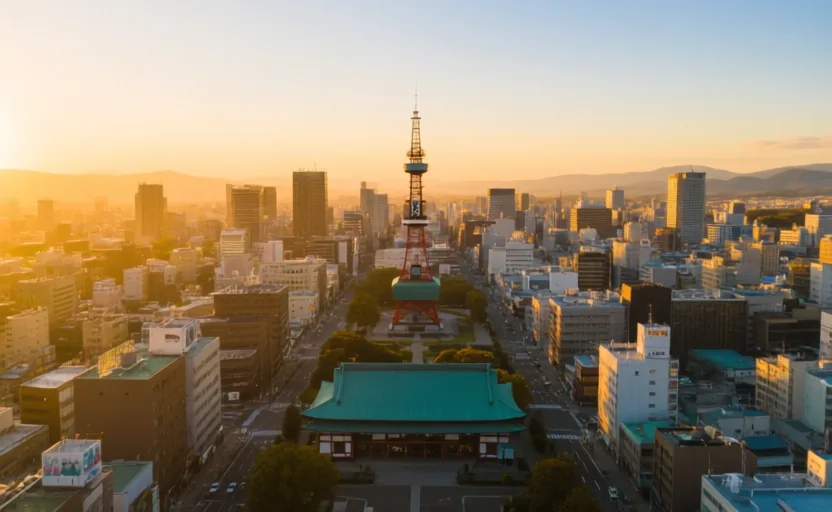 AI city illustration · Artistic impression
What people learn after moving
≈1.96 million in the city — about a third of everyone in Hokkaido, in one place
Japanese, close to the standard register with Hokkaido vocabulary rather than a strong accent. English is limited outside the university and the ski resorts
Japanese yen (JPY)
JST (GMT+9) — one time zone for the whole country, and no daylight saving despite the northern latitude
AI city illustration · Artistic impressionCost of living in Sapporo
Check your eligibility
Pick your passport to see entry rules and the long-stay routes we have researched.
Pick your passport to see whether you can enter Japan — and what it takes to stay.
Japan hands you a residence card at the airport, which is efficient and misleading — the card alone does nothing administratively. What matters is filing a move-in notification at the correct one of Sapporo's ten ward offices within fourteen days. That produces the jūminhyō certificate, starts your My Number, and is the precondition for health cover, a bank account and a phone. Sapporo also hosts the only immigration bureau on the island, which is a convenience for residents here and a day's travel for everyone else in Hokkaido.
Converting a foreign licence — gaimen kirikae — needs a knowledge check and, unless your country is on the exemption list, a practical test on a closed course that fails competent drivers routinely, and the whole procedure was tightened nationally on 1 October 2025. The three-month presence rule blocks more applications than the test does. Beyond that, Sapporo is the one Japanese city where a car is genuinely useful and genuinely demanding: the 1990 spike tyre law legislated studded tyres out of use, studless winter tyres are effectively compulsory, and you cannot register a vehicle at all without first proving you have somewhere off-street to park it.
Several major Japanese banks will not open a full account until you have six months of residence — an internal policy, not a law, and one that catches people in their first week. Japan Post Bank and the online banks do not apply it, so they are almost every foreign resident's first account. In Hokkaido there is a second consideration: North Pacific Bank and Hokkaido Bank between them hold the branch and ATM network outside Sapporo, and a good deal of winter administration — kerosene deliveries, neighbourhood levies, small landlords — still runs on direct debit and cash.
Enrolment is a legal obligation, not a choice. Once in, you pay 30% of the cost of most treatment at the counter and the scheme pays the rest, with a monthly ceiling that stops a serious illness becoming a financial one. Pension enrolment is equally compulsory and partially refundable if you leave Japan. Two things are specific to Sapporo: falls on ice fill ambulances every winter, and Hokkaido swaps Japan's famous cedar pollen for birch pollen, which behaves differently and comes with an allergy nobody warns you about.
Japanese mobile was expensive for years and then government pressure produced a healthy market of low-cost sub-brands and MVNOs running on the same towers. You need a residence card and, for most postpaid plans, a Japanese bank account or a Japanese-issued credit card. Home fibre is fast and cheap. What is specific to Hokkaido is the utility side: the island sits on the 50 Hz grid and Hokkaido Electric Power charges among the highest household tariffs in the country, which turns an all-electric flat into an expensive one.
Most employees never file a return — the employer's December year-end adjustment settles it. The two things that catch foreign residents everywhere in Japan are residence tax, assessed on last year's income and billed from the following June, and the non-permanent resident category that shields foreign income until it quietly expires. Sapporo adds one genuinely local item: the National Tax Agency treats the cost of clearing snow from a roof as a deductible casualty loss, and almost nobody claims it.
Each guide has verified costs, timelines, required documents, and the non-obvious gotchas — sourced from official government pages. Last verified August 2026.
Reading a list isn’t learning it. Globe Quest turns these into a trainer — hear each phrase spoken, drill them with spaced repetition, and get scored as you say them out loud.
Sapporo is divided into ten wards, and you must register at the office covering your address within fourteen days of moving in. That registration produces the jūminhyō certificate, starts your My Number, and is the precondition for health insurance, most bank accounts and a phone contract. The grid address helps — Kita and Higashi are literally north and east of the origin — but the ward boundaries do not follow the numbered blocks tidily, so check before you travel. Fourteen days is a statutory deadline, not a suggestion.
Heating a Sapporo flat costs roughly JPY 15,000–30,000 a month from November to April, mostly kerosene, and Hokkaido Electric Power charges among the highest unit rates in the country so an all-electric flat is worse. Add winter tyres, possibly a road-heated parking space, and a neighbourhood contribution towards hauling snow off your street. Newcomers compare Sapporo's low rents against Tokyo's and conclude it is cheap. It is cheaper — but only if you have counted the winter.
Jūminzei is assessed on the previous calendar year's income and collected from the following June. Your first year in Japan produces almost none; your second carries the full weight of your first year's earnings. If you leave partway through a year you can still owe residence tax on money you have already spent. Settle it or appoint a tax representative before you go — this is the most common financial shock among people finishing a stint in Japan.
If your employer runs shakai hoken it is handled for you. If not — freelancers, part-timers, anyone between jobs — you enrol in National Health Insurance and the National Pension yourself at the ward office, and back-payments can be demanded. The pension has a lump-sum withdrawal claimable within two years of leaving Japan, worth a real sum after a few years of contributions, and it is forgotten constantly.
What heats the flat, who buys the fuel, and where does the snow go. Central heating with a shared boiler is billed by consumption; an FF kerosene stove means you order deliveries yourself; electric panel heaters on Hokuden rates are the expensive trap. Then ask whether the property has anywhere to put snow, because tipping it into the road is unlawful, and whether the parking is road-heated. Hokkaido housing is genuinely insulated and double-glazed in a way Honshu's is not — but only the stock built to modern standards.
Sapporo's central grid counts blocks north, south, east and west from the corner of Ōdōri and the old Sōsei River, so 'Kita 5-jō Nishi 2-chōme' is five blocks north and two blocks west of the origin. You can find an unfamiliar address without a map, which is impossible in almost every other Japanese city. The system frays at the edges of the city and in the older Toyohira and Minami districts, so do not extrapolate too far.
Rapidus, Tokyo Electron, Hokkaido semiconductor supply chain
Rapidus is building Japan's 2nm foundry at Chitose, forty minutes from Sapporo, with a pilot line running since 2025 and mass production targeted for 2027 — the largest industrial bet Hokkaido has seen in decades.
Nitori, Tsuruha Holdings, Ain Holdings, Ishiya
Nitori, Japan's dominant furniture and homeware chain, and Tsuruha, one of its largest drugstore groups, are both Sapporo companies — the city produces national retailers out of all proportion to its size.
Sapporo Valley IT cluster, BPO and contact centres, Hokkaido University spinouts
The 'Sapporo Valley' software cluster grew out of Hokkaido University in the 1970s. Low rents and a widely-held perception of accent-neutral Japanese also made the city one of Japan's biggest contact-centre destinations.
Sapporo Breweries, Megmilk Snow Brand, Yoshimi, Rokkatei
Sapporo Breweries began in 1876 as a project of the Kaitakushi, the government agency that colonised Hokkaido. Dairy, potatoes, wheat and seafood make the prefecture Japan's agricultural engine.
Hokkaido Electric Power, Hokkaido Gas, JR Hokkaido, Hokkaido Railway construction
Hokkaido Electric Power charges among the highest household tariffs in Japan. JR Hokkaido has been closing unprofitable rural lines for a decade while the Shinkansen extension to Sapporo is built — tunnelling problems pushed the target from the end of fiscal 2030 to the end of fiscal 2038, and even that is not guaranteed.
Kamori Kanko, Nihon Harmony Resorts, Hokkaido hotel and ski operators
Niseko, Rusutsu and Furano built an international winter industry within two hours of the city, and the Sapporo Snow Festival draws two million visitors in a week each February.
Landmark · Chūō-ku, the centre of the grid
A 1.5-kilometre green strip cutting the city in half, and the origin point from which every Sapporo address is counted.
Local tip: The Clock Tower two blocks north is routinely nominated as one of Japan's three most disappointing sights, and it deserves it — a small wooden building hemmed in by offices. Go to Ōdōri instead, and in February the whole park becomes the Snow Festival.
Nightlife · Southern Chūō-ku
The largest entertainment district north of Tokyo — thousands of bars, izakaya and ramen counters packed into a few blocks.
Local tip: Ramen Yokochō is the famous alley and is mostly for visitors now. The better miso ramen is in the ordinary shops a few streets out. Susukino is safe but it is the one part of Sapporo where touts operate; ignore anyone who approaches you on the street.
Neighborhood · Western Chūō-ku, Tōzai subway line
Sapporo's leafy, expensive quarter — a shrine in old-growth forest, a small zoo, and the best bakeries and coffee in the city.
Local tip: Hokkaidō Jingū sits in genuine primary woodland and the walk up Maruyama itself takes half an hour. Bear sightings do occur on the mountain in autumn, and the city posts notices at the trailhead — read them rather than assuming they are boilerplate.
Food · Chūō-ku, east of Susukino
A compact covered fish market that has traded since the 1900s — crab, uni, scallops and sea urchin rice bowls.
Local tip: Prices at the front stalls are set for visitors. Locals buy at the Curb Market by Nijūyonken station instead, which is bigger, cheaper and entirely unglamorous. If you do eat at Nijō, the kaisen-don at the back counters is fine value; the crab sold by the stall is not.
Nature · Minami-ku, 50 minutes south by bus
A hot spring valley of two dozen inns in a gorge — inside Sapporo city limits, despite feeling like a weekend away.
Local tip: Almost every ryokan sells day-use bathing for a few hundred to a couple of thousand yen, so you never need to stay overnight. Go on a weekday in October for the maples, or in deep winter when the snow-covered gorge is the entire point.
Nature · Higashi-ku, 40 minutes northeast
A former municipal rubbish tip rebuilt as a single enormous sculpture by Isamu Noguchi, finished in 2005 after his death.
Local tip: Noguchi designed the whole 188-hectare site as one artwork — a glass pyramid, a man-made mountain, a sea fountain. Most Sapporo residents have been once and forgotten it exists. Bring a bike in summer; in winter it becomes a free cross-country ski and sledging ground.
Side-by-side cost of living, language, climate and careers — to help you choose.