Population
~250,000 (city and immediate district)
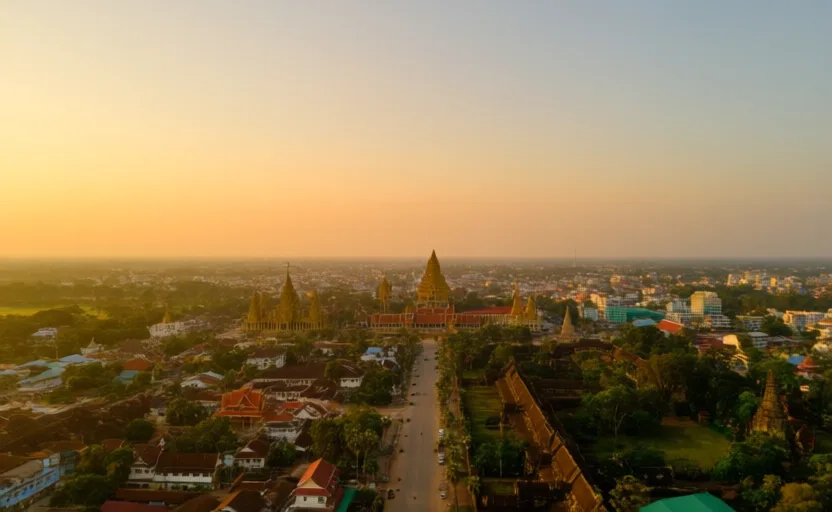 AI city illustration · Artistic impression
What people learn after moving
~250,000 (city and immediate district)
Khmer; English widely spoken in tourism
Riel (KHR) and US dollar side by side
Siem Reap–Angkor Intl (SAI), ~45km east, 60–90 min
AI city illustration · Artistic impressionCost of living in Siem Reap
Check your eligibility
Pick your passport to see entry rules and the long-stay routes we have researched.
Pick your passport to see whether you can enter Cambodia — and what it takes to stay.
The mechanics are national and identical to Phnom Penh: a USD 35 ordinary visa, extended in-country under a purpose suffix, plus a separate work permit filed through FWCMS that expires every 31 December. What differs in Siem Reap is the environment — a smaller pool of agents, more seasonal and informal employment, and employers who are less likely to file your labour paperwork unprompted.
Cambodia will swap a valid foreign licence for a local one without a road test, for about USD 10 (motorcycle) or USD 30 (car). In Siem Reap this happens at the Provincial Department of Public Works and Transport rather than at the Phnom Penh mall counters, and the two documents that hold everyone up are the embassy-certified translation and the Commune/Sangkat residence letter.
Cambodia's banking is far more digital than its reputation, and Siem Reap benefits fully: instant free transfers between any two Cambodian banks through Bakong, and the national KHQR code accepted from hotel receptions to market stalls. Bring your visa extension and a proof of address and you will be set up in an hour.
Siem Reap handles routine medicine well and complex medicine not at all. Royal Angkor International Hospital and a handful of good clinics cover consultations, minor procedures and diagnostics; anything serious moves to Phnom Penh, Bangkok or over the Thai border. The town's distance from a tertiary hospital is the single fact your insurance needs to answer for.
Data is cheap and coverage in town is good. What is different in Siem Reap is what happens when you leave town: the temple roads, the Tonlé Sap villages and the route to the new airport are where network choice starts to matter, and where Metfone's rural reach earns its reputation.
The tax regime is national and simple: monthly withholding, progressive rates to 20% for residents, a flat final 20% for non-residents, and no personal annual return for a plain employee. What complicates it in Siem Reap is the shape of the work — seasonal, part-time, cash-in-hand and often for employers who are not fully registered.
Each guide has verified costs, timelines, required documents, and the non-obvious gotchas — sourced from official government pages. Last verified August 2026.
Reading a list isn’t learning it. Globe Quest turns these into a trainer — hear each phrase spoken, drill them with spaced repetition, and get scored as you say them out loud.
Since September 2022, foreigners who have legally resided in Cambodia for at least two years can apply to Angkor Enterprise for a special pass giving free entry to the Angkor Archaeological Park and Koh Ker. It is free, valid for a year, and applied for online at spass.angkorenterprise.gov.kh or at the Angkor Enterprise office. Without it you pay the visitor rate — USD 37 a day. Almost nobody tells new residents this exists.
The old airport six kilometres from the centre closed when Siem Reap–Angkor International opened on 16 October 2023. It is now roughly 45–50km away and a 60–90 minute drive. Budget a full half-day and around USD 30–40 for the transfer each way, and stop assuming a flight is a quick errand — plenty of residents now take the road to Phnom Penh instead.
Roughly November to February the town is full, restaurants are hiring and rents firm up. From May the wet season empties it, businesses cut hours or close, and casual work evaporates. If your income depends on visitors, plan your year around that curve — and if it doesn't, the low season is when you get the town, and the temples, to yourself.
Angkor's active religious sites require shoulders and knees covered, and it is enforced at Angkor Wat's upper level. This applies to residents on a special pass exactly as it does to visitors. Keep a light long-sleeve shirt in your bag permanently; you will need it more often than you expect.
An EB extension comes from immigration; the work permit comes from the Ministry of Labour through FWCMS and expires every 31 December. Siem Reap's hospitality employers are less practised at this than Phnom Penh's corporates, so check yourself rather than assuming your employer has filed. Since 2024 immigration checks for a valid permit before approving long EB renewals.
Siem Reap has decent private clinics and Royal Angkor International Hospital for routine care, but complex cases go to Phnom Penh, Bangkok or across the Thai border. The town's remoteness makes medical evacuation cover more valuable here than in the capital, not less. Check the policy names a provider and a destination.
Raffles Grand Hotel d'Angkor, Belmond, Anantara, hundreds of independents
Overwhelmingly the largest employer; almost every other sector in town ultimately depends on it.
APSARA National Authority, EFEO, international conservation missions
Long-running archaeological and restoration programmes with genuine professional employment for specialists.
Angkor Hospital for Children, education and rural-development NGOs
A dense NGO sector, and a significant source of long-stay foreign residents.
Artisans Angkor, silk and ceramics workshops, Kandal Village studios
A real export-oriented craft economy rather than souvenir production alone.
Siem Reap–Angkor International Airport, regional carriers
The 2023 airport relocation reshaped transport, freight and the road corridor east of town.
Rice growers, Tonlé Sap fishing communities
The provincial economy outside the tourist strip — rice, freshwater fish and increasingly mango.
Landmark · Angkor Archaeological Park
The largest religious monument on earth and the reason the town exists — and, with a resident pass, somewhere you can visit on a whim.
Local tip: Sunrise is famously crowded. Residents go late afternoon on a weekday, when the light is better on the western face and the coaches have gone.
Culture · Angkor Archaeological Park
Two hundred stone faces above the walled city of Jayavarman VII, plus the Terrace of the Elephants and the Baphuon.
Local tip: Cycle the Angkor Thom loop rather than driving it — the interior roads are shaded, flat and almost empty once you leave the main circuit.
Neighborhood · East bank of the Siem Reap river
The leafy east-bank streets where most long-stay foreign residents end up — independent cafés, design shops, yoga studios and quiet lanes.
Local tip: Wat Bo and Kandal Village are walkable to each other and to the Old Market, which in a town without transit is the whole argument for living here.
Food · Southeast of the centre, National Road 6
The big, unglamorous local market where the town actually shops — produce, fish, hardware and food stalls, with almost no tourists.
Local tip: Go early. It is a fraction of Old Market prices for the same goods, and the food stalls at the back do the best cheap breakfast in Siem Reap.
Nightlife · Old Market (Psar Chas)
Three loud blocks of bars and neon, ringed by much better alleys of small restaurants, galleries and night-market stalls.
Local tip: Locals treat Pub Street itself as a landmark to walk past. The lanes behind it — Alley West and The Passage — are where residents actually drink.
Nature · 8km west of town
An eleventh-century reservoir eight kilometres long, still holding water, where Khmer families swim, picnic and rent inner tubes at weekends.
Local tip: This is where Siem Reap goes on a Sunday and almost no visitor ever does. Bring a hammock, buy grilled fish and beer from the shacks on the southern bank, and swim.
Side-by-side cost of living, language, climate and careers — to help you choose.