
Population
≈290,000 in the city; ≈510,000 across the Eurométropole, plus the German conurbation immediately across the Rhine
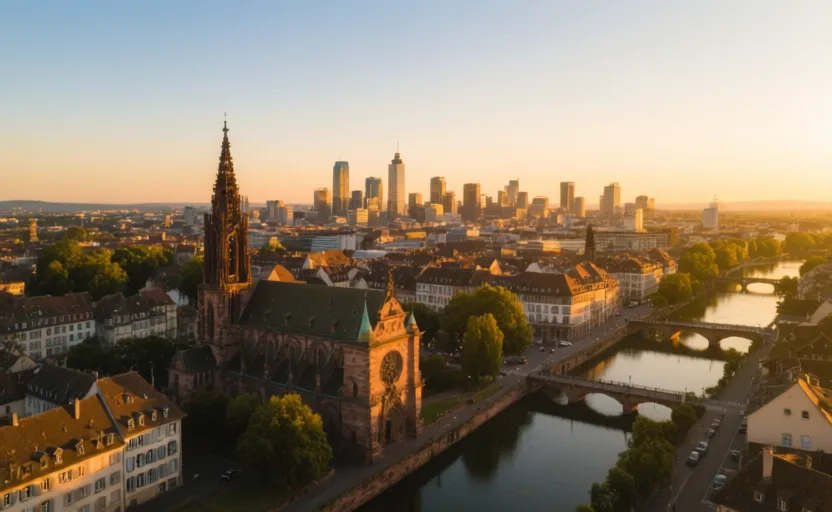 AI city illustration · Artistic impression
What people learn after moving
≈290,000 in the city; ≈510,000 across the Eurométropole, plus the German conurbation immediately across the Rhine
French, with German widely spoken and Alsatian still heard. English is standard in the European institutions and the research sector
Euro (EUR) — the same on both sides of the Rhine
CET (GMT+1); CEST (GMT+2) from late March to late October — identical to Germany
AI city illustration · Artistic impressionCost of living in Strasbourg
Check your eligibility
Pick your passport to see entry rules and the long-stay routes we have researched.
Pick your passport to see whether you can enter France — and what it takes to stay.
Most people arrive on a long-stay visa that becomes a residence permit only once validated online within three months, with renewals through ANEF. Strasbourg's distinctive case is the European institutions: their staff and accredited dependants hold a special residence title issued by the Ministry for Europe and Foreign Affairs rather than a préfecture card, which is a different document with different consequences. The second local wrinkle is that a French permit does not authorise employment across the Rhine.
EU and EEA licences are exchangeable without difficulty; for everyone else it depends on whether France holds a reciprocity agreement with the issuing state, with a one-year window from the date your first residence permit takes effect. Locally, you need a French Crit'Air sticker for the Eurométropole's zone and, if you drive into German cities with environmental zones, a separate German Umweltplakette — the two schemes do not recognise each other. Strasbourg is also France's leading cycling city and has a tram that crosses into Germany, so the case for a car is weaker than in most French cities of its size.
French life runs on the RIB — your account details, handed over for salary, rent, utilities, tax and health reimbursements. A digital account breaks the proof-of-address circularity in days, and the droit au compte exists if you are refused outright. If you are paid from Germany, a French IBAN must be accepted for a euro transfer. And in a genuinely unusual piece of local law, someone in serious personal debt who is domiciled in Alsace or Moselle can petition the court directly for faillite civile rather than going through the national over-indebtedness commission.
French healthcare reimburses rather than being free at the point of use, and a top-up insurer called a mutuelle normally covers the gap. Alsace-Moselle is the exception: a compulsory local scheme funded by an additional employee contribution — held at 1.30% of uncapped earnings for 2026 — lifts reimbursement to around 90% on consultations and dental care, covers hospital costs in full including the daily charge, and covers scheduled medical transport in full. Enrolment is automatic. The practical consequence is that the mutuelle you need here is smaller and cheaper than the one a colleague in Lyon needs.
France has some of the cheapest mobile tariffs in Europe — considerably cheaper than Germany's — a legacy of the price war that followed Free Mobile's arrival in 2012. Prepaid SIMs are available on a passport and contracts are usually month-to-month. The local issues are that handsets in eastern Strasbourg register on German networks without being asked, and that calling a German number from France is an international call rather than roaming, which the EU rules do not cover.
France taxes the household rather than the individual through the quotient familial, tax is withheld at source, and the annual spring declaration remains compulsory. The local difference is not the rate but the border: France and Germany still operate a genuine frontier-worker regime, so a resident of Bas-Rhin, Haut-Rhin or Moselle working within thirty kilometres of the border on the German side is taxed in France rather than Germany, subject to a day limit and a certificate your employer needs on file.
Each guide has verified costs, timelines, required documents, and the non-obvious gotchas — sourced from official government pages. Last verified August 2026.
Reading a list isn’t learning it. Globe Quest turns these into a trainer — hear each phrase spoken, drill them with spaced repetition, and get scored as you say them out loud.
If you work in Bas-Rhin, Haut-Rhin or Moselle you are enrolled in the régime local d'assurance maladie automatically — there is nothing to sign up for. An additional employee contribution, held at 1.30% of uncapped earnings for 2026, buys reimbursement at roughly 90% on consultations and dental care instead of 70% and 60%, full cover of hospital costs including the daily hospital charge that everyone else pays out of pocket, and full cover of scheduled medical transport. It applies to employees and contractual public agents working here; tenured civil servants and the self-employed are outside it. The practical consequence is that the standard French mutuelle sold nationally is over-specified for you.
Complementary health insurance in France is priced to fill the gap the state leaves. In Alsace-Moselle the régime local has already filled most of it, which is why local insurers sell cut-down policies designed to sit on top of it. If you take a national employer scheme designed for Lyon or Nantes without asking whether an Alsace-Moselle version exists, you are paying twice for the same cover. Ask your employer specifically what its scheme assumes, because payroll teams based elsewhere frequently do not know the régime local exists.
Under article L3134-13 of the Code du travail, Good Friday is a public holiday here — but only in communes possessing a Protestant temple or a mixed church, a condition Strasbourg comfortably meets — and the second day of Christmas, 26 December, is one throughout the three departments with no such condition attached. That is two days more than the rest of the country. The same local law makes Sunday and public holiday closing considerably stricter than elsewhere: article L3134-2 states a flat prohibition on employing staff in industrial, commercial and artisanal businesses on Sundays and public holidays, with derogations rather than the other way round. Plan the weekly shop for Saturday. Newcomers from Paris are consistently caught out by a genuinely closed Sunday.
France and Germany still operate a frontier-worker tax regime. Live in Bas-Rhin, Haut-Rhin or Moselle and work in a German commune lying wholly or partly within 30 km of the border, returning home as a rule each day, and your salary is taxable in France rather than Germany. You are allowed up to 45 days a year working outside the zone or not returning home before the status is lost, and home working inside the border zone is not counted against that. Your employer needs the exemption certificate on file or German wage tax will be withheld anyway. Social security, separately, follows the German employer.
Alsace and Moselle keep the livre foncier, a land register maintained at the tribunal judiciaire under the supervision of a land registry judge, rather than the service de publicité foncière used in the rest of France. Registration is checked by a magistrate and an entry carries a presumption of accuracy — a rebuttable one, so contrary proof is admitted, but still a genuinely stronger position than elsewhere. It also means the procedure, the timescales and the professionals differ — if you buy here, use a notaire who practises in Alsace-Moselle rather than one who does not, because this is not a formality they can improvise.
Tram line D has run across the Rhine to Kehl since 2017, on an ordinary Strasbourg transport ticket. That makes German supermarkets, doctors, restaurants and the Black Forest railway a fifteen-minute ride rather than an expedition, and it materially changes what the city is. It also means the two extra public holidays, the Sunday closing and the German shopping calendar interact in ways worth learning early — Sunday is closed on both sides, but German shops keep different hours and holidays from French ones.
European Parliament, Council of Europe, European Court of Human Rights, European Ombudsman, EDQM, Eurocorps
Strasbourg is one of the European Union's three official seats and hosts the Council of Europe and the human rights court, which supports a large multilingual professional community with its own legal status and its own labour market.
Lilly France, Octapharma, Transgene, Alcon, Institut de Génétique et de Biologie Moléculaire et Cellulaire
A substantial pharmaceutical manufacturing and biotech base along the Rhine corridor, tightly linked to the German and Swiss industry a short distance upstream.
Port autonome de Strasbourg, Punch Powerglide, Hager, Kronenbourg, Liebherr
The second largest river port in France sits on the Rhine, and a great deal of the local industrial economy is organised around the German market rather than the French one.
Université de Strasbourg, CNRS, Inserm, INSA Strasbourg, ENA legacy campus
One of France's leading research universities with an unusually strong record in chemistry and life sciences, and a student body drawn from both sides of the Rhine.
Arte, France 3 Alsace, Éditions Bayard legacy sites, Opéra national du Rhin
The Franco-German public broadcaster Arte is headquartered here, which is both a significant employer and a fair summary of the city's professional character.
Hôpitaux Universitaires de Strasbourg, IHU Strasbourg, IRCAD, Clinique Rhéna
The IRCAD surgical training institute is a world reference for minimally invasive surgery and draws surgeons from everywhere, giving the city a medical technology cluster out of proportion to its size.
Landmark · Grande Île
A single-spired Gothic cathedral in pink Vosges sandstone, for centuries the tallest building in the world, with a sixteenth-century astronomical clock inside.
Local tip: The clock's full automaton sequence runs once a day at half past twelve and needs a separate ticket bought that morning. The platform climb is 332 steps and the view takes in the Vosges, the Black Forest and, on a clear day, the Alps.
Neighborhood · West of the Grande Île
The old tanners' quarter of half-timbered houses on the canals, with the covered bridges and the Vauban dam at its western end.
Local tip: Walk out onto the roof terrace of the Barrage Vauban — it is free, open daily and gives the view of the covered bridges that everyone else queues to photograph from the ground.
Neighborhood · East and north of the Grande Île
The monumental German imperial quarter built after 1871, added to the UNESCO listing in 2017 — vast avenues, palaces and apartment blocks unlike anything else in France.
Local tip: Most visitors never cross the canal into it. Walk the axis from Place de la République out toward the university and you will understand more about Alsace in an hour than any museum will tell you.
Nature · Beside the European quarter
The city's oldest park, with a lake, a small free zoo, storks nesting in the trees and the European institutions on its edge.
Local tip: The storks are the real attraction and they are genuinely wild — the reintroduction programme worked. Go at the end of the afternoon in spring when they are on the nests, then walk five minutes to look at the Council of Europe and the human rights court.
Nature · Both banks of the Rhine
A cross-border park spanning the river, joined by a pedestrian and cycle bridge, with the German town of Kehl on the far side.
Local tip: Take tram D to Kehl on an ordinary ticket and walk back across the footbridge. Lunch in Germany, a walk home to France, and the whole thing costs a single fare — the most quietly extraordinary hour available in any French city.
Culture · 30–60 km west and south
A chain of walled wine villages along the foot of the Vosges, backed by forested mountains with ruined castles on the ridgelines.
Local tip: The regional trains reach Obernai, Barr, Sélestat and Colmar without a car, which matters when the point of the trip is tasting. Go in the week — the villages on the route are lovely and on an autumn Sunday they are impassable.
Side-by-side cost of living, language, climate and careers — to help you choose.