
Population
≈615,000 in the city; ≈2.8 million in the Stuttgart Region and around 5.3 million in the wider metropolitan area
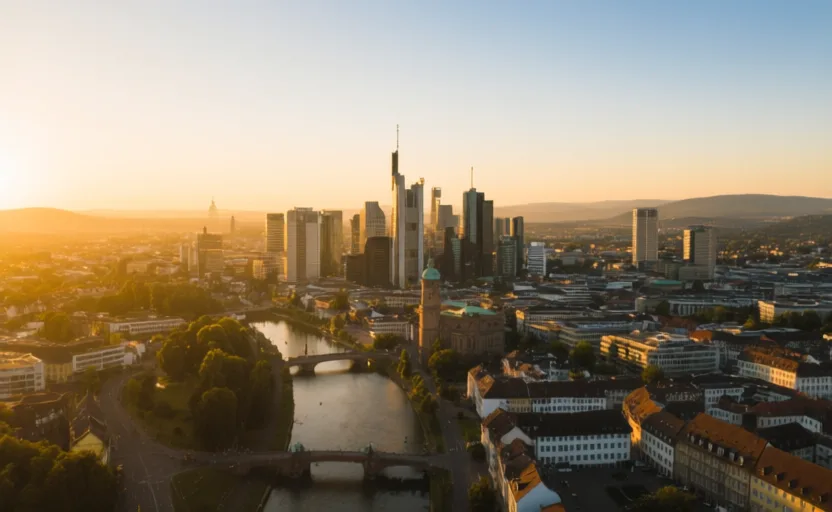 AI city illustration · Artistic impression
What people learn after moving
≈615,000 in the city; ≈2.8 million in the Stuttgart Region and around 5.3 million in the wider metropolitan area
German, spoken locally in a strong Swabian dialect. English is standard in engineering and research workplaces and much rarer at the counter
Euro (EUR)
CET (GMT+1); CEST (GMT+2) from late March to late October
AI city illustration · Artistic impressionCost of living in Stuttgart
Check your eligibility
Pick your passport to see entry rules and the long-stay routes we have researched.
Pick your passport to see whether you can enter Germany — and what it takes to stay.
Everything in Germany hangs off one appointment: register your address within two weeks of moving in and you receive the Meldebescheinigung that the tax office, your bank, your insurer and the immigration office all require. Stuttgart adds two useful specifics — the region runs a free Welcome Center that will sequence the whole process for skilled workers and their families, and Baden-Württemberg charges church tax at 8% rather than the 9% most states levy, decided by a single line on the registration form.
An EU or EEA licence needs no action. A non-EU licence is valid for six months from taking up residence, and whether the exchange is a form or a full driving course depends on the issuing country — and for the United States, Canada and Australia, the individual state or province. The genuinely Stuttgart part is what you are allowed to drive: the basin's air quality produced Germany's first serious diesel bans, and they still apply to Euro 5 diesels inside the small environmental zone.
A German IBAN is the precondition for salary, rent and the direct debits that run everything here. Traditional banks want your registration certificate and tax ID first, which is circular on arrival; digital banks generally do not. The harder problem is Schufa: an empty file is normal for a newcomer and reads as an unknown to a landlord in a city where almost nothing gets built because there is nowhere flat left to build it.
Employees below an annually reset income threshold must join the statutory system, where contributions are income-based, split with the employer, and cover non-earning dependants free. Above it, and for the self-employed, private insurance opens up — attractive at thirty, expensive at sixty, priced per person and very hard to leave. Stuttgart's own layer is the basin: inversion weather holds pollen and particulates in the valley, and respiratory complaints are a normal thing to discuss with a GP here.
There is no anonymous SIM in Germany. Every card is tied to an identified person, verified in store, by video call or at a post office, and prepaid is the only realistic first move because contracts need a bank account, an address and a credit history. Home broadband is where the real delay sits — order it the day you sign the lease. Stuttgart adds a physical wrinkle: a city of tunnels, cuttings and steep slopes has more mobile dead spots than a flat one.
For an employee the machinery runs itself — Lohnsteuer comes off each month according to your tax class and many people are never obliged to file. Three things are worth understanding here: church tax is 8% rather than the usual 9%, the annual profit share that the big regional employers pay in spring is withheld far more harshly than your salary is, and the commuting allowance is unusually valuable in a region where half the workforce lives in one town and works in another.
Each guide has verified costs, timelines, required documents, and the non-obvious gotchas — sourced from official government pages. Last verified August 2026.
Reading a list isn’t learning it. Globe Quest turns these into a trainer — hear each phrase spoken, drill them with spaced repetition, and get scored as you say them out loud.
The Anmeldung at a Bürgerbüro is legally due within two weeks of moving in and unlocks the tax ID, the bank account, health insurance and the residence permit. Stuttgart's appointment availability is better than Munich's but slots still move quickly, so book online the moment you know your move date. The Stuttgart Region also runs a Welcome Center for international skilled workers and their families, which will walk you through the sequence for free — it is genuinely useful and almost nobody arriving knows it exists.
The religion question on your registration form is a tax election. Declare membership of a recognised church and Kirchensteuer is deducted automatically from every payslip at 8% of your income tax liability — the reduced rate that only Baden-Württemberg and Bavaria charge. Declaring no affiliation is lawful and costs nothing. Leaving the church afterwards requires a formal appointment and a fee and takes effect only from the following month, never retrospectively.
Baden-Württemberg issued a Mietpreisbremse in 2015 and then failed to publish the reasoning behind it. In March 2019 the Landgericht Stuttgart held that formal defect fatal and declared the ordinance ineffective, so for years landlords in Stuttgart could not be held to the cap at all. The replacement took effect on 4 June 2020 covering 89 municipalities, and it is now renewed in short increments rather than for years at a time: the ordinance of 16 December 2025 runs from 1 January 2026 only to 31 December 2026 and covers 130 municipalities, Stuttgart among them. It limits a new rent to 10% above the local reference rent — but check the ministry's current list and dates against the day your contract starts.
Stuttgart sits in a bowl with poor air circulation, which for years made the Neckartor junction the most polluted measuring point in Germany. The city introduced Germany's first serious diesel driving bans in response: since July 2020 Euro 5 diesels have been excluded from the small environmental zone covering the Talkessel plus Bad Cannstatt, Feuerbach and Zuffenhausen, and further restrictions have been repeatedly deferred rather than dropped. A green Umweltplakette is the minimum everywhere. Buying a used diesel in Germany's automotive capital is the specific mistake to avoid.
Everyone must be insured. Employees below the annually reset threshold — around EUR 77,400 gross for 2026 — are in the statutory system, where contributions are income-based, split with the employer, and cover non-earning dependants at no extra charge. Above it, private cover opens up: cheaper at thirty, materially more expensive at sixty, priced per person, and very difficult to leave. Brokers in a high-salary engineering city are persistent about this. Decide on the thirty-year view.
Swabia's rotating cleaning duty allocates the stairwell, the pavement outside and the bin area to each flat in turn, usually weekly. In many Stuttgart buildings it is written into the house rules attached to the tenancy, which makes it a contractual obligation rather than a custom. Skipping your turn is the fastest way to a bad relationship with a whole building, and pavement clearing after snow carries a genuine liability if someone falls. Ask at the viewing how the building handles it.
Mercedes-Benz, Porsche, Daimler Truck
Mercedes-Benz builds in Untertürkheim and Sindelfingen and Porsche in Zuffenhausen — both inside the city. Stuttgart is the only place on earth where two globally famous carmakers were founded within a few kilometres of each other.
Bosch, Mahle, Eberspächer, Behr, Dürr
Bosch is headquartered in Gerlingen on the city's edge and is the world's largest automotive supplier. The regional supply chain is deep, highly paid, and currently absorbing the shift away from the combustion engine.
Trumpf (Ditzingen), Festo (Esslingen), Stihl (Waiblingen), Kärcher (Winnenden)
The Mittelstand belt around Stuttgart contains an unusual density of world market leaders in narrow categories — laser cutting, pneumatics, chainsaws, pressure washers — most of them family-owned and in small towns.
IBM Deutschland (Ehningen), Hewlett Packard Enterprise (Böblingen), Vector Informatik, Cyber Valley
The Cyber Valley initiative links Stuttgart and Tübingen into one of Europe's larger machine-learning research clusters, and automotive software houses such as Vector employ heavily in the region.
LBBW, Wüstenrot & Württembergische, Allianz Leben, Börse Stuttgart
Landesbank Baden-Württemberg is one of Germany's largest state banks, and Börse Stuttgart is the country's second stock exchange and its main retail securities venue.
University of Stuttgart, Universität Hohenheim, Fraunhofer IPA and IAO, Max Planck for Intelligent Systems, DLR
One of Germany's densest concentrations of applied research, weighted heavily toward production engineering, robotics and materials — which is why so much industrial R&D is done here rather than in a corporate lab elsewhere.
Landmark · On the southern rim of the basin
The world's first television tower built in reinforced concrete, finished in 1956 and copied everywhere afterwards.
Local tip: Get there on the Zacke, the rack railway that climbs from Marienplatz to Degerloch — it is a scheduled tram line, covered by your normal ticket, and it carries bicycles on a dedicated open wagon at the front. The view is over the whole Kessel and out to the Swabian Alb on a clear day.
Nature · Bad Cannstatt
Germany's only combined zoological and botanical garden, built as a Moorish pleasure palace for a nineteenth-century king.
Local tip: The Moorish architecture is the reason to come even if you do not care about zoos, and the magnolia grove in April is one of the oldest outside Asia. An annual pass costs little more than two visits and locals treat the grounds as a park.
Culture · Bad Cannstatt and Berg
Stuttgart sits on the largest mineral water reserves in western Europe after Budapest, and has bathed in them since the Romans.
Local tip: Mineralbad Berg and Leuze draw naturally carbonated water straight from the springs. Berg is the local one — plainer, cheaper, and full of people who have been coming for forty years. The water is genuinely fizzy against your skin, which surprises everyone the first time.
Neighborhood · The southern slopes above the centre
Streets that climb the vineyard terraces by staircase, with a beer garden on a hill in the middle of them.
Local tip: The Karlshöhe beer garden has the best free view in the city and is fifteen minutes' climb from the centre. Learn two or three Stäffele near your flat — they routinely halve a journey that looks long on a map, and they are how residents actually move around the slopes.
Food · Uhlbach, Rotenberg, Untertürkheim, Bad Cannstatt
Wine growers' temporary taverns, allowed to open only a few weeks a year, marked by a broom hung above the door.
Local tip: A Besen serves the grower's own wine and a short list of very plain food, in what is usually their barn or front room. They open in rotation and are advertised on a paper calendar the wine associations publish rather than online. This is the single most local thing in Stuttgart and visitors essentially never find it.
Nightlife · City centre and Nordbahnhof
The mainstream bar strip in the centre, and a complex of old railway sheds north of the station that houses the alternative scene.
Local tip: The 'Theo' is where the city drinks on a Saturday and is exactly what you expect. The Wagenhallen — studios, clubs and a container village in a former locomotive hall — are where the more interesting half happens, and the surrounding Rosenstein quarter is being rebuilt around them.
Side-by-side cost of living, language, climate and careers — to help you choose.