
Population
≈392,000 and slowly falling; the functional urban area extends across the German border into Vorpommern
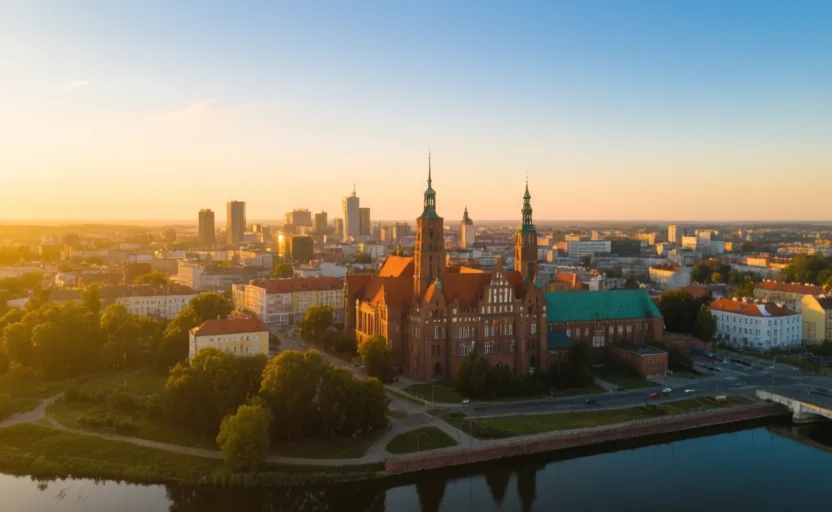 AI city illustration · Artistic impression
What people learn after moving
≈392,000 and slowly falling; the functional urban area extends across the German border into Vorpommern
Zachodniopomorskie — residence cases are decided by the Zachodniopomorski Urząd Wojewódzki, Wały Chrobrego 4, historically the slowest office in Poland
Polish; German is more useful here than anywhere else in Poland, and the IT and services sector recruits in both German and English
Polish złoty (PLN); euro pricing is common in cross-border trade and some contracting
AI city illustration · Artistic impressionCost of living in Szczecin
Check your eligibility
Pick your passport to see entry rules and the long-stay routes we have researched.
Pick your passport to see whether you can enter Poland — and what it takes to stay.
One combined permit covers residence and work for a named employer. Since 27 April 2026 the MOS portal is the only accepted filing channel, so a login.gov.pl trusted profile is a prerequisite. Two local warnings. First, Zachodniopomorskie recorded the longest average residence-decision time in the country in the interior ministry's 2019–2022 review, at 442 days. Second, Szczecin is the one Polish city where 'move somewhere cheaper nearby' can silently mean moving to Germany, which your Polish permit does not cover.
EU and EEA licences remain valid indefinitely. A non-EU licence expires for Polish purposes six months after you establish residence and must be exchanged, with a sworn translation and — for countries outside the Vienna and Geneva road traffic conventions — a Polish theory exam. Szczecin has no clean transport zone. The local wrinkle is that a car here is a cross-border tool: the German border is fifteen kilometres from the western suburbs and a great many households drive over it routinely, which brings German traffic rules, tolls, and insurance green-card questions into ordinary life.
Opening an account is straightforward and Polish retail banking is genuinely excellent. Two things are worth doing deliberately here: issue your profil zaufany inside the bank app, because it gates the MOS residence filing, and open a euro sub-account from the start. In Szczecin the euro is not an occasional holiday currency — it is what you spend when you cross the border, and paying by card in Germany from a złoty account costs you a conversion spread every single time.
An employment contract enrols you in NFZ automatically through employer ZUS contributions. A B2B contract does not: you pay the health contribution yourself, at a rate that depends on which tax regime you elected. Szczecin's Pomeranian Medical University runs the region's teaching hospitals and the city is the referral centre for the whole of West Pomerania. The genuinely local complication is cross-border care: EU coordination rules mean a Polish-insured resident has emergency cover in Germany with an EHIC, and planned treatment across the border requires prior authorisation — and if you live in Germany and work here, the whole question changes.
Four networks and a healthy reseller market at some of the lowest prices in the EU. Every SIM, prepaid included, must be registered against an identity document. Fibre is widely available in the postwar estates and new build; the surviving prewar villas and tenements in Pogodno, Łękno and Niebuszewo are more variable. Set your handset to manual network selection if you live or work near the border.
Employment income is taxed at 12% and 32%, with a PLN 30,000 tax-free allowance and a near-total exemption for workers under 26. Contractors elect ryczałt at 12% of revenue for software development, with IP Box available at 5% on qualifying software income. What is different here is that tax residence is not a formality: 183 days and centre of vital interests are live tests when your house is in Brandenburg and your job is in Szczecin, and the Poland–Germany double taxation treaty then decides who taxes what.
Each guide has verified costs, timelines, required documents, and the non-obvious gotchas — sourced from official government pages. Last verified August 2026.
Reading a list isn’t learning it. Globe Quest turns these into a trainer — hear each phrase spoken, drill them with spaced repetition, and get scored as you say them out loud.
Several thousand people have bought houses in Löcknitz, Gartz, Penkun and Pasewalk, twenty to thirty kilometres from the centre, because German village property has been dramatically cheaper. For an EU citizen that is a lifestyle choice with tax and school consequences. For a non-EU national it is not a variation on your Polish permit — it is German residence law, a German registration, German health insurance and cross-border social security coordination, and your Polish karta pobytu does not authorise you to live there. People find this out after they have bought. Take advice before, not after.
The interior ministry's 2019–2022 review put the average temporary residence decision here at 442 days, the worst figure in the country. The office has since digitised — since 27 April 2026 all applications go through the MOS portal — and it has changed its appointment rules more than once, at points suspending online booking and assigning slots by the order applications were received. Check the office's own notices at szczecin.uw.gov.pl rather than any third-party guide, and do not plan travel outside the Schengen area around an expected decision date.
Szczecin has no significant international airport of its own; Berlin Brandenburg is around two hours away and is how most people here fly. The Berlin line is mid-rebuild: the German section between Angermünde and the border is being double-tracked and electrified with completion targeted for 2026, and the Polish sections — Szczecin Gumieńce to the border, then Szczecin Główny to Gumieńce — are scheduled for 2029 and 2030. When it is all finished the fastest trains are meant to run Szczecin to Berlin in about ninety minutes. Until then, budget around two hours and check for engineering works.
The Szczecin shipyard's collapse after 2009 took the city's defining industry with it. What is replacing it is offshore wind: Windar Renovables is opening a tower factory in the port with at least 450 planned jobs in the first half of 2026, the port authority is running a programme worth over a billion złoty through 2027, and the Świnoujście installation terminal serves Poland's first big offshore farms. Industry projections put the Szczecin–Świnoujście cluster at several thousand direct jobs by the end of 2026. Treat those as projections, not payroll — but the direction is real and it is where the hiring is.
Szczecin was rebuilt in the second half of the nineteenth century on a radial plan of broad avenues meeting at star-shaped plazas, which locals will tell you was modelled on Paris. Whatever the lineage, the practical effect is that addresses are hard to picture from a map and easy to reach by tram, that the city feels far larger than its 391,000 people, and that the grand terraces at Wały Chrobrego above the river are the correct place to stand to understand it.
Parks, cemeteries, the Beech Forest to the south-east, Lake Dąbie to the east — one of the largest lakes in Poland and entirely inside the city boundary — and the Odra delta islands in between. Szczecin has more green and water per resident than any comparable Polish city, and it is the single thing residents consistently name when asked why they stay. It also partly explains the rents, which are mid-market rather than cheap.
Windar Renovables, Bilfinger Mars Offshore, Baltic Power supply chain
The sector the city is betting on. Windar's tower plant in the port is due to start up in the first half of 2026 with at least 450 planned jobs, and the Świnoujście installation terminal is being rebuilt to handle heavy-lift offshore logistics under a port investment programme running to 2027.
Port of Szczecin-Świnoujście, Euroafrica, Unity Line, Bulk Cargo
A two-part port complex — the river port at Szczecin and the deep-water one at Świnoujście, including the LNG terminal. It is the closest sea port to Berlin and to the Czech border, which is the whole commercial argument for the city.
Tietoevry, Spyrosoft, Arvato, Espeo, Netto Polska
A smaller and less English-dominated services layer than Wrocław's or Kraków's, but a real one — and the German-language half of it is unusually strong here for obvious geographic reasons.
Netto, Selgros, Kaufland regional operations, small importers
A large local economy runs on the border itself: German shoppers coming south for cheaper services, Polish shoppers going north for particular goods, and a dense layer of small logistics and trade firms. It is invisible in statistics and obvious on the roads.
Drobimex, Bosman (Carlsberg), Fosfan, Kraft-Mondelēz regional plants
The agricultural hinterland of West Pomerania feeds a processing sector around the city, and the Bosman brewery is a genuinely local brand that predates the war under a different name.
University of Szczecin, West Pomeranian University of Technology, Maritime University of Szczecin
The Maritime University trains deck and engineering officers for the international fleet — one of the few Polish qualifications that is directly and globally portable, and a real route out of the region as well as into it.
Landmark · Above the Odra, north of the centre
A five-hundred-metre terrace of monumental Prussian public buildings on a bluff over the river, built 1902–1921 with the fortress walls beneath it.
Local tip: Stand at the top and look at the port, then walk down the stairs to the water. It is the one place where Szczecin's scale, its river and its German origins all make sense at once. The National Museum and the Maritime Museum are both up here.
Culture · Śródmieście, by the Old Town
A white, translucent, sharply gabled concert hall completed in 2014 on the site of the destroyed Konzerthaus, and winner of the EU's Mies van der Rohe prize for contemporary architecture in 2015.
Local tip: Go inside even if you are not going to a concert — the golden main auditorium is the point, and the building glows from the street after dark. Tickets are cheap by Western European standards and the programming is serious.
Nature · South-east, beyond Podjuchy
A hilly beech forest of nearly a hundred square kilometres on the city's edge, with lakes, ravines and the Szczecin Landscape Park.
Local tip: Take the bus to Jezierzyce and walk to Jezioro Szmaragdowe — an emerald-green flooded chalk quarry that collapsed into groundwater in 1925. It is fifteen minutes from a tram stop and looks like it belongs in another country.
Nature · East of the city, on the Odra delta
One of the largest lakes in Poland, entirely inside the city boundary, connected to the sea and used for sailing rather than swimming.
Local tip: This is where Szczecin's sailing culture lives, and courses through the local clubs are cheap. The islands of the Odra delta between the lake and the city are a genuine wetland maze that almost nobody who has not got a boat ever sees.
Culture · West of the centre
The largest cemetery in Poland and one of the largest in Europe — nearly two hundred hectares laid out in 1901 as a landscaped park with a chapel, avenues and specimen trees.
Local tip: It was designed as a public park that happens to contain graves, and locals treat it that way. Go in autumn. It is the clearest surviving statement of what German Stettin thought a city should be.
Neighborhood · Across the Odra from the Old Town
The old warehouse island opposite the city, half derelict and half redeveloped, with the Lastadia boulevards and the surviving port cranes.
Local tip: Walk the boulevard on the island side at dusk and look back at Wały Chrobrego across the water — the best view of the city is from the industrial side, and the city has spent a decade slowly turning this island around. Come back in five years and it will be different.
Side-by-side cost of living, language, climate and careers — to help you choose.