
Population
≈460,000 (city); ≈620,000 (Harju county)
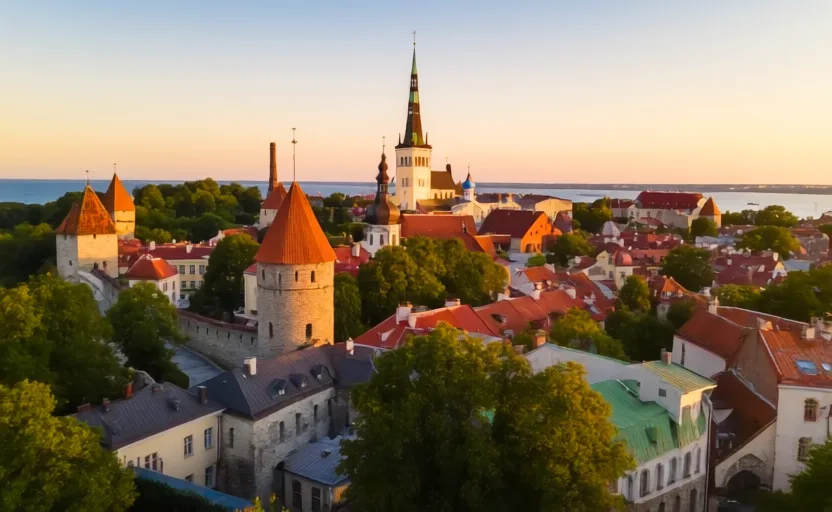 AI city illustration · Artistic impression
What people learn after moving
≈460,000 (city); ≈620,000 (Harju county)
Estonian; Russian widely spoken; English excellent among under-40s and in tech
Euro (EUR) — Estonia is in the eurozone
EET (GMT+2); EEST (GMT+3) in summer
AI city illustration · Artistic impressionCost of living in Tallinn
Check your eligibility
Pick your passport to see entry rules and the long-stay routes we have researched.
Pick your passport to see whether you can enter Estonia — and what it takes to stay.
Three different things get confused constantly. e-Residency is a digital identity for running an EU company remotely and confers no right to live here at all. The Digital Nomad Visa is a long-stay (D) visa of up to 365 days for remote workers earning at least €4,500 gross a month — it does not lead to permanent residency. A temporary residence permit is the actual route to living in Estonia, issued for up to five years and extendable for up to ten at a time.
You can exchange once you are a permanent resident living in Estonia at least 185 days a calendar year. EU/EEA/Swiss and 1968 Vienna Convention licences generally exchange without exams. 1949 Geneva Convention licences exchange without exams for categories A and B only. Everything else requires a theory and practical test. Non-EU licences stay valid for just 12 months from when you establish residency.
With an Estonian ID-card or residence permit card this is easy. Without one it is not: Estonian banks require documented proof of a genuine connection to Estonia, and every major bank requires non-residents to identify themselves in person at a branch. The e-Resident digital ID is explicitly not sufficient on its own — it is not an identity document.
Estonian health insurance is run by Tervisekassa and is tied to social tax, not to a separate premium. For an employee it starts automatically — but only after a 14-day waiting period from the start date entered in the employment register, unless you were already insured. The whole system then runs through your perearst (family doctor), whose list you have to actively join.
Three networks — Telia, Elisa and Tele2 — with strong nationwide coverage and some of the cheapest mobile data in the EU. Estonia has no statutory prepaid SIM registration regime, though individual retailers commonly ask for a passport or ID at the counter. The one thing worth getting right is Mobiil-ID, which requires a specific kind of SIM.
Estonia levies a flat 22% income tax. From 1 January 2026 the basic exemption became a universal €700 per month — €8,400 a year — that no longer shrinks as your income rises, abolishing the long-criticised 'tax hump'. Social tax of 33% is paid by the employer on top of your gross salary. Returns are filed through e-MTA between 16 February and 30 April.
Each guide has verified costs, timelines, required documents, and the non-obvious gotchas — sourced from official government pages. Last verified July 2026.
Reading a list isn’t learning it. Globe Quest turns these into a trainer — hear each phrase spoken, drill them with spaced repetition, and get scored as you say them out loud.
Estonia's e-Residency programme gives you a digital identity and an EU company you can run online. The government states plainly that it grants no visa, no residence permit, and no right to enter or live in Estonia or the EU. People genuinely arrive believing otherwise. If you want to physically live here you need a residence permit or a long-stay visa, and they are separate applications.
You must submit a notice of residence to your Tallinn city district government within 14 days. Beyond being a legal obligation, being registered as a Tallinn resident in the population register makes public transport free — Tallinn was the first EU capital to do this. The register is re-checked monthly, so it has to be your actual registered address.
Estonia's e-state is genuinely excellent, but only once you can authenticate. Smart-ID, Mobiil-ID or an ID-card unlocks e-MTA for tax, your bank, digital signatures and eesti.ee. Until then you are doing everything in person, which is the slow path through an otherwise fast country.
Cover commences after a 14-day waiting period from the start date entered in the employment register — unless you were already insured, in which case it's immediate. That two-week gap is real, and it's worth carrying travel insurance across it rather than discovering it at a clinic.
Tallinn sits at 59°N. Midwinter is dark by mid-afternoon and the grey is more of an adjustment than the cold, which is manageable. Vitamin D, a bright lamp and booking something in January are the standard local defences. June's near-white nights are the compensation.
Estonians are direct and comfortable with pauses. A short answer isn't rudeness and small talk isn't expected, especially with strangers. Read plainness as respect rather than coldness and the social calibration gets much easier.
Wise, LHV, Salv, Modularbank
Wise was founded by Estonians and keeps major engineering here. Fintech is the strongest single cluster, helped by a regulator used to digital-first businesses.
Bolt
Bolt is Estonia's largest company by valuation and the biggest single tech employer in Tallinn, covering ride-hailing, delivery and micromobility across dozens of countries.
Pipedrive, Klaus, Whatagraph
Pipedrive is the archetypal Estonian SaaS exit and seeded a large part of the local product and go-to-market talent pool.
Veriff, Guardtime, Cybernetica, Malwarebytes
Identity verification and cryptography are a natural specialism for a country that runs its state on digital identity. Guardtime's work underpins parts of the e-state itself.
Starship Technologies, Skeleton Technologies, Milrem Robotics
Sidewalk delivery robots, ultracapacitors and unmanned ground vehicles — an unusually strong hardware scene for a country of 1.3 million.
Nortal, Helmes, Net Group
Estonian firms export the e-government model itself, building digital state infrastructure for other countries. Consistent demand for English-speaking engineers and analysts.
Neighborhood · Kalamaja
A former industrial complex turned into studios, bars, a food hall and Fotografiska, five minutes' walk from the train station.
Local tip: Go on a Saturday when the flea market runs. This is where the city's creative and startup crowd actually spends its time, unlike the Old Town.
Culture · Kadriorg
A baroque palace park built by Peter the Great, with Estonia's flagship art museum embedded in the hillside at one end.
Local tip: KUMU's top floor on Soviet-era Estonian art is the most quietly powerful room in the city — it shows what artists made under occupation and what they couldn't.
Landmark · City centre
One of Europe's best-preserved medieval town centres, walled, cobbled and entirely walkable.
Local tip: Beautiful and genuinely worth it, but it's cruise-ship territory by day. Come at 8am or in winter, and eat one street back from Raekoja plats.
Food · Behind the railway station
A rebuilt market hall with produce, street food, a meat and fish floor and a basement of vintage and junk.
Local tip: Cheapest good lunch in central Tallinn, and the top floor's small kitchens are where you'll find real Estonian and Georgian food rather than tourist menus.
Nature · 1 hour east by car
Bogs, boardwalks, pine forest, manor houses and a Baltic coastline of glacial boulders.
Local tip: The Viru bog boardwalk is the classic short walk. Estonians take bog-walking seriously — rent bog shoes and it becomes a proper day out.
Nature · North-west of Kalamaja
A bird reserve on a former closed Soviet military zone, twenty minutes from the centre and almost empty.
Local tip: Nobody visits. Crumbling bunkers, sea on three sides, and in spring it's one of the better migratory bird spots on the Gulf of Finland.
Side-by-side cost of living, language, climate and careers — to help you choose.