
Population
~470,000 (Tel Aviv-Yafo); ~4 million (Gush Dan metro)
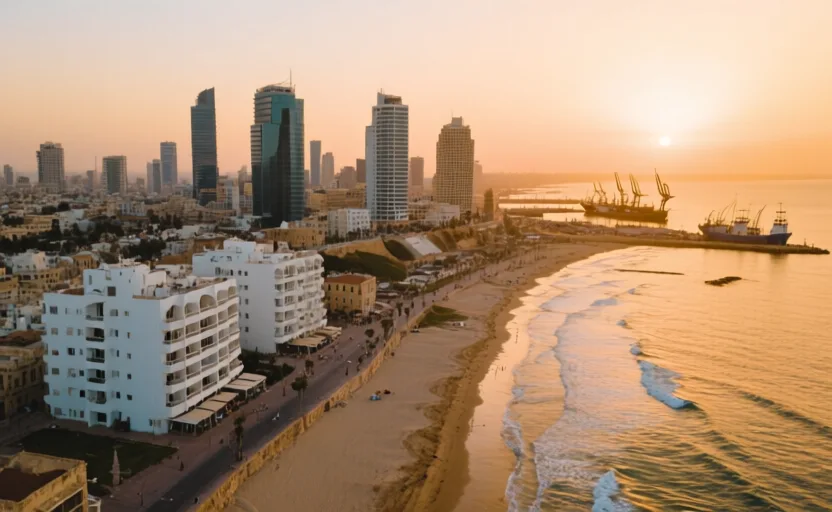 AI city illustration · Artistic impression
What people learn after moving
~470,000 (Tel Aviv-Yafo); ~4 million (Gush Dan metro)
Hebrew (official, own alphabet); Arabic; English very widely spoken
Israeli New Shekel (ILS / ₪); approx ₪3.7 = US$1 (2026)
Israel Standard Time (GMT+2; GMT+3 in summer — observes daylight saving)
AI city illustration · Artistic impressionCost of living in Tel Aviv
Check your eligibility
Pick your passport to see entry rules and the long-stay routes we have researched.
Pick your passport to see whether you can enter Israel — and what it takes to stay.
Israel's immigration system is built around the Law of Return: Jews and their children, grandchildren and spouses are entitled to immigrate (Aliyah) and receive citizenship and a Teudat Zehut (national ID) essentially on arrival, usually free and even subsidised via the Jewish Agency / Nefesh B'Nefesh. Everyone else faces a far narrower system run by the Population & Immigration Authority (PIBA / Misrad HaPnim): the main long-stay route is the employer-sponsored B/1 work visa (notably the 'foreign expert' track, which requires a salary of roughly twice the national average). Most Western nationals enter visa-free for 90 days on a B/2 visitor permit — now gated by a pre-travel ETA-IL — but the B/2 confers zero work rights. Student (A/2), clergy (A/3) and family-reunification routes exist but are situation-specific. Pick your lane before you book a flight: the Aliyah path and the work-visa path share almost nothing.
Tel Aviv is a compact, transit-and-scooter city: the Rav-Kav smartcard (and apps like Moovit and HopOn) covers buses (Dan, Egged, Kavim), the new Light Rail Red Line (opened Aug 2023), and Israel Railways, all with distance-based fares and ~90-minute free transfers. The defining quirk: trains and most buses STOP for Shabbat (Friday afternoon to Saturday night) — sheruts, taxis, scooters, bikes and a free municipal weekend-bus network fill the gap. Visitors may drive on a valid foreign licence (plus an IDP/translation) for up to one year; olim and residents must convert to an Israeli licence via Misrad HaRishui, typically needing only an eye test and green medical form if they qualify for the expedited (no-test) track. Parking is scarce, expensive and governed by blue-and-white zones — a resident sticker is the real prize.
Israel has five dominant banks — Bank Hapoalim, Bank Leumi, Israel Discount Bank and Mizrahi-Tefahot (all branch-based) plus the fully digital ONE ZERO. Opening is straightforward with a Teudat Zehut and usually needs one in-person branch visit even for digital banks (identity verification). The real shock is fees: Israeli retail banking is notoriously expensive, with monthly account-management fees (~₪10-30) and per-action charges on top — so newcomers should negotiate an 'oleh' or low-fee track, or pick ONE ZERO's flat plan. Olim can open an account same-day; non-residents may wait days for compliance approval. US citizens must complete FATCA (W-9) paperwork — a major issue given Israel's large US-Israeli dual-national population.
Israel runs an excellent universal system under the 1995 National Health Insurance Law, delivered by four competing health funds (kupot holim) — Clalit, Maccabi, Meuhedet, Leumit — and funded by a health-tax slice of National Insurance (Bituach Leumi). If you are a resident or oleh, you register with Bituach Leumi, pick ONE kupah, and get the full state benefits basket (sal briut) with only small copays. Olim get coverage from day one of Aliyah, with health-tax typically waived for the first 6 months. Crucially, NON-resident foreign workers on a B/1 visa are NOT in the national system — their employer is legally required by the Foreign Workers Law to provide private medical insurance — and tourists/remote workers must buy private or travel cover. Almost everyone adds bituach mashlim (the kupah's own supplemental plan, ~₪50-150/mo) for faster specialists, surgeon choice, and partial dental. Major Tel Aviv hospitals are Sourasky/Ichilov (downtown) and Sheba/Tel HaShomer just east in Ramat Gan. Emergency ambulance is 101 (Magen David Adom).
Since the 2012 market reform, Israeli mobile is among the cheapest in the OECD: unlimited calls/SMS plus tens-to-hundreds of GB run roughly ₪29-50/month (~US$8-14). The big three are Cellcom, Partner and Pelephone; the cheap MVNOs are Golan Telecom, Hot Mobile, 019 Mobile and Rami Levy. Plans are no-commitment and your number ports for free in minutes, so arrive on a prepaid/eSIM, then switch to a ₪30 monthly plan once you have an ID and a bank account.
Israel taxes residents on worldwide income, with residency set by the 'center of life' test (backed by 183-day and 425-day presumptions). The headline benefit: new immigrants and senior returning residents get a 10-year exemption on foreign-source income AND foreign capital gains — covering work, business, pensions, dividends, interest, rent and gains generated abroad — one of the world's most generous regimes. It does NOT exempt Israeli-source income. Resident income tax is progressive (10/14/20/31/35/47%) plus a 3% surtax on very high income (~50% top), capital gains generally 25%, plus Bituach Leumi and health-tax contributions. Self-employed register with the Tax Authority and VAT (Ma'am standard rate ~18% since 1 Jan 2025).
Each guide has verified costs, timelines, required documents, and the non-obvious gotchas — sourced from official government pages. Last verified 2026-06-29.
Reading a list isn’t learning it. Globe Quest turns these into a trainer — hear each phrase spoken, drill them with spaced repetition, and get scored as you say them out loud.
Israel's system splits hard. If you (or a parent, grandparent, or spouse) are Jewish, the Law of Return entitles you to Aliyah — near-instant citizenship, a Teudat Zehut ID, and an absorption (klita) benefits basket, arranged free via the Jewish Agency / Nefesh B'Nefesh. If you have no such claim, there's no equivalent fast track: you need an employer-sponsored B/1 work visa (the 'expert' track requires ~2x the average wage), and a 90-day B/2 visitor stamp grants zero work rights. There is no digital-nomad visa. Work out your lane before you book a flight.
Olim chadashim and senior returning residents are exempt from Israeli tax on foreign-source income AND foreign capital gains for 10 years — covering salary, business, pensions, dividends, interest, rent and gains generated abroad. It does NOT exempt Israeli-source income. One change to note: for anyone becoming resident on/after 1 Jan 2026, the income stays tax-exempt but you must now disclose foreign assets/income (the old reporting exemption was abolished). Get an accountant before assuming what's covered.
Israel's universal system runs through four health funds (kupot holim: Clalit, Maccabi, Meuhedet, Leumit), funded by a health-tax slice of National Insurance (Bituach Leumi). Olim are covered from day one of Aliyah (health-tax often waived ~6 months). Crucially, B/1 foreign workers and remote workers are NOT in the national system — employers must provide private insurance for B/1 staff, and everyone else needs private/travel cover. Most residents add a cheap supplemental plan (bituach mashlim, ~₪50-150/mo). Ambulance is 101.
From mid-afternoon Friday until after dark Saturday, the trains and most buses stop, and many shops close. Tel Aviv is the most secular city in Israel, so beaches, cafés, bars and restaurants stay open, and the city runs a free municipal weekend-bus network — but to reach Ben Gurion Airport on Shabbat you'll need a taxi or a sherut (the shared yellow minibuses that run all week). Build the rhythm into your week; it catches every newcomer once.
Repeatedly ranked among the world's priciest cities: a central 1-bed runs ₪6,000-9,500/month and a café hafuch ₪14-18. Salaries (especially in tech) are high to match. Day-to-day payments run through Bit (Bank Hapoalim's near-universal P2P app) and PayBox — install one on arrival, as splitting bills and paying landlords often skips cash and bank transfers entirely.
Tel Aviv is a liberal, LGBTQ-friendly, beach-and-startup bubble distinct from the rest of the country — ~300 days of sun, world-class food, and a famously direct, informal social style (don't mistake bluntness for rudeness). Like all of Israel it has a security dimension; locals keep the Home Front Command (Pikud HaOref) app for alerts. Day-to-day life is normal, walkable and safe; learning the city's rhythms is the fastest way to feel at home.
Monday.com, Wix, Fiverr, plus thousands of startups and the global VC/R&D centres of Google, Meta, Microsoft, Nvidia, Apple
Tel Aviv is the engine of 'Startup Nation' — one of the highest startup and VC densities on earth. The deepest market anywhere for engineers, product and founders, with most global tech giants running large R&D centres here.
Check Point, CyberArk, Wiz, Palo Alto Networks (R&D), the Unit 8200 alumni pipeline
Israel is the world's cyber capital, and Tel Aviv/Herzliya is its heart. The elite military-intelligence pipeline feeds a dense cluster of security firms — a global specialism and a magnet for cyber talent.
Local and global VCs, banks (Hapoalim, Leumi), the Tel Aviv Stock Exchange
The financial and investment hub of the country — VC, private equity, fintech and banking cluster in central Tel Aviv around the startup ecosystem they fund.
Elbit Systems, Israel Aerospace Industries (IAI), Rafael
A large, globally significant defence-tech and aerospace sector with deep R&D and engineering employment across the Gush Dan region.
Teva, and a dense biotech, pharma and digital-health startup scene
Pharma, biotech, medical devices and digital health are a major growth cluster, drawing on Israel's strong research universities and hospitals.
A celebrated restaurant scene, beach clubs, bars and a booming tourism sector
Tel Aviv's food, café, beach and nightlife culture is world-renowned and a large employer — a common entry point for new arrivals in F&B and hospitality.
Nature · Mediterranean seafront
Kilometres of golden city beach backed by the Tayelet promenade — matkot (beach paddleball), sunset swims, beach bars and a daily ritual of sea, sun and sport.
Local tip: Gordon and Frishman are the social, central beaches; Hilton beach is the LGBTQ+ and surfer favourite; the quieter southern stretches by Jaffa are calmer. Friday-evening sunset on the sand, with a beer from a kiosk, is the quintessential Tel Aviv moment.
Culture · Jaffa (south)
The ancient port city at Tel Aviv's southern edge — stone alleys, the old harbour, galleries, and the Shuk HaPishpeshim flea market alive with antiques, bars and music.
Local tip: Wander the flea market in the late afternoon when the bars and restaurants among the stalls fill up. Eat at the legendary hummus and seafood spots, watch the sunset from the harbour, and explore the artists' quarter above.
Food · City centre
The city's loud, sprawling main market (Shuk HaCarmel) — produce, spices, street food and bargains — spilling into the atmospheric Yemenite Quarter's tiny food joints.
Local tip: Go hungry: graze hummus, sabich, knafeh and fresh juice. Dive into the Kerem HaTeimanim lanes beside the market for the city's best old-school Yemenite and Mizrahi cooking, then a drink at one of the new-wave bars hidden among the stalls.
Landmark · City centre
The leafy, café-lined central boulevard at the heart of the UNESCO-listed 'White City' — the world's largest concentration of 1930s Bauhaus architecture.
Local tip: Stroll or bike the shaded median past the Bauhaus facades and kiosks; stop at the Independence Hall. Take a Bauhaus walking tour to actually see the architecture you'd otherwise walk straight past. The boulevard is the city's social spine.
Neighborhood · South Tel Aviv
The gritty, graffiti-covered former workshop district turned hipster heartland — street art, dive bars, design studios, hummus joints and the city's edgiest nightlife.
Local tip: Come for the street-art walls (some of the best in the Middle East) and stay for the bars; weekend nights here are the rawest, youngest scene in the city. Great cheap eats and a real artists-and-makers energy.
Culture · South-west of centre
Tel Aviv's first neighbourhood — charming low-rise lanes, boutiques and the Suzanne Dellal dance centre — beside HaTachana, the restored old Jaffa railway station turned shopping-and-dining compound.
Local tip: Wander Shabazi Street's boutiques and cafés, catch a show at Suzanne Dellal, then walk to HaTachana and on to the beach. The prettiest, most village-like corner of the city — a calm contrast to the boulevards.
Side-by-side cost of living, language, climate and careers — to help you choose.