Population
≈650,000 in the commune of Tunis; roughly 2.7 million across Greater Tunis including Ariana, Ben Arous and Manouba
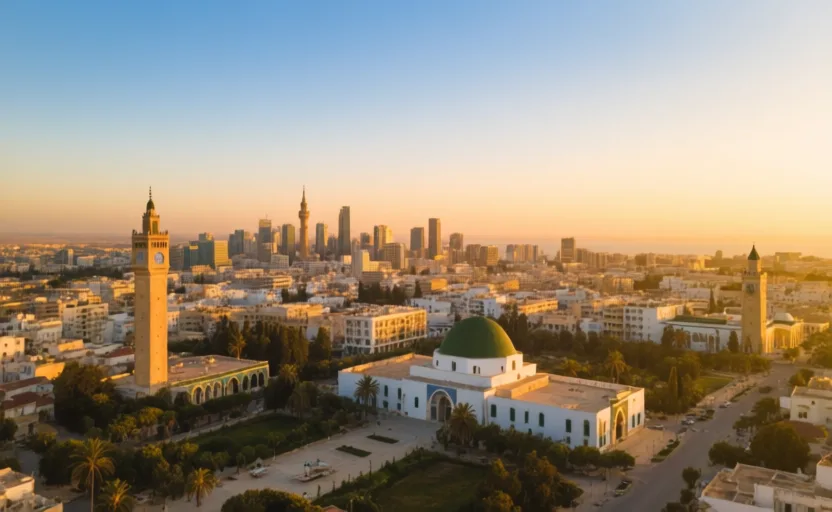 AI city illustration · Artistic impression
What people learn after moving
≈650,000 in the commune of Tunis; roughly 2.7 million across Greater Tunis including Ariana, Ben Arous and Manouba
Tunisian Arabic (derja) and French in daily use; French near-universal in business and administration; English increasingly common among younger professionals
Tunisian dinar (TND) — non-convertible, and it is illegal to take banknotes out of the country
CET (GMT+1) year-round — Tunisia does not observe daylight saving, so the offset from Europe shifts twice a year
AI city illustration · Artistic impressionCost of living in Tunis
Check your eligibility
Pick your passport to see entry rules and the long-stay routes we have researched.
Pick your passport to see whether you can enter Tunisia — and what it takes to stay.
Tunisia requires a carte de séjour from anyone residing more than three consecutive months, or more than six non-consecutive months in a year. The temporary card runs no longer than the documents behind it and never beyond one year; the ordinary card, valid two years and renewable, comes later. The two things that catch people are the non-consecutive limb of the threshold and the exit penalty — because a residence problem in Tunisia is settled at the border, not by post.
The ATTT will transform a foreign licence into a Tunisian one, but you must hold resident status and you must apply within one year of your last entry into Tunisia. That second condition is unusual and it is the one that catches people: the clock runs from your most recent arrival, and the file asks for a document evidencing that date. The licence must be valid and not suspended, restricted or withdrawn. In Tunis itself, the TGM and the métro léger cover a great deal and a car is genuinely optional if you live on a line.
The dinar is non-convertible and it is illegal to take banknotes out of the country. What money can do is therefore decided by account type and by status: resident dinar accounts, convertible dinar accounts for non-residents, and foreign-currency accounts each behave differently. For a business serving clients abroad, the non-resident fully-exporting company regime — which permits foreign-currency accounts and justified foreign settlements without prior Central Bank authorisation — is the structural answer. A replacement exchange code has been before parliament since October 2025; until it passes, the 1976 regime is the law.
A Tunisian employer must affiliate with the CNSS and declare a new recruit within forty-eight working hours of hiring. Health cover then runs through the CNAM, and the insured person chooses a filière — public sector, private 'family doctor' sector, or a reimbursement track — which determines where you can be treated and how you pay. Tunis has good private clinics at prices that surprise Europeans. The catch to understand early is that benefits are generally not payable to foreign workers who cease to reside in Tunisia unless a reciprocity agreement provides otherwise.
Buy the SIM in an operator shop with your passport — registration against identity is required and a pre-activated card from a kiosk is in someone else's name. Prepaid is cheap and immediate. Fixed broadband in Tunis is adequate rather than exceptional and varies substantially by district: the newer developments around the lake and in the northern suburbs are better served than the older centre. The genuinely useful thing to know is that Tunisia does not observe daylight saving, so the gap to Europe moves twice a year.
Tunisia taxes residents on their income under the IRPP, with residence turning on having your habitual abode here — a main home in Tunisia, or presence for a substantial part of the year. Employees have tax withheld at source. The structural feature that matters is the non-resident, fully-exporting regime: it is simultaneously a tax status and an exchange-control status, and for anyone serving clients abroad the two questions have to be answered together because the same structure decides both.
Each guide has verified costs, timelines, required documents, and the non-obvious gotchas — sourced from official government pages. Last verified August 2026.
Reading a list isn’t learning it. Globe Quest turns these into a trainer — hear each phrase spoken, drill them with spaced repetition, and get scored as you say them out loud.
Tunisian law requires a carte de séjour from anyone residing more than three consecutive months, or more than six non-consecutive months in a year. That second limb is the trap: people who winter here, leave, and return in spring believe they have reset a clock they have not. Failing to hold a card when required is a criminal offence under loi n° 68-7, not a paperwork lapse, and it surfaces at the airport.
If your residence card has expired or you have overstayed a visa, the border police assess a penalty in the form of a fiscal stamp scaled to the length of the overstay, and you pay it at the airport before you are permitted to leave. People discover this at passport control with a boarding pass in hand and a flight in forty minutes. The statutory position is harsher still — imprisonment and a fine under article 23 of loi 68-7. Check the current rate with your district rather than trusting any published figure.
A contract between a Tunisian company and a foreign national is limited to one year and renewable only once. That is the labour law, not a company policy. Anyone moving to Tunis on an ordinary employment contract should understand from the first week what the third year is supposed to look like — a different basis, an investment-law route, or leaving. The investment law relaxes the quota on how many foreigners a company may employ; it does not extend the contract.
Importing or exporting Tunisian banknotes and coin is prohibited. There is no legal way to carry dinars out, no meaningful market in them abroad, and no way to convert an unspent balance at the airport without the exchange receipts showing where it came from. Foreign currency above the customs threshold must be declared on entry — and that declaration is what lets you take it out again. Keep every bureau de change receipt.
A non-resident, fully-exporting company — at least 66% of capital held by non-residents and funded by importing convertible currency — may hold accounts in foreign currency or convertible dinars and settle justified foreign transactions without prior Central Bank authorisation. For a consultant or an agency serving European clients from Tunis, that is the difference between a functioning business and a permanent argument with exchange control. Note that the company being non-resident does not make you personally non-resident.
Alcohol is sold openly in supermarkets and served widely, mixed social life is unremarkable, and the northern suburbs are visibly Mediterranean rather than conservative. The cost base is materially below Morocco's and far below Europe's. The trade-offs are a small and fragile economy, a currency you cannot take out, and public services that have been under real strain — none of which show up on a two-week visit.
Teleperformance, Sitel/Foundever, Vermeg, Sofrecom, Talan, Linedata
French-language IT, finance and customer operations for European clients are the volume employer in Tunis, and the reason the city has a large population of engineers working European hours for Tunisian salaries.
InstaDeep alumni, Expensya, Kaoun/Flouci, GoMyCode, El Ghazala technopark firms
Tunisia has produced genuinely internationally-known technology companies from a very small base — InstaDeep's sale to BioNTech is the reference point — and the Startup Act gives labelled companies real tax and foreign-currency privileges.
Leoni, Sagemcom, Aptiv, Marquardt, Yazaki, Coficab
Wiring harnesses, electronics and aerospace components for European manufacturers are a substantial part of the economy, mostly in the industrial belts around Tunis, Bizerte and Sousse under the fully-exporting regime.
BIAT, Attijari Bank Tunisie, Amen Bank, UIB, BCT
A domestically-focused banking sector operating under exchange control — which is why so much foreign-facing business is structured through non-resident entities rather than ordinary Tunisian accounts.
Ministries, the African Development Bank's historical presence, UN agencies, EU delegation
Tunis is the seat of the Arab Maghreb Union and hosts a substantial diplomatic and development sector, concentrated in the northern suburbs alongside the international schools.
Carthage, Sidi Bou Said, the Bardo, coastal hotels
Less dominant in Tunis than on the coast, but Carthage and the Bardo mosaics are world-class and the sector remains a significant employer and a barometer of the wider economy.
Landmark · City centre, west of Avenue Bourguiba
A UNESCO-listed old city of covered souks, Ottoman palaces and the Zitouna mosque — lived in rather than curated.
Local tip: Far less commercialised than Marrakech's, and correspondingly less hassled. Go up: several souk merchants will let you onto their roof terrace for a small purchase or a tip, and the view across the tiled rooftops to the Zitouna minaret is the one photograph worth taking here.
Culture · Northern suburbs, above the bay
The blue-and-white cliff village above Carthage — cobbled lanes, bougainvillea, and the most photographed place in the country.
Local tip: It is genuinely beautiful and genuinely overrun between eleven and four. Go at eight in the morning or after six, when the coaches have gone and the residents come back out. Café des Nattes is the famous one; the terrace at Café Sidi Chabaane further down has the better view of the gulf.
Landmark · Northern suburbs, on the TGM line
The Punic and Roman capital, scattered across several separate sites among modern villas and the presidential palace.
Local tip: It is not one site — the Antonine Baths, the Punic ports, the amphitheatre and the Byrsa hill are each separate stops on the TGM, and a single ticket covers them. Most visitors do one and leave. The Punic ports are the smallest and the most historically astonishing.
Neighborhood · End of the TGM line, north
The coastal suburb belt — beaches, cafés, international schools, embassies and most of the city's foreign residents.
Local tip: La Marsa's corniche and the café strip behind it are where the northern suburbs actually socialise. Gammarth beyond it is quieter, more villa-and-hotel, and thinner on daily life. If you are choosing between them, spend an ordinary Tuesday evening in each.
Culture · West of the centre
One of the world's great collections of Roman mosaics, housed in a nineteenth-century beylical palace.
Local tip: The scale is the point — room after room of floor mosaics lifted whole from villas across the country, in a quantity no European museum can match. Allow three hours rather than one, and go on a weekday. The Virgil mosaic is the famous piece and the marine scenes are better.
Nature · 1–1.5 hours east around the gulf
The peninsula closing the Gulf of Tunis — hot springs running into the sea at Korbous, cliffs, vineyards and quiet beaches.
Local tip: Korbous has thermal springs that pour straight off the rocks into the Mediterranean, and you can sit in the hot outflow with cold sea around you. It is a local weekend habit and almost unknown to foreigners in Tunis. Go on a weekday and continue up the coast road toward Sidi Daoud, which is one of the best drives in northern Tunisia.
Side-by-side cost of living, language, climate and careers — to help you choose.