
Population
≈1.1 million and declining from a mid-2010s peak — the smallest of Korea's metropolitan cities
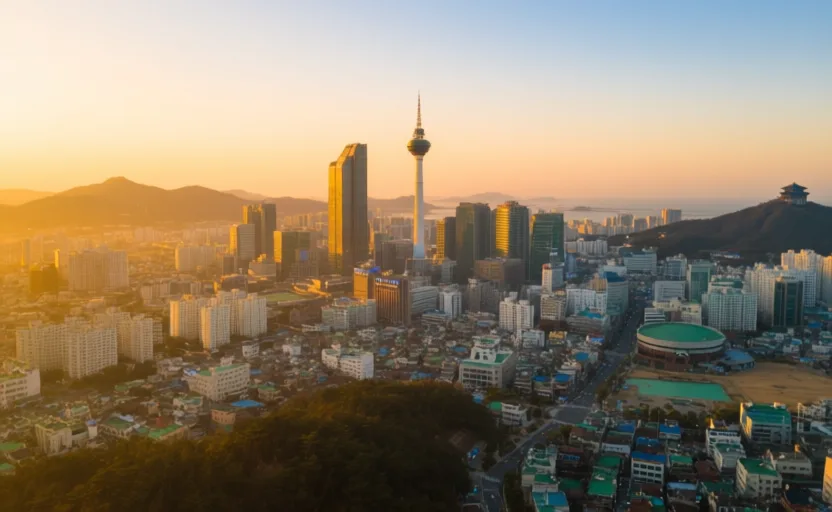 AI city illustration · Artistic impression
What people learn after moving
≈1.1 million and declining from a mid-2010s peak — the smallest of Korea's metropolitan cities
Korean, in the Gyeongsang dialect — pitch-accented, blunt, with -나 and -노 question endings. Ulsan speech sits closest to Busan's
South Korean won (KRW, ₩)
KST (GMT+9) — Korea does not observe daylight saving
AI city illustration · Artistic impressionCost of living in Ulsan
Check your eligibility
Pick your passport to see entry rules and the long-stay routes we have researched.
Pick your passport to see whether you can enter South Korea — and what it takes to stay.
Korea separates entry from residence completely. Visa-free entry or a K-ETA lets you visit and nothing else. The long-stay category — E-7 skilled work, E-9 non-professional employment, E-2 teaching, D-8 startup, D-10 job search, D-2 study, F-6 spouse, F-1-D remote work — is normally issued by a Korean consulate before you fly, and several cannot be switched into from inside Korea. Once here you have ninety days to register and obtain the Alien Registration Card. Ulsan's own shape is industrial: a very large share of its foreign residents are here on employment categories tied to a specific sponsor in the auto, shipbuilding or petrochemical supply chains, often through subcontractors — and the identity of that sponsor, not just the visa letter, is what your residence actually depends on.
You may drive on your home licence plus a Geneva Convention International Driving Permit for one year from entry, and the permit must be issued at home before you fly. Once you hold an ARC, KoROAD will exchange your foreign licence — an eyesight and aptitude check for reciprocity countries, a 40-question written test in English for everyone else. Do this promptly here: Ulsan is the only Korean metropolitan city with no urban rail in operation, the industrial complexes and the Ulju attractions are spread across a very wide area, and the KTX station is a long way out of town. A car is not a convenience in Ulsan, it is close to infrastructure.
A Korean account belongs to a verified identity, and for a foreigner that identity is the ARC. Before it arrives some banks will open a deposit-and-withdraw-only account on a passport — no transfers, no app banking, no outward remittance. A full account needs the ARC plus a Korean mobile number registered in exactly the same name. Even then, anti-fraud rules open every new account as a limited-transaction account capped around ₩1 million a day until you document its purpose. Ulsan's practical wrinkle is that a very large part of its foreign workforce remits money home every month, so outward transfer cost and limits deserve more attention than the account-opening ritual — and BNK Busan Bank is the regional institution with the strongest presence here alongside the national banks.
National Health Insurance enrolment is compulsory once you pass six months of residence and cannot be declined because you hold private cover. With an employer the premium is split and payroll-deducted; without one you become a local subscriber billed a premium benchmarked to the national average rather than to your Korean income. Arrears can block a visa extension. Pension contributions are equally compulsory and reclaimable on departure only depending on your nationality. Ulsan adds a second system most Korean cities barely surface: industrial accident insurance and statutory occupational health checks, which cover foreign workers on the same terms as Korean ones and are separate from NHIS entirely.
The point of a Korean number is identity, not calls. Korean real-name verification binds your name, birth date, registration number and phone line together, and only a line registered to you personally passes it — which gates banking apps, delivery, government portals and most of the useful internet. A data eSIM or a passport-bought prepaid SIM gives connectivity and a number but not verification. The sequence is eSIM or prepaid as a bridge, then the ARC, then a postpaid or MVNO line in your own name. Home fibre is fast and cheap in the apartment stock; the Ulsan-specific caution is company housing and dormitories, where you may not control the connection at all.
You become a Korean tax resident by having a settled life here or by 183 days of presence in a tax year. Residents are taxed on worldwide income at progressive rates plus a 10% local surtax. Two national reliefs matter to foreigners: resident five years or fewer of the last ten and your foreign-source income is taxed only when a Korean payer pays it or you remit it; and foreign employees may elect a flat 19% on Korean employment income, forfeiting all deductions. That second one deserves more attention in Ulsan than anywhere else in Korea: this is the region with the highest output per head and among the highest industrial wages, which is exactly the income range where a flat rate can beat the progressive scale.
Each guide has verified costs, timelines, required documents, and the non-obvious gotchas — sourced from official government pages. Last verified August 2026.
Reading a list isn’t learning it. Globe Quest turns these into a trainer — hear each phrase spoken, drill them with spaced repetition, and get scored as you say them out loud.
Ulsan has for years recorded the highest gross regional product per head of any Korean region, on the back of Hyundai's car plant, HD Hyundai's shipyard and the Ulsan and Onsan petrochemical complexes. Housing has not kept pace with that: a family apartment here costs a fraction of a Suwon or Seoul equivalent, and rents sit close to Daegu's rather than the capital region's. For an engineer or technician on an industrial contract that combination is the single strongest financial case in the country. The catch is that the earning half is concentrated in a handful of employers and their supply chains, so if your work is not in that ecosystem the premium does not reach you.
The eastern district is the shipyard district, and its rental and sale prices have historically tracked HD Hyundai's order book with very little lag — emptying out through the late-2010s downturn and refilling as orders returned. Practically, that means two things for a tenant. First, ask what the yard's hiring looks like before you sign a two-year lease that assumes the district stays full. Second, and more usefully, a downturn is exactly when Dong-gu offers the best-value stock in Ulsan. Either way, do not treat the district as a stable market the way you would Nam-gu.
There is no subway, no light rail and no tram in operation. The city runs on buses, a limited BRT and a great many cars — car ownership per head is among the highest in Korea, which is unsurprising in the city that builds them. A hydrogen tram line from Taehwagang station to the Sinbok junction, roughly 10.85 km with about fifteen stops, cleared its national feasibility assessment in 2024 with construction targeted from 2026 and opening targeted for 2029; Korean rail dates move, so treat it as a plan. Until it runs, assume you will drive or take a bus, and weigh a flat's road access more heavily than you would anywhere else in Korea.
Unpaid national and local taxes rank ahead of your deposit when a property goes to auction. Since April 2023 a tenant whose deposit exceeds ₩10 million may inspect the landlord's unpaid national taxes at any tax office in the country, without the landlord's consent, from the moment the contract is signed until the lease start date, on production of ID and a copy of the contract; unpaid local taxes are inspected the same way at any si/gun/gu office. Before signing you still need consent, so ask for it and treat a refusal as an answer. Ulsan sits in the metropolitan-city deposit bracket — a deposit up to ₩85 million qualifies for the ring-fenced slice, with ₩28 million protected first in line — which covers a great many tenants here outright.
This is a working industrial city and the Mipo and Onsan complexes are large, close and legally sited where they are. Odour and air-quality episodes are a documented, localised and wind-dependent feature of life in parts of Nam-gu and southern Ulju rather than a constant across the city — Jung-gu along the Taehwa river and Buk-gu inland are a different experience entirely. The only reliable research is asking people who live in that specific block what a bad day smells like, and visiting once in the evening as well as at a midday viewing. The city publishes air-quality monitoring by station; read it before you shortlist.
The Taehwagang was an effectively dead river in the 1990s, and the clean-up that followed produced Korea's second national garden, designated in 2019, right in the middle of the city — bamboo groves, a summer rose garden and a heron and rook colony that returns in numbers. It is genuinely unusual: a national-garden-grade park inside a heavy industrial city, walkable from Jung-gu and Nam-gu. Whatever else the industry does to Ulsan's reputation, the riverside is the daily amenity that residents actually cite, and it should weigh in where you choose to live.
Hyundai Motor Ulsan plant and roughly 700 auto-related suppliers
The Ulsan complex is the largest single automobile plant in the world — five factories on one site with its own pier — producing on the order of 1.5 million vehicles a year with a workforce in the tens of thousands. A dedicated EV plant on the site broke ground in November 2023 for around ₩2 trillion with mass production planned from early 2026, though reporting in 2026 indicates the planned capacity has since been cut substantially as EV demand softened.
HD Hyundai Heavy Industries, HD Hyundai Mipo, the Dong-gu supplier belt
The Dong-gu yard is one of the largest shipbuilding sites anywhere, and the district's economy, housing and hiring all move with its order book. Work is heavily cyclical and a large share of the on-site workforce is subcontracted, which is worth understanding before signing anything.
SK Energy, S-Oil at Onsan, Lotte Chemical, Kumho Petrochemical, the Ulsan Mipo and Onsan national industrial complexes
Ulsan holds the country's largest refining and petrochemical concentration, which is the third leg of the local economy and the biggest single reason the region's output per head is what it is. It is also the source of the air-quality and odour questions worth asking before choosing a neighbourhood.
Korea Zinc and the Onsan smelting cluster
The Onsan complex holds one of the world's largest zinc smelting operations alongside a wider non-ferrous metals cluster. It is a specialist, capital-intensive sector with a small but well-paid technical job market and a long history of local environmental scrutiny.
The city's hydrogen programme, floating offshore wind consortia off the Ulsan coast, industrial hydrogen users
Ulsan has positioned itself as Korea's hydrogen city — by-product hydrogen from the petrochemical complex, a hydrogen tram planned for the first urban rail line, and large floating offshore wind projects proposed off the coast. Several of these are still at consortium and permitting stage, so treat announced capacities and dates as intentions.
UNIST, University of Ulsan and its medical school, Korea Institute of Industrial Technology's Ulsan centres
UNIST is one of the four national science and technology institutes, opened in 2009, with a graduate-heavy and largely English-language research culture — the main non-industrial route into the city for foreign professionals. The University of Ulsan is closely tied to the Hyundai group and runs the region's main teaching hospital.
Nature · Jung-gu
Korea's second national garden, designated in 2019 on reclaimed riverbank that was a dumping ground thirty years ago, with a ten-li bamboo grove along the water.
Local tip: The bamboo grove (십리대숲) is the reason to come and it is best at dusk, when the rook and heron colonies come in to roost — a genuinely startling sight for a park in the middle of an industrial city. The summer rose garden and the night walk lighting run from late spring.
Culture · Ulju-gun
Rock carvings up to 7,000 years old along the Bangucheon stream, inscribed on the UNESCO World Heritage List in July 2025, including what is believed to be the world's oldest depiction of whale hunting.
Local tip: The Bangudae panel is often partly submerged by the Sayeon Dam reservoir, so check the water level before you go — winter and dry spells are when the carvings are visible. The museum at the site and the separate Cheonjeon-ri panel upstream are worth the trip regardless of the water.
Nature · Dong-gu
A headland of wind-shaped pines and split black rock at the eastern tip of the city, with a footbridge out to the rock said to hold a queen's tomb.
Local tip: Go at sunrise — this is one of the first places on the mainland to get the light, and the pine grove on the way out is empty at that hour. It is a short walk from Ilsan beach, which is the closest thing Dong-gu has to a resort front and is where the shipyard district goes on a Sunday.
Culture · Nam-gu
The old whaling port turned into a museum quarter — a reconstructed 1960s-70s village, a whale museum and an aquarium, on the water at Jangsaengpo.
Local tip: The reconstructed village is more interesting than the museum: it is a full-scale 1970s Korean port street, and older Ulsan residents visit it as a memory rather than as history. Commercial whaling has been banned since 1986, which the site handles more directly than you might expect.
Landmark · Ulju-gun
The cape that sees the earliest sunrise on the Korean mainland, with a lighthouse, a wind-blasted headland and an enormous postbox.
Local tip: New Year's Day is a crowd of tens of thousands and is worth avoiding unless that is the point. Any other clear morning it is nearly empty, and the coastal path north toward Jinha beach is one of the better walks in the province. About an hour from central Ulsan by bus.
Nature · Ulju-gun
A range of nine peaks over a thousand metres on Ulsan's western edge, with a silver-grass plateau that turns the ridges white in autumn.
Local tip: The Ganwoljae silver grass in October is the famous sight and the ridge is packed for it; go on a weekday or start before six. Ulju runs a 'nine peaks' completion certificate that a surprising number of residents are quietly working through, which is the local way into the hiking scene.
Side-by-side cost of living, language, climate and careers — to help you choose.