
Population
≈92,000 in the City of Victoria itself and about 400,000 across greater Victoria, which is divided into thirteen separate municipalities
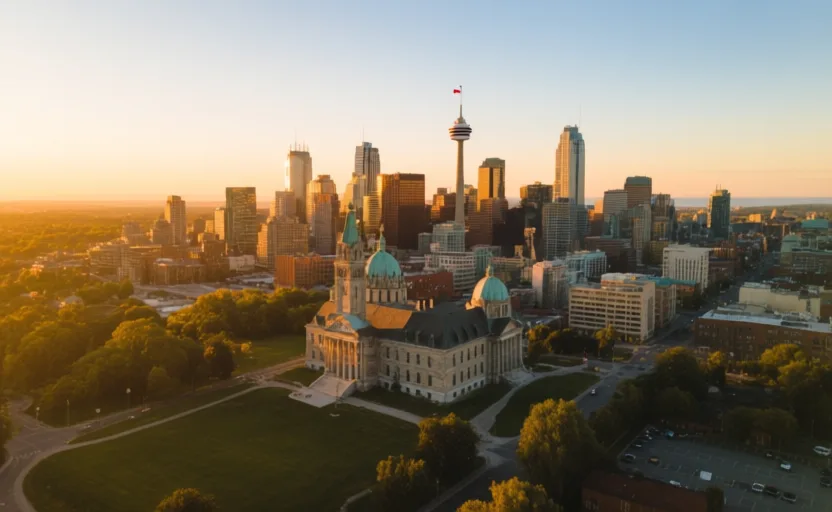 AI city illustration · Artistic impression
What people learn after moving
≈92,000 in the City of Victoria itself and about 400,000 across greater Victoria, which is divided into thirteen separate municipalities
English. This is the territory of the Lekwungen (Songhees and Esquimalt) peoples, and Chinese, Punjabi, Tagalog and German are the most commonly spoken other home languages
Canadian dollar (CAD)
PST/PDT (GMT−8/−7) — the same clock as Vancouver, Seattle and San Francisco, and three hours behind Toronto
AI city illustration · Artistic impressionCost of living in Victoria
Check your eligibility
Pick your passport to see entry rules and the long-stay routes we have researched.
Pick your passport to see whether you can enter Canada — and what it takes to stay.
Two doors, and the provincial one narrowed sharply. Express Entry ranks you on points, needs no employer, and carries a six-month service standard after an invitation. The BC Provincial Nominee Program is the second door, and after its federal allocation was cut it stopped issuing general and tech draws, ended the Entry Level and Semi-Skilled stream after December 2024, and declined to launch the planned graduate streams. From 2026 it is organised around three priorities — Care (health, education, childcare and veterinary), Build (certified skilled trades) and Innovate (high-impact roles) — and the province expects at least 35% of nominations to go to candidates working outside Metro Vancouver, which is a point in Victoria's favour rather than against it. Skills Immigration application fees rose to $1,750 on 22 January 2026.
You have 90 days to switch to a BC licence after moving. A defined list of jurisdictions exchanges without testing; everyone else takes a knowledge and road test. The critical document is your driving history: two years of non-learner experience exempts you from the Graduated Licensing Program, and ICBC will credit up to fifteen years of experience against an acceptable driving record — which is worth a great deal of money, because basic insurance is bought from ICBC and priced on that record. Then there is the geography: reserve your ferry sailings, check the Malahat before driving north, and expect winter tyres to matter on the highways even though they are irrelevant downtown.
Opening a chequing account takes under an hour and every major bank runs a newcomer package with waived fees and no requirement for Canadian credit history. Your credit record does not cross the border, and in a rental market this tight an empty file plus no employment letter is what loses you the flat. Two BC-specific things: the credit unions here compete seriously on day-to-day banking and lending, and if you are thinking about buying, budget for the property transfer tax and understand that British Columbia charges an additional transfer tax on foreign purchasers in specified areas — of which the capital region is one.
MSP charges no premiums, but coverage does not start on arrival: the waiting period is the balance of the month in which you establish residence plus two further months. Buy private cover for the gap, or keep your former province's plan running. Enrolment is online, and the physical BC Services Card — which is both your health card and your provincial ID — is issued at an ICBC driver licensing office, so it is the same appointment as your licence. Prescription drugs run through Fair PharmaCare, an income-tested plan you must register for; it is not automatic. Finding a family doctor is done through the Health Connect Registry, and the wait on Vancouver Island is long.
Every phone sold in Canada has been unlocked since 2017, so bring your handset. Without a Canadian credit file a postpaid plan means a credit check and often a deposit — unless you ask for a newcomer plan and present a work permit, study permit or PR card, which waives it. Flanker brands ride the same networks for much less. Fixed internet in the urban core is good, with cable and fibre competing; out towards Sooke, the Highlands and the rural peninsula it thins out fast. And because the Island's connectivity depends on submarine cable, a single cut can degrade service across the region in a way mainland cities do not experience.
One return to the CRA, due 30 April, covering both federal and BC tax. British Columbia's brackets are its own: the top provincial rate is 20.5% on income over $265,545 for 2026, which combined with the federal rate puts the top marginal rate a little above 53%. The brackets were indexed by 2.2% for 2026, but indexation has been paused for 2027 through 2030 — quiet bracket creep that almost nobody has noticed. Sales tax is 5% GST plus 7% PST charged separately rather than harmonised, so the total depends on what you are buying. And if you own residential property in the capital region, the Speculation and Vacancy Tax declaration is due every 31 March without fail.
Each guide has verified costs, timelines, required documents, and the non-obvious gotchas — sourced from official government pages. Last verified August 2026.
Reading a list isn’t learning it. Globe Quest turns these into a trainer — hear each phrase spoken, drill them with spaced repetition, and get scored as you say them out loud.
The capital region is a designated taxable area — Victoria, Saanich, Oak Bay, Esquimalt, View Royal, Langford, Colwood, Sidney, Central Saanich, North Saanich, Metchosin, Highlands and Sooke are all named. Every residential owner in those municipalities must file a declaration each year by 31 March, even with nothing to report. For the 2026 tax year the rate for Canadian citizens and permanent residents rose to 1% of assessed value and for foreign owners and untaxed worldwide earners to 3%, with a further rise scheduled for 2027. The people it hurts are rarely speculators: they are owners posted away for a year, or renovating slowly, or who simply never opened the envelope.
MSP has charged no premiums since 2020, but coverage does not begin on arrival. The wait is the balance of the month in which you establish residence plus two further months, so an arrival on 20 September means coverage from 1 December. Buy private cover for the gap on the day you book your flight, and if you are moving from another province arrange to keep that province's plan running through the wait. Newcomers who have read Ontario guidance — where the three-month wait was abolished in 2020 — arrive uninsured and do not know it.
The Malahat, the mountain section of Highway 1 north of town, is the only road link up-island; a crash or a snowfall closes it outright with no practical detour. Everything else moves by water or air: BC Ferries from Swartz Bay to the mainland, the MV Coho and the Victoria Clipper to Washington State, and float planes from the Inner Harbour to downtown Vancouver in about thirty-five minutes. Book ferry reservations for anything that matters, keep a passport current if you will use the American boats, and understand that living here means a permanent low-level logistics tax on travel.
This is the warmest winter in the country and the region publishes a flower count in February to prove it. Two consequences newcomers miss. Summers here are genuinely dry — the capital region runs on reservoirs and water restrictions are a normal part of July and August, not an emergency. And because measurable snow is rare, there is very little clearing equipment and the terrain is steep in places; ten centimetres closes schools, strands buses and produces a week of chaos that Winnipeg would not notice.
Greater Victoria is not one city. The City of Victoria itself holds fewer than 100,000 people; Saanich, Langford, Oak Bay, Esquimalt and the rest are separate municipalities with their own councils, bylaws, building permits and, in several cases, their own police departments. Amalgamation is the region's permanent argument. Practically: your parking rules, your short-term rental rules, your building permit and the police non-emergency number all depend on which municipality your address sits in, and a rule you read about 'Victoria' may not apply to you.
The provincial public service is headquartered here and is the largest employer in the region; CFB Esquimalt, home of Maritime Forces Pacific, is the largest single-site one. The University of Victoria, Camosun College and Island Health follow. There is a genuine technology sector — ocean science, marine robotics, health software and games — but it is made of small and mid-sized companies rather than large ones, and the practical route in is through the local network rather than through job boards. Salaries across the board trail Vancouver's while housing does not trail it by nearly as much.
BC Public Service, the Legislative Assembly, BC Housing, BC Hydro regional offices, Crown agencies
The capital's defining employer. Ministries are headquartered here rather than in Vancouver, which makes the BC Public Service the largest employer in greater Victoria and gives the city an unusually stable, well-pensioned professional class. Many roles require Canadian citizenship or permanent residence.
CFB Esquimalt, Maritime Forces Pacific, Fleet Maintenance Facility Cape Breton, Seaspan Victoria Shipyards, Babcock Canada
Canada's Pacific naval base and the largest single-site employer in the region, with a civilian workforce alongside the uniformed one. The Victoria Shipyards in Esquimalt handle submarine and frigate refits — long-cycle work that sustains a skilled trades economy.
Island Health, Royal Jubilee Hospital, Victoria General Hospital, Saanich Peninsula Hospital
Island Health runs services for all of Vancouver Island from here, so the hospitals serve a catchment far larger than the city. Health care is among the largest employers and is one of the three occupation groups BC's nominee programme now prioritises.
University of Victoria, Camosun College, Royal Roads University, Ocean Networks Canada, Institute of Ocean Sciences
UVic anchors the region's research, and Ocean Networks Canada operates cabled undersea observatories from here. Ocean science is a genuine local specialism built on the geography rather than on policy.
Latitude Technologies, StarFish Medical, Certn, Semaphore Solutions, Codename Entertainment, Carmanah/Kirkland, VIATEC member firms
Several hundred small and mid-sized firms in health technology, marine and environmental sensing, security software and games, organised around the VIATEC industry association. It is a real sector and a shallow one — few large employers, so a redundancy usually means a smaller pond than in Vancouver.
BC Ferries, Black Ball Ferry Line, Harbour Air, Victoria Clipper, the Fairmont Empress, Butchart Gardens, Ogden Point cruise terminal
A large seasonal economy built on cruise calls at Ogden Point, the American day-trip market and the gardens. It is the reason downtown feels different in February and August, and the reason a great deal of the service workforce is on seasonal contracts.
Landmark · Downtown, at the foot of Government Street
The working harbour at the centre of the city — the 1898 Legislative Assembly outlined in lights, the Empress hotel opposite, float planes landing among the water taxis, and the Coho tying up from Washington State.
Local tip: The float plane traffic is the thing to watch: this is a scheduled commuter service to downtown Vancouver taking about thirty-five minutes, and it is the fastest link between the two cities. Free public tours of the Legislature run most of the year, and the building is genuinely worth the hour.
Nature · Immediately south of downtown
Seventy-five hectares of Garry oak meadow, ponds and gardens running down to a cliff-top path above the Strait of Juan de Fuca, with the Olympic Mountains across the water in Washington.
Local tip: Go along Dallas Road in a winter southeasterly when the strait is white and the mountains are clear — it is the best free thing in the city and almost nobody visits in February. The Garry oak meadows are a genuinely endangered ecosystem, which is why parts are fenced off in spring.
Culture · Fisgard Street, north end of downtown
The oldest Chinatown in Canada, established in 1858 during the Fraser gold rush, with Fan Tan Alley — a metre wide in places — running through the middle of the block.
Local tip: The alley was a gambling and opium quarter and is now full of very small shops; go on a weekday morning before the cruise passengers. The interpretive plaques on Fisgard are unusually honest about the head tax and the exclusion era, which is not true of every heritage district in Canada.
Food · West of the Inner Harbour, Erie Street
A floating village of brightly painted houseboats, fish-and-chip and seafood kiosks, and a resident harbour seal population that has learned exactly how this works.
Local tip: Take the little harbour ferry across from the Inner Harbour rather than walking — they are the smallest passenger ferries you will ever board and in summer they perform a synchronised water ballet on Sunday mornings, which is exactly as odd and as charming as it sounds.
Neighborhood · North-east of downtown, around Gladstone and Fernwood Road
A dense pre-war neighbourhood of narrow streets and heritage houses around a tiny square with a theatre, a bakery, a coffee shop and a co-operatively run grocery.
Local tip: This is where the city's non-tourist life happens and where a newcomer is most likely to end up making friends. It is also a useful housing lesson: character conversions with cheap rent and no insulation, walkable to downtown, and precisely the sort of stock that is being eyed for redevelopment.
Nature · James Bay and Vic West, either side of the harbour mouth
A 750-metre concrete arm reaching into the strait past the cruise terminal, decorated along its base with a large Coast Salish mural, and a harbourside path opposite running from the bridge to the point.
Local tip: Walk out on the breakwater in a westerly when the swell is breaking over it — it is the closest thing this sheltered city has to open ocean. The Unity Wall mural at its base is worth reading properly, and the Songhees walkway across the water gives the best view of the downtown skyline at dusk.
Side-by-side cost of living, language, climate and careers — to help you choose.