
Population
≈380,000 in the tiny city proper; over 1 million across the continuous urban area spilling into Sleman and Bantul
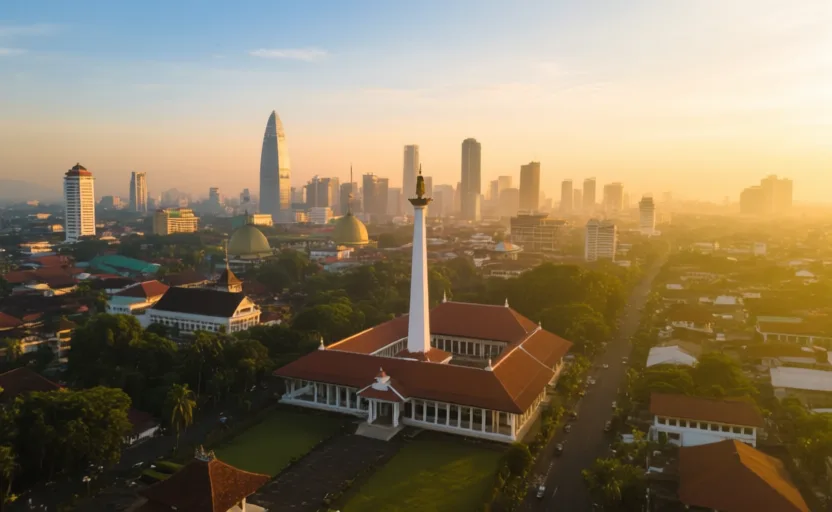 AI city illustration · Artistic impression
What people learn after moving
≈380,000 in the tiny city proper; over 1 million across the continuous urban area spilling into Sleman and Bantul
The only Indonesian province with no gubernatorial election — under Law 13/2012 the reigning Sultan is governor and the Prince of Pakualaman is deputy
Indonesian and Javanese, in the courtly krama-heavy register. English is common around the universities and thin elsewhere
Indonesian rupiah (IDR); QRIS QR payment accepted almost everywhere
AI city illustration · Artistic impressionCost of living in Yogyakarta
Check your eligibility
Pick your passport to see entry rules and the long-stay routes we have researched.
Pick your passport to see whether you can enter Indonesia — and what it takes to stay.
Every long-stay route needs a sponsor and starts with an electronic visa applied for from outside Indonesia. The e-visa is not the permit: you enter, complete biometrics at the Yogyakarta immigration office, and the limited-stay permit (ITAS, still called KITAS) is activated. You then register with the civil registry for an SKTT residence certificate. The Yogyakarta-specific complication is geographic: the city proper is small and most of what people call Yogyakarta is Sleman regency to the north or Bantul to the south, each with its own civil registry, so the SKTT you need may not be the city's at all. Students and academics have a smoother path than most, because the universities are experienced sponsors.
Yogyakarta is small, flat and compact, and almost everyone rides a scooter — a fact that makes life cheap and easy and also produces the city's main injury risk. Short visits run on an International Driving Permit paired with your home licence, and only for the categories that licence already covers, which is where most people go wrong. Once you hold a KITAS you apply for an Indonesian SIM at a Satpas: SIM C for a scooter, SIM A for a car, after a psychology screening and health check. There is no odd-even restriction here and no congestion charging. The local quirk is administrative: the whole special region shares one plate prefix, AB, but vehicle tax is still handled by the Samsat of the registering regency.
The national rules apply: a stay permit plus proof of a local address opens a standard account. The Yogyakarta wrinkle is that branch-level discretion is real, the branches are small, and English support is limited outside the university districts. If you are affiliated with a university, the institution's own banking relationship is the shortest route. If you are here for a year on a study or research permit, many people simply never open one and run on a multi-currency card plus QRIS, which in a city this cheap works better than it sounds. Where a local account genuinely matters is paying a year's rent by traceable transfer rather than in cash.
Foreigners working in Indonesia for six months or more must be enrolled in BPJS Kesehatan, at 4% employer and 1% employee of wages on a capped base; students and self-funded residents generally carry private or travel cover instead. BPJS is referral-gated from a first-level clinic assigned near your registered address, so where your SKTT says you live determines where you must start. Yogyakarta punches far above its size medically: RSUP Dr. Sardjito is a national referral hospital and UGM's teaching hospital, and Panti Rapih, Bethesda and JIH cover the private end well. The two hazards worth planning for are not medical at all — Merapi and earthquakes.
Every Indonesian prepaid SIM must be registered before it activates — against your passport as a foreigner — and one identity holds only a limited number of lines per operator. Coverage across the city and the Sleman and Bantul suburbs is good on all four networks; Telkomsel's rural advantage matters if you spend time in Gunungkidul or the southern coast, and much less if you do not. The rule that catches long-stayers is the handset: a phone bought abroad is blocked at hardware IMEI level after roughly 90 days unless registered with customs, and no SIM will fix it. Home internet is cheap and, in a student city, generally already installed.
The income-tax spine is national: resident after more than 183 days in any twelve months or earlier under the intent-to-reside test, taxed on worldwide income at 5% to 35%, an NPWP that is now your NIK, and an annual return by 31 March through Coretax. The property side is where Yogyakarta departs from the rest of the country. No foreigner may hold freehold Hak Milik anywhere in Indonesia; foreigners with a stay permit may hold Hak Pakai, and strata title on apartments, above nationally set minimum prices. On top of that, this province has land held by the Sultanate and the Pakualaman as legal entities, and a 1975 instruction restricting freehold to Indonesian citizens of indigenous descent that the national Ombudsman has said should no longer be applied and which the province has continued to apply.
Each guide has verified costs, timelines, required documents, and the non-obvious gotchas — sourced from official government pages. Last verified August 2026.
Reading a list isn’t learning it. Globe Quest turns these into a trainer — hear each phrase spoken, drill them with spaced repetition, and get scored as you say them out loud.
Two things are true here and nowhere else. The Sultanate and the Pakualaman hold land as legal entities under the province's special-status law, so a great deal of the city and the surrounding villages sits on Sultan Ground or Pakualaman Ground and is occupied by palace permit rather than owned. And a 1975 instruction of the head of the region bars the grant of freehold Hak Milik to Indonesian citizens of non-indigenous descent — the national Ombudsman recommended in 2020 that it cease to be applied, the province has continued to apply it, and it remains genuinely contested. Neither rule is discoverable from a national property guide.
The city proper is tiny — around 32 square kilometres and under 400,000 people — while the continuous urban area sprawls north into Sleman regency and south into Bantul. The student districts around the big universities, the airport road, and most of the newer housing are all in Sleman. This decides which civil registry issues your SKTT, which tax office you register with, which regency assesses your property tax, and which set of local rules applies. Get the regency written on your lease.
The provincial minimum wage for 2026 is around IDR 2.42 million a month — under half Surabaya's and well under half Jakarta's — while Yogyakarta consistently records one of the highest expenditure inequality ratios of any Indonesian province. For a newcomer paid from outside the province this makes life inexpensive; it also means local salaries and local prices for housing and services are on completely different scales, and behaving as though they are not is noticed.
Under Law 13/2012 on the special status of the Special Region of Yogyakarta, the reigning Sultan of Yogyakarta holds the office of governor and the Prince of Pakualaman the deputy governorship — there is no gubernatorial election here, unlike every other Indonesian province. It is why the palace has legal personality in land matters, why the province receives a dedicated special-status budget line, and why cultural policy carries administrative weight.
Piped supply does not reach everywhere, and a great many houses draw from shallow wells. The city's hotel and apartment building lifted its moratorium in 2019 and residents in several kampung have since reported wells drying out near large commercial developments, with the Miliran case the best documented. Ask whether the house is on the piped supply or a well, how deep the well is, and whether it has ever run dry in the dry season.
Yogyakarta is a courtly city and its Javanese leans heavily on the high krama register — the opposite of Surabaya's blunt ngoko. Indonesian works everywhere, but 'monggo', 'matur nuwun' and 'nuwun sewu' are received quite differently from their Indonesian equivalents. It costs an evening to learn and it is the cheapest goodwill available anywhere in this country.
Universitas Gadjah Mada, UNY, UII, Sanata Dharma, ISI Yogyakarta, UPN Veteran
UGM is one of Indonesia's two or three leading universities and the city holds hundreds of thousands of students — education is not an industry alongside others here, it is the base of the economy.
The Kraton, Prambanan, Borobudur an hour away, Malioboro's hotel strip
Yogyakarta is the cultural capital of Java and the base for two UNESCO World Heritage temple complexes, which is why hotel development and its groundwater demand became a political issue.
Kotagede silver, batik workshops, leather wayang, furniture and ceramics exporters
Kotagede has been a silversmithing quarter since it was the Mataram capital, and the export craft economy remains a genuine employer rather than a tourist performance.
ARTJOG, Biennale Jogja, ISI Yogyakarta, a dense independent gallery scene
Yogyakarta produces a disproportionate share of Indonesia's contemporary artists and its gallery and studio scene is the strongest in the country outside Jakarta.
Software houses and development shops clustered around the universities in Sleman
The combination of a huge engineering graduate pool and the lowest wage base in Java has made Yogyakarta a substantial back-office and software development location for Jakarta companies.
RSUP Dr. Sardjito, Panti Rapih, Bethesda, RS JIH
Sardjito is a national referral hospital and UGM's teaching hospital, which gives a city of this size an unusually deep medical specialist base.
Culture · City centre, south of Malioboro
The Sultan's palace, still a working court with its own staff and ceremonial calendar, and the ruined eighteenth-century water castle behind it.
Local tip: The palace is open in the morning only and the abdi dalem court servants who guide you are the point — they work in traditional dress for a nominal stipend as a matter of service. Taman Sari's underground mosque is easy to miss; ask for the Sumur Gumuling.
Neighborhood · City centre
The pedestrianised main street running from the station to the palace, with the city's great covered market halfway down it.
Local tip: Malioboro itself is for visitors. Beringharjo market behind it is where the city actually shops, and the batik on the upper floor is a fraction of the street price. Go before nine, when the market is trading rather than performing.
Landmark · 17 km east, on the Central Java border
A ninth-century Hindu temple complex of soaring stone spires, the largest in Indonesia and a UNESCO World Heritage site.
Local tip: Go at opening or in the last hour before closing — the light is better and the heat is survivable. The Ramayana ballet performed against the temples in the dry season is genuinely worth the ticket, and the outdoor stage is far better than the indoor one.
Food · City-wide; the classics near Tugu station
Cart-and-mat street stalls serving tiny rice parcels and skewers, the slow-cooked jackfruit dish the city is named for, and coffee with a burning charcoal dropped in it.
Local tip: Gudeg is eaten at breakfast and the famous places open at dawn or late at night, not at lunchtime. Kopi joss is exactly what it sounds like — the charcoal goes in glowing — and it is at the angkringan by the north side of Tugu station.
Nature · 25 km north, in Sleman
The cool hill town on the volcano's flank, with pine forest, lava-flow tracks and a temperature ten degrees below the city.
Local tip: The jeep tours over the 2010 eruption deposits are touristy but the landscape is not. Note that the upper slopes are formal hazard zones where permanent housing is restricted — this is a place to visit rather than a suburb to move to.
Culture · South-east, straddling the city and Bantul
The first capital of the Mataram sultanate, now a quiet quarter of silversmiths, narrow lanes and Javanese-Dutch hybrid houses.
Local tip: Almost nobody comes here and it is fifteen minutes from Malioboro. Walk the lanes between Jalan Mondorakan and the old cemetery, look for the joglo houses behind their gateways, and buy silver from a workshop rather than a shop — the price difference is large and the work is the same.
Side-by-side cost of living, language, climate and careers — to help you choose.