Population
~1.5 million and growing fast; Kazakhstan's capital since 1997
 AI city illustration · Artistic impression
What people learn after moving
~1.5 million and growing fast; Kazakhstan's capital since 1997
Kazakh (state language) and Russian; English is the working language inside the AIFC
Kazakhstani tenge (KZT); roughly KZT 500-540 = US$1 in 2026
GMT+5 — Kazakhstan moved to a single nationwide time zone on 1 March 2024
AI city illustration · Artistic impressionCost of living in Astana
Check your eligibility
Pick your passport to see entry rules and the long-stay routes we have researched.
Pick your passport to see whether you can enter Kazakhstan — and what it takes to stay.
Around 56 nationalities enter visa-free for 30 days per visit, capped at 90 days in any 180. Beyond that the routes are the Neo Nomad visa (B12-1) for foreign-income remote workers, the B9/B9-1 digital nomad visa for in-demand professions administered through Astana Hub, an employer-sponsored work permit inside the national quota — or, uniquely in Astana, employment by an AIFC participant, which sits outside the quota entirely and carries expert visas of up to five years.
Kazakhstan drives on the RIGHT. Astana's driverless LRT opened on 16-17 May 2026 — 22.4 km, 18 stations, airport to the administrative districts, KZT 200 a ride. Buses run on the Tulpar card at around KZT 180 in the first zone. Yandex Go and inDrive are cheap and ubiquitous. The real driving story here is winter: this is a city where cars are block-heated and where -35°C changes what a vehicle is for.
The national picture applies here as in Almaty: the IIN is the gate, Kaspi.kz will open an account for a non-resident in branch, Halyk generally wants a residence permit, and remote onboarding for non-residents is closed across the major banks. What is different in Astana is the AIFC layer — an entire parallel financial ecosystem with its own regulator, its own exchange and its own licensed institutions.
Kazakhstan's compulsory social health insurance (OSMS) covers employees through payroll contributions against your IIN; foreigners without a local employer use private clinics and private insurance, which the nomad visas require anyway. Astana has strong modern hospital capacity built alongside the capital. The dominant local health issue is not pollution, as it is in Almaty — it is cold injury and the effects of a long dark winter.
Kcell/activ, Beeline and Tele2/Altel sell SIMs cheaply, with mandatory registration and a separate IMEI device-registration regime that blacklists an unregistered handset 30 days after it first connects to a Kazakh SIM. Data is inexpensive and city coverage is strong. The Astana-specific point is that your phone is a winter survival tool, and lithium batteries do not behave at -35°C.
Two regimes coexist. Ordinary Kazakh tax changed on 1 January 2026 when the new Tax Code replaced the flat 10% individual income tax with 10% up to KZT 35,258,000 a year and 15% above, and raised VAT to 16%. Separately, AIFC participants and bodies — and their foreign employees, on AIFC earnings — are exempt from a defined set of taxes until 1 January 2066. Which one applies to you depends on whether your employer is an AIFC participant.
Each guide has verified costs, timelines, required documents, and the non-obvious gotchas — sourced from official government pages. Last verified August 2026.
Reading a list isn’t learning it. Globe Quest turns these into a trainer — hear each phrase spoken, drill them with spaced repetition, and get scored as you say them out loud.
The Astana International Financial Centre is not a branding exercise. It operates its own legal framework based on English common law, its own AIFC Court and International Arbitration Centre sitting outside Kazakhstan's judicial system, English as the working language, a simplified visa and labour regime that lets participants hire foreign staff without work permits and issues expert visas of up to five years, and an exemption from a defined set of taxes running until 1 January 2066 — covering corporate income tax on qualifying financial-services income and individual income tax for foreign employees on their AIFC earnings. Nothing comparable exists in Almaty.
The exemption attaches to AIFC participants and bodies and to defined financial-services activities set out in joint acts. Income from activities outside that list, and Kazakh-source income earned outside the Centre, is taxed normally. The schedule of covered taxes and activities has been amended more than once since 2018, so read the current instrument rather than a summary. Renting an office near the EXPO site does not put you inside the regime — registration as an AIFC participant does.
Kazakhstan's Individual Identification Number is issued only in person at a Public Service Centre and has been unavailable remotely since February 2024. Without it you cannot open a Kaspi or Halyk account, sign a registered lease, take a post-paid SIM or go on payroll. Bring your passport and a notarised Kazakh or Russian translation. In Astana the centres away from the government quarter tend to move faster than the central ones.
January averages around -14°C and cold snaps reach -40°C, with wind on the open steppe making it worse; only Ulaanbaatar is colder among capitals. Summers are the opposite extreme, hitting 35°C. Practical consequences: buy proper Arctic-grade outerwear locally rather than bringing a European winter coat, choose a building with reliable central heating and sealed windows, and understand that the city's life moves indoors from November to March — which is why so much of it is connected malls, atriums and covered walkways.
Astana's light rail entered service on 16-17 May 2026: 22.4 km, 18 stations, fully automated driverless trains, linking the international airport with the administrative and business districts. The fare is KZT 200, paid by LRT card, bank card, NFC, QR or the FacePay system in the Halyk Bank app. Buses run on the Tulpar card at around KZT 180 in the first zone. Any guide written before mid-2026 describes Astana as having no rail transit at all.
The capital moved north in 1997 and the split is sharp. Astana has the ministries, the embassies, the AIFC, Astana Hub, Nazarbayev University and a strongly official professional culture. Almaty has the banks' operational headquarters, the startups, the universities, the mountains and the actual cultural life. Neither is a substitute for the other, and the domestic flight between them takes about ninety minutes and runs constantly.
AIFC-registered banks, funds, fintechs, the Astana International Exchange, Big Four firms
The Centre's English-common-law regime, its own court and the exemption to 2066 have pulled regional financial activity to Astana. This is the city's distinctive employer and it hires internationally.
Ministries, national agencies, embassies and international organisations
As the purpose-built capital, Astana concentrates the state. Diplomatic missions and international organisations are a major employer of foreign professionals here in a way they are not in Almaty.
Astana Hub resident companies, government digital projects
Astana Hub is the state technology park and the administrator of the B9/B9-1 digital nomad visa for in-demand professions. The engineering depth is in Almaty; the policy and grant machinery is here.
KazMunayGas, Samruk-Kazyna portfolio companies, Kazatomprom
The national companies and the sovereign wealth fund are headquartered in the capital, so the corporate, legal and strategy end of the resource economy sits here rather than at the fields.
State-linked developers, LRT and transport contractors, architectural practices
The city has been continuously built for nearly three decades and the pipeline is still running — the second LRT line to Kosshy has begun construction.
Nazarbayev University, Astana IT University, national research institutes
Nazarbayev University teaches entirely in English and recruits faculty internationally, which makes it one of the most straightforward routes into Kazakhstan for an academic.
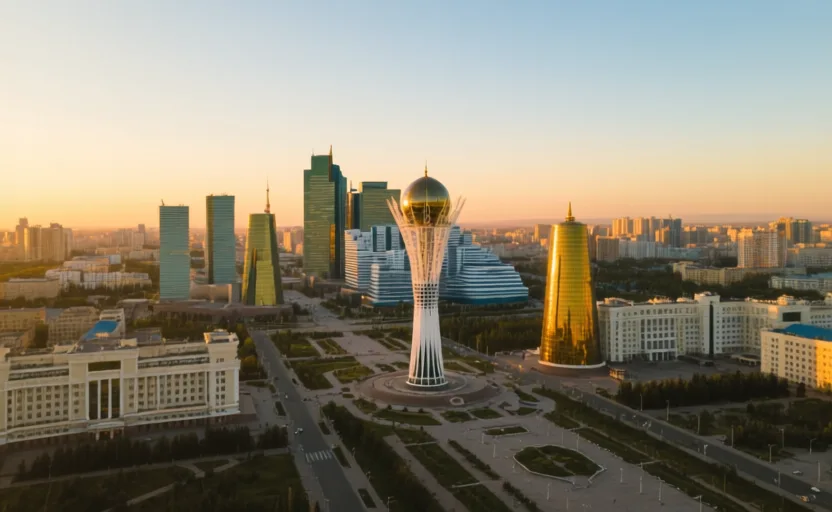
Landmark · Left bank, on the Nurzhol boulevard axis
The 97-metre tree-and-egg monument at the centre of the ceremonial axis, and the standard first stop for understanding what this city is trying to be.
Local tip: Go up at dusk in winter when the whole boulevard is lit and the steppe beyond is black — it is the clearest possible picture of a capital built deliberately on empty ground.
Neighborhood · West end of the boulevard axis
Norman Foster's translucent tent — a shopping centre with an indoor beach and a monorail, and in practice the city's covered public square from November to March.
Local tip: This is not a tourist curiosity, it is infrastructure. At -30°C the entire social life of the western districts happens inside heated structures like this one, and knowing that changes how you plan a winter here.
Culture · Left bank
Another Foster building — a 62-metre glass and steel pyramid housing an opera house, a congress hall and an interfaith meeting space.
Local tip: The opera house inside the base is excellent value and rarely full. Book the guided tour if you want the apex chamber with the stained-glass doves; it is not open to general visitors.
Culture · Left bank, east of Baiterek
One of the largest mosques in Central Asia, in classical Islamic style with Kazakh ornament, facing the modernist Palace of Independence across the square.
Local tip: Non-Muslim visitors are welcome outside prayer times; dress modestly and cover your head if female. The scale reads very differently in falling snow — go in winter if you can.
Neighborhood · Right bank
The pre-1997 Soviet town the capital was grafted onto — low-rise streets, older cafés, the Central Park and a completely different texture from the left bank.
Local tip: This is where Astana feels like a real city rather than a masterplan. The restaurants along Auezov and the Central Park in summer are where locals go; the boulevard is where visitors go.
Nature · ~130 km south-west
The open Kazakh steppe and the Korgalzhyn nature reserve — a UNESCO wetland on a major migration route, and the northernmost place flamingos breed.
Local tip: May and September are the migration windows for the flamingos. Go with a driver who knows the tracks; there is nothing out there, and that emptiness is precisely the point of the trip.
Side-by-side cost of living, language, climate and careers — to help you choose.