Population
~1.12 million (2025) — roughly one Kyrgyz citizen in six lives here
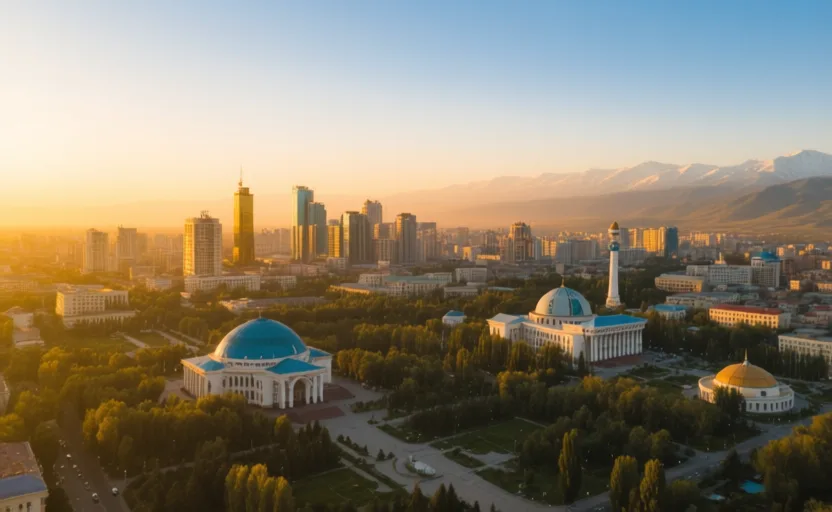 AI city illustration · Artistic impression
What people learn after moving
~1.12 million (2025) — roughly one Kyrgyz citizen in six lives here
Kyrgyz (state language) and Russian (official language); Russian dominates daily life in Bishkek
Kyrgyz som (KGS); National Bank official rate 87.45 som = US$1 on 6 August 2026
GMT+6 year-round — Kyrgyzstan abolished daylight saving in 2005
AI city illustration · Artistic impressionCost of living in Bishkek
Check your eligibility
Pick your passport to see entry rules and the long-stay routes we have researched.
Pick your passport to see whether you can enter Kyrgyzstan — and what it takes to stay.
Kyrgyzstan admits a long list of nationalities visa-free and runs an e-visa for everyone else — neither of which is a right to live here. The routes that are: 'Digital Nomad' status for people in IT and software, which has a strikingly low financial bar; the Unified Permit, a single QR-coded electronic document bundling the work visa, the employer's permit to attract foreign labour and the individual work permit; the Investment visa at 10 or 20 million som; and underneath all of them the temporary residence permit. Registration at your place of stay is due within five working days of entry and is the thing that actually catches people.
Kyrgyzstan drives on the RIGHT. Bishkek has no metro, no tram and no suburban rail — it runs on municipal buses, electric buses and privately-operated marshrutkas, with Yandex Go for everything else. Fares are 17 som with a Tulpar card and municipal buses went cashless on 1 July 2026. Exchanging a foreign licence means sitting a qualification exam, taken through an interpreter if you do not speak the state language.
Kyrgyz banking is cheap, app-first and gated on a personal identification number. MBANK operates as a licensed digital bank in its own right and is what most people actually pay with; Optima, Demir, Bakai and Kompanion are the branch banks. The domestic rail is Elcart, and plenty of merchants take Elcart and nothing else — which is why a foreign Visa is not a substitute for a local account here.
Bishkek has the country's best hospitals and a large, inexpensive private clinic sector; most foreign residents pay out of pocket for routine care and carry insurance for anything serious. The state Mandatory Health Insurance Fund covers contributors, which foreigners without a local employer generally are not. The real local health issue is not access — it is the winter air, and where you live changes how much of it you breathe.
Three operators — O!, MEGA (the state operator, formerly MegaCom) and Beeline — sell SIMs cheaply against your passport, and data in Kyrgyzstan is among the cheapest anywhere. Fixed fibre in Bishkek is fast and inexpensive. The catch is that a Kyrgyz number is not optional infrastructure: banking apps, state services and the Digital Nomad platform all authenticate to a local +996 number.
Kyrgyzstan runs a flat 10% personal income tax and 12% VAT, with a separate turnover-based sales tax and a patent regime for small trades. The genuinely unusual instrument is the High Technology Park: 0% VAT, 0% corporate income tax, 0% sales tax, a 1% contribution to the HTP Directorate and 5% personal income tax for employees. It is administered from Bishkek and it is export-oriented, so the qualifying-activity test is the whole question.
Each guide has verified costs, timelines, required documents, and the non-obvious gotchas — sourced from official government pages. Last verified August 2026.
Reading a list isn’t learning it. Globe Quest turns these into a trainer — hear each phrase spoken, drill them with spaced repetition, and get scored as you say them out loud.
This is not a formality here. UK FCDO advice states plainly that you must always carry your passport or a notarised copy, and that the police can arrest you if you do not carry ID. Bishkek police run document checks in the street and regular raids on bars and clubs, masked and armed; the routine is to produce ID and be waved on. Get a notarised, translated copy made in your first week — a notary office (нотариус) will do it in under an hour — and leave the passport itself in a drawer.
Foreign nationals must register at their place of stay within five working days of entry, unless their nationality is on the published exemption list. Hotels do this automatically, which is precisely why the rule catches people: the first week is handled invisibly, and then you move into a rented flat and the obligation is yours and nobody tells you. Your landlord may not know it is a thing. If you hold Digital Nomad status you are exempt outright — one of the two genuinely valuable things that status buys.
The city sits in a bowl at the foot of the Kyrgyz Ala-Too. From roughly November to March, cold air sinks, a temperature inversion caps the basin, and the smoke from coal-fired household heating in the surrounding zhilmassivs and private-sector housing has nowhere to go. Bishkek has repeatedly appeared near the top of global live pollution rankings on winter mornings. The southern districts on the higher ground toward the mountains sit above the worst of it; the northern flats around the railway and Dordoi sit inside it. Check the live monitors before you commit to a lease, and budget for a HEPA purifier for the bedroom.
Bishkek's mayor's office set the fare at 17 som on ordinary buses, 20 som on small-class buses, and 20 som where you pay cash into a validator. From 1 July 2026 buses and electric buses accept non-cash payment only. A Tulpar card works, and so does any contactless Visa or Elcart card issued by a Kyrgyz bank — which is a real argument for opening a local account in your first fortnight rather than living off a foreign card. A monthly standard transport card is 1,020 som; pensioners, children under seven and people with disabilities ride municipal transport free on a personalised photo card.
In the capital you will get by entirely in Russian: shops, taxis, banks, offices and most paperwork. Kyrgyz is the state language, is mandatory in official use, and its role has been expanding steadily — signage, forms and government communication increasingly appear in Kyrgyz first. Outside Bishkek, and markedly so in the south, Kyrgyz is what people actually speak. English is confined to the universities, the development sector, the IT companies and a handful of central cafés. Learning Russian gets you through Bishkek; learning some Kyrgyz gets you through the country.
Two orientation facts that save a lot of confusion. First, Bishkek's main city market is called Osh Bazaar and has nothing to do with the city of Osh 600 km south; taxi drivers will take you to the market, travel agents may not. Second, Bishkek is a Soviet grid on a gentle slope with the Ala-Too range permanently visible to the south, so directions here are given as 'towards the mountains' and 'away from the mountains' rather than by compass. Once you internalise that the grid is trivial. Ala-Archa National Park, glaciers and 4,000 m peaks included, is about 40 km from Ala-Too Square.
High Technology Park residents, outsourcing and product studios, fintech engineering teams
The HTP is a national export-oriented regime and it is administered from Bishkek. Residents pay 0% VAT, 0% corporate income tax and 0% sales tax, a 1% contribution to the HTP Directorate, and 5% personal income tax for employees against the national flat 10%. Company registration is quoted at up to three business days, fully remote, with 100% foreign ownership permitted.
MBANK, Optima Bank, Demir Bank, Bakai Bank, O!Bank, Kompanion, Elcart (the national card scheme)
Bishkek's banking sector digitised fast and unevenly. MBANK operates as a licensed digital bank in its own right under National Bank licence №014 and is the app most people actually pay with; Elcart is the domestic card rail that a foreign Visa cannot substitute for.
Dordoi Bazaar traders, freight forwarders, customs brokers on the China corridor
Dordoi on the northern edge of Bishkek is one of the largest wholesale markets in Central Asia and the country's largest private employer in practice. Chinese goods enter over the Torugart and Irkeshtam passes and leave for Kazakhstan and Russia — Kyrgyzstan's EAEU membership since 2015 is the whole commercial logic of it.
Several thousand small and mid-size sewing workshops across the city and its outskirts
Bishkek's least visible major industry: a dense network of small sewing shops producing for the Russian and Kazakh markets. It employs an enormous number of people, much of it informally, and it is why the city's industrial districts are full of unmarked workshops rather than factories.
American University of Central Asia, Kyrgyz-Russian Slavic University, Kyrgyz-Turkish Manas University, Kyrgyz National University
AUCA teaches entirely in English on a US liberal-arts model and is the usual landing pad for foreign academics and for internationally-minded Kyrgyz students; Manas is a joint Kyrgyz-Turkish institution. Bishkek's medical faculties also carry large South Asian intakes.
UN agencies, OSCE, World Bank, ADB, Aga Khan network, GIZ, a dense NGO layer
For its size Bishkek carries an unusually large international-organisation presence — a legacy of being the most open political system in Central Asia through the 2000s. It is the single most reliable source of English-language professional work in the country.
Landmark · Central, Chuy Avenue
The city's civic centre — the Manas statue, the State Historical Museum behind it, the flagpole with its hourly changing of the guard, and the fountains that everyone under twenty sits on in summer.
Local tip: The changing of the guard at the flagpole runs on the hour and takes about three minutes; it is the only piece of ceremony in Bishkek and it is genuinely worth the wait. The square is also where the country's two revolutions started, which locals will mention unprompted.
Food · West of the centre, Chuy Avenue
The city market — spice mountains, dried fruit and nut walls, horse sausage, whole rows of Korean salads from the deported Koryo-saram community, and the cheapest good lunch in Bishkek.
Local tip: The Korean salad row is the genuinely distinctive part and exists almost nowhere else outside the post-Soviet space. Go before 11am for the produce and bring cash or an Elcart card — plenty of stalls take neither a foreign Visa nor a story about one.
Nature · ~40 km south of the city
An alpine gorge running up into the Kyrgyz Ala-Too with glaciers, 4,000 m peaks and a network of day hikes, forty minutes from a city-centre flat.
Local tip: The Ak-Sai waterfall trail is the standard half-day and the Ratsek hut the standard overnight. There is no public transport into the gorge — share a taxi, agree the return time before you set off, and take a layer: the valley floor and the ridge are a different season from each other.
Neighborhood · Northern edge of the city
Kilometres of stacked shipping containers forming one of Central Asia's biggest wholesale markets — clothing, hardware, electronics, everything, sold two storeys up a ladder.
Local tip: Go on a weekday morning when it is working rather than a weekend when it is heaving, and understand that the ground floor of each container stack is retail and the upper floor is wholesale. It is a working market, not a sight, which is exactly why it is worth seeing.
Culture · Central, between Erkindik and Sovetskaya
Bishkek's oldest park, planted in the 1890s, now an open-air sculpture collection under mature oaks with the Kyrgyz National Museum of Fine Arts a block away.
Local tip: The sculptures were installed from the mid-1980s and range from the accomplished to the frankly strange — it is the best free hour in the city. Erkindik Boulevard just east is the shaded promenade locals actually walk in the evening.
Landmark · ~80 km east, near Tokmok
An 11th-century minaret standing over the remains of Balasagun, a Karakhanid capital on the Silk Road, surrounded by a field of balbal grave markers and the Chuy valley.
Local tip: You can climb the internal staircase — it is dark, steep and unlit, so bring a phone torch. Pair it with the Chon-Kemin valley on the same day trip; both are inside a comfortable half-day of Bishkek and almost nobody does them together.
Side-by-side cost of living, language, climate and careers — to help you choose.