
Population
≈8 million in the Distrito Capital; ≈11 million across the Bogotá region
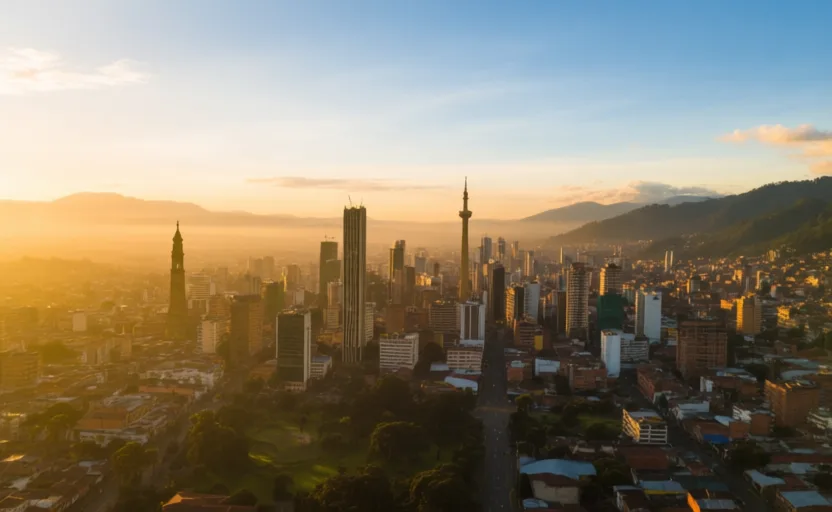 AI city illustration · Artistic impression
What people learn after moving
≈8 million in the Distrito Capital; ≈11 million across the Bogotá region
2,640 m — high enough that altitude sickness is a normal first-week experience
Spanish, in a formal highland accent that uses 'usted' far more than the coast or Medellín
Colombian peso (COP)
AI city illustration · Artistic impressionCost of living in Bogotá
Check your eligibility
Pick your passport to see entry rules and the long-stay routes we have researched.
Pick your passport to see whether you can enter Colombia — and what it takes to stay.
Colombia sorts long stays into three visa classes: V (Visitante, including the digital-nomad visa), M (Migrante — work, marriage, pensionado, investment) and R (Residente). Applications are made online through the Cancillería portal and decided within a published thirty-day window, without a consular interview in most cases. The step people miss is what comes after: any visa valid for more than three months must be registered with Migración Colombia within fifteen calendar days, and that registration produces the cédula de extranjería, the ID card that unlocks banking, EPS health cover, leases and utility contracts. Nothing in Colombian civil life works properly without it. A tourist stamp allows 90 days, extendable to a maximum of 180 days in a calendar year, and confers no right to reside or work.
Bogotá has no metro yet — Línea 1 was around 80% built by mid-2026 with commercial service targeted for the first quarter of 2028 — so the backbone is TransMilenio, the articulated-bus BRT, plus the SITP zonal buses and TransMiCable gondolas, all on one flat fare of COP 3,550 paid with a tullave card. Most newcomers never buy a car, and the traffic is the reason. If you do drive, Bogotá's pico y placa restricts by digit band rather than odd/even plate, runs 6am to 9pm Monday to Friday, and can be bought out with a Pico y Placa Solidario permit. Colombia does not swap most foreign licences: after six months you need a Colombian one, which means RUNT registration, a medical exam at a CRC, a course at a registered driving school and both theory and practical tests.
The cédula de extranjería is the gate. With one you can open an account at Bancolombia, Davivienda, BBVA, Banco de Bogotá or Scotiabank Colpatria; without one you generally cannot, because anti-money-laundering rules (SARLAFT) key on it. Until then you live on a foreign card, cash and Wise. Two things have changed recently and are worth knowing before you choose a bank: Bre-B, the Banco de la República's interoperable instant-payments scheme, now lets you send money between any participating bank or wallet using a registered 'llave' — phone number, ID number, email or alphanumeric code — which has broken the old Nequi-versus-Daviplata silo. And the 4x1000 (GMF), a 0.4% levy on most withdrawals and transfers, can be legally dodged on one nominated account up to a monthly cap, which many foreigners never ask for.
Colombia's contributory health system runs through EPS insurers. Employees contribute 4% of salary with the employer adding 8.5%; the self-employed pay the full 12.5% of a declared income base that cannot fall below one minimum wage, which for 2026 means a floor of roughly COP 219,000 a month. Affiliation requires a cédula, and some visa classes — notably M-Pensionado and several V categories — cannot affiliate at all and rely on private cover. Most foreigners who can, hold EPS plus a medicina prepagada plan on top for fast specialist access. The sector is in the middle of a contested reform with several large EPS under Superintendencia intervention, so check that the insurer you pick is actually operating normally in Bogotá before you sign. Separately: at 2,640 m Bogotá is above the altitude at which yellow fever, dengue and malaria circulate, which is a real health advantage — until you travel down to the Llanos, Tolima or the coast.
A prepaid (prepago) SIM takes fifteen minutes, costs almost nothing and needs only your passport — the clerk registers the line in your name because Colombian law requires it. The real trap is the device rather than the line: Colombia runs a national IMEI database to fight phone theft, and a handset bought abroad that is not registered gets cut off the network after roughly three to four weeks. Do it when you buy the SIM. Claro has the widest coverage and the highest prices, Movistar and Tigo sit in the middle, and WOM is cheapest with good city coverage and thinner reach outside it. For home internet Bogotá has an option the rest of the country does not: ETB, the district-owned operator, with a large fibre footprint across the city alongside Claro, Tigo and Movistar. WhatsApp is how everything here is arranged, from viewings to doctors.
Colombia taxes residents on worldwide income, and residency is a day count: 183 days or more inside the country across any rolling 365-day period, consecutive or not. A digital-nomad visa does not exempt you and neither does being paid by a foreign employer. Rates are progressive to 39% and every threshold is expressed in UVT, a peso unit DIAN republishes each December, so any figure you read in pesos ages badly. You register a RUT with DIAN, then file the declaración de renta in the August-to-October window on a date fixed by the last two digits of your NIT. What is easy to miss in Bogotá is the second tax authority: the district levies ICA, the industry and commerce tax, on business and independent professional activity carried out in Bogotá, filed with the Secretaría Distrital de Hacienda and entirely separate from your DIAN return.
Each guide has verified costs, timelines, required documents, and the non-obvious gotchas — sourced from official government pages. Last verified August 2026.
Reading a list isn’t learning it. Globe Quest turns these into a trainer — hear each phrase spoken, drill them with spaced repetition, and get scored as you say them out loud.
Bogotá sits at 2,640 m — higher than any European capital and higher than Quito's centre. Most arrivals get some version of soroche: headache, poor sleep, breathlessness on stairs, and alcohol hitting roughly twice as hard. Drink far more water than feels necessary, skip the gym and the aguardiente for the first few days, and do not book a hike up Monserrate for your first morning. It passes. The UV at this altitude is genuinely fierce even at 14°C, so sunscreen matters on grey days too.
Calles run east–west, numbered upward as you go north; Carreras run north–south, numbered upward as you go west, away from the Cerros Orientales. An address like 'Cra 7 # 72-41' means Carrera 7, 41 metres past Calle 72. Because the mountains are always east, you can orient yourself anywhere in the city by looking up. Newcomers who ignore this spend months confused; those who learn it navigate better than their taxi drivers.
Every dwelling in Colombia carries a socioeconomic stratum from 1 to 6, assigned to the property by the city (not to you), and it sets what you pay for electricity, water, gas and rubbish collection. Estratos 1–3 are subsidised, estrato 4 pays the unsubsidised cost, and estratos 5 and 6 pay a solidarity surcharge on top. How big that surcharge is depends on the service: for electricity and piped gas, Ley 142 de 1994 art. 89.1 holds it to 20% of the service value, but for water, sewerage and rubbish it is far heavier — Ley 1450 de 2011 art. 125 sets floors of 50% for estrato 5 and 60% for estrato 6. Bogotá has large estrato 6 pockets in Chicó, Rosales and northern Usaquén, so a flat that looks fairly priced can carry utility bills two or three times a comparable estrato 3 place. The estrato is printed on any utility bill — ask to see one.
This trips up everyone who has driven elsewhere in Colombia. In Bogotá the restriction runs Monday to Friday 6am–9pm, and the rule is stated the other way round from what you might expect: on odd-numbered calendar days it is plates ending 1, 2, 3, 4 or 5 that may circulate, so 6, 7, 8, 9 and 0 are the ones banned; on even-numbered days plates ending 6, 7, 8, 9 or 0 may circulate and 1 to 5 are banned. It is the day of the month that alternates, not the parity of your plate. You can buy your way out with a Pico y Placa Solidario permit, priced from the vehicle's value, model year, fuel and where it is registered — with a higher multiplier for plates registered outside Bogotá.
Bogotá's Día sin carro y sin moto bans private cars and motorcycles city-wide from 5am to 9pm. It is not a campaign or a suggestion — the city voted for it in a 2000 referendum and it is imposed by district decree every year (5 February in 2026). If you have a flight, a removal van or a hospital appointment that day, plan around it. Public transport and taxis run, and the city is oddly wonderful.
Bogotá has no summer or winter, just wetter and drier months — roughly April–May and October–November are the rainy peaks. Days run about 19°C and nights drop to 7–9°C, and almost no building has heating, so an indoor jumper is normal. Tap water comes from the Chingaza páramo and is genuinely good; the 2024–25 rationing was lifted in April 2025 after the reservoirs refilled, but the city is more water-conscious than it used to be.
Bancolombia, Grupo Aval, Davivienda, BBVA Colombia, Sura
Bogotá is where Colombian finance is headquartered — the Banco de la República, the Bolsa de Valores de Colombia and the head offices of every major bank and insurer are here.
Ministries, DIAN, DNP, UN agencies, IDB, embassies
As the Distrito Capital, Bogotá is the entire national bureaucracy plus the largest diplomatic and multilateral community in the country — a substantial English-using employment market on its own.
Rappi, Globant, Endava, Softtek, Mercado Libre
The largest tech employment base in Colombia, concentrated around Chapinero and the Calle 100 / Salitre corridors; Rappi was founded here and is still the flagship.
Teleperformance, Concentrix, Konecta, TaskUs
A very large bilingual contact-centre and shared-services sector serving North America — the most accessible route into formal employment for a Spanish-and-English speaker.
Avianca, LATAM Colombia, El Dorado airport, Opain
El Dorado is one of Latin America's busiest cargo airports and Avianca is headquartered here, anchoring a large maintenance, freight and travel-services cluster.
Universidad Nacional, Los Andes, Javeriana, Rosario, Externado
Colombia's densest concentration of universities and research centres, which is also why Bogotá has the deepest pool of English-speaking professional talent in the country.
Neighborhood · Historic centre, at the foot of the mountains
The colonial core — painted balconied houses, the Plaza de Bolívar, the Botero and Gold museums, and a student population that keeps it alive.
Local tip: Go by day and on foot, and stick to the lit, busy streets after dark. The Museo del Oro is the one museum in Colombia you should not skip, and it is free on Sundays.
Landmark · Cerros Orientales, above La Candelaria
The white church on the ridge at 3,152 m, reached by funicular, cable car or a punishing pilgrim stairway, with the whole savanna laid out below.
Local tip: Do not attempt the walking path in your first week — it climbs 500 m and the altitude will punish you. The funicular runs early; go before 9am for clear air, since cloud usually rolls in by midday.
Culture · Usaquén, north Bogotá
A colonial village swallowed by the city, whose Sunday market fills the plaza and side streets with crafts, food stalls and live music.
Local tip: Pair it with brunch on the Hacienda Santa Bárbara side and arrive before 11am — by mid-afternoon it is shoulder to shoulder and the pickpocketing goes up with the crowd.
Nature · Citywide, Sundays and public holidays
Over 100 km of main roads closed to cars from 7am to 2pm every Sunday, taken over by a million and a half cyclists, runners, skaters and dog-walkers.
Local tip: The Carrera 7 stretch through Chapinero is the classic. Rent a bike near Parque de la 93; the recreovía aerobics stages along the route are free and gloriously unselfconscious.
Food · Chapinero Alto
Bogotá's serious eating district — tasting menus, Andean produce cooking and specialty coffee, in a grid of red-brick English-style houses.
Local tip: Book the well-known kitchens a week ahead. Quinta Camacho next door is where the same chefs eat: cheaper, smaller rooms, no reservation needed on a weeknight.
Nature · Cerros Orientales, above Chapinero
A cloud-forest stream trail climbing straight out of the city into the eastern hills — hummingbirds, moss and the sound of Bogotá receding beneath you.
Local tip: Bogotanos hike this before work. Access is early-morning only and the hours change, so check the district environment authority's current schedule before you set off — and give the altitude a fortnight before you try it.
Side-by-side cost of living, language, climate and careers — to help you choose.