
Population
665,952 at the 2022 census — Bulawayo Province is the city
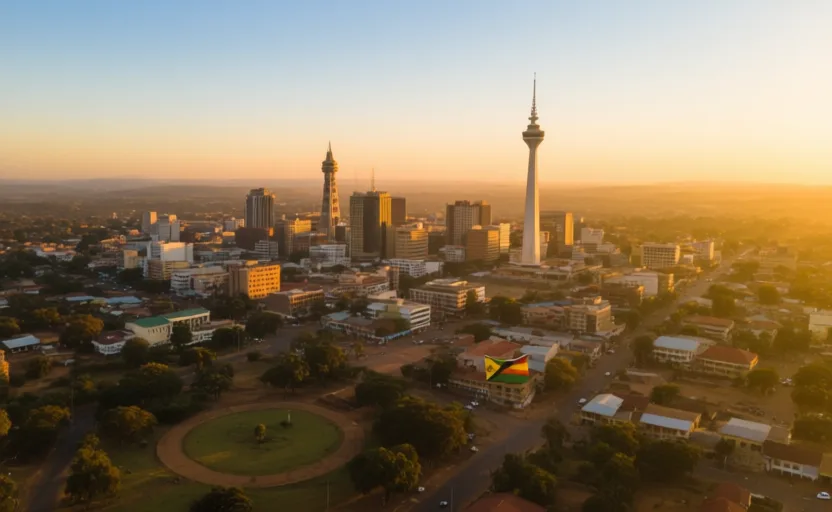 AI city illustration · Artistic impression
What people learn after moving
665,952 at the 2022 census — Bulawayo Province is the city
English for government and business; isiNdebele is the language of the city and of Matabeleland
ZiG (ZWG) is the local unit; the US dollar is what rent, fees and salaries are quoted in
CAT (GMT+2); no daylight saving
AI city illustration · Artistic impressionCost of living in Bulawayo
Check your eligibility
Pick your passport to see entry rules and the long-stay routes we have researched.
Pick your passport to see whether you can enter Zimbabwe — and what it takes to stay.
The Temporary Employment Permit is the standard route: form I.F.5 in duplicate, a letter to the Chief Director of Immigration, a newspaper advertisement of the post with the shortlisted local candidates' CVs, police clearance under six months, a radiological certificate, and US$500 plus US$300 per dependant. Every requirement page directs the application to the Chief Director, whose head office is in Harare — so a Bulawayo file has 440 kilometres in it that a Harare file does not.
The Vehicle Inspectorate Department tests drivers; the Central Vehicle Registry registers vehicles and produces the licence card and is where a foreign-licence enquiry starts. Both operate networks of offices across the country. Bulawayo's own driving quirk is its street grid — laid out wide enough for a wagon and a full span of oxen to turn — which makes the city genuinely easy to drive and easy to speed in.
Zimbabwean banks run local-currency accounts and foreign currency accounts side by side, and the Reserve Bank's guidelines explicitly recognise an individual FCA funded with salaries and diaspora remittances. In Bulawayo that second word does a lot of work — the city sits on the South African and Botswanan corridors and remittance income is a normal part of household finance rather than an edge case.
Bulawayo is unusually well provided with tertiary medicine for its size: the Ministry of Health lists Mpilo Central Hospital, United Bulawayo Hospitals and Ingutsheni Central Hospital here. What it is not well provided with is water, and intermittent supply is a public health question as much as a household one — the shedding programme is the single most important health fact about living in this city.
Three networks operate nationally: Econet on the 077 and 078 prefixes, NetOne on 071 and Telecel on 073. Econet carries EcoCash and has the widest reach. The Bulawayo-specific detail is the landline code — POTRAZ assigns Bulawayo the national destination code 9, dialled 0292 domestically, and the city's institutions still publish landlines.
PAYE runs on a rising scale to 40% with a 3% AIDS levy on the tax due. ZIMRA publishes a ZWG table and a separate foreign-currency table and directs employers with mixed-currency payrolls to use the USD one. On top of that sits the Intermediated Money Transfer Tax on electronic transfers. None of this varies by city — but Bulawayo City Council's rates, water and refuse charges do, and they are the local bill that actually differs.
Each guide has verified costs, timelines, required documents, and the non-obvious gotchas — sourced from official government pages. Last verified August 2026.
Reading a list isn’t learning it. Globe Quest turns these into a trainer — hear each phrase spoken, drill them with spaced repetition, and get scored as you say them out loud.
Bulawayo City Council publishes rotating water-shedding schedules by reservoir zone — programmes of 120 and 130 hours a week have both been in force, with supplies cut and restored at fixed times and only industry, mines and the CBD exempted. This is not a bad month; it is the operating condition. Before you sign anything, find out which reservoir zone the property is on, whether it has a borehole or a tank, and how big that tank is. It matters more than the number of bedrooms.
About 11.5% of Zimbabweans speak Ndebele as a mother tongue nationally, but Bulawayo and the Matabeleland provinces are where they are. 'Salibonani' rather than 'mhoroi' is a five-second courtesy that changes how a whole conversation goes, and getting it wrong is the most common thing a newcomer from Harare does.
Bulawayo was Zimbabwe's manufacturing capital and the headquarters of the National Railways of Zimbabwe. Much of that base has gone, and the empty factory shells along the Belmont and Kelvin industrial roads are the visible half of it. If you are moving without a job already in hand, Bulawayo is a harder proposition than Harare — which is precisely why it is cheaper.
Zimbabwe reintroduced a local unit, the ZiG, in April 2024. The state uses it — ZIMSTAT publishes a ZWG inflation rate, ZERA prints the pump price in both — but rent, medical aid, school fees and every immigration fee are asked for in US dollars. Bring clean small notes: the shortage of low-denomination US bills is chronic and change comes back in ZiG.
Bulawayo sits at about 1,358 metres in a rain shadow, lower and considerably drier than the capital. October before the rains is genuinely punishing, and the dryness is the same fact as the water crisis — the supply dams depend on a catchment that keeps failing.
The Ministry of Health lists Mpilo Central Hospital, United Bulawayo Hospitals and Ingutsheni Central Hospital in Bulawayo. For a city a third of Harare's size that is an unusual concentration of tertiary medicine, and it is one of Bulawayo's genuine advantages over any other Zimbabwean city outside the capital.
National Railways of Zimbabwe, freight forwarders, cross-border haulage
Bulawayo is the headquarters of the national railway and the junction of the lines to South Africa, Botswana and Victoria Falls. The network is a shadow of what it was, but the logistics and haulage trade around the Beitbridge and Plumtree corridors is real employment.
Food, beverage, textile and engineering firms in Belmont, Kelvin and Thorngrove
The city's industrial areas are far below capacity and that is the central economic fact about Bulawayo. What survives is largely food, beverage and light engineering serving the domestic market.
Gold operations across Matabeleland, coal at Hwange, service and engineering firms
Bulawayo is the supply and engineering town for Matabeleland's gold belt and for Hwange's coal, which is the most reliable professional employment in the city.
Safari operators, tour companies, hospitality
Matobo Hills and Khami Ruins are both UNESCO World Heritage sites within an hour, and Hwange and Victoria Falls are reachable by road and by the overnight train. Bulawayo is the base for the country's western circuit.
National University of Science and Technology, Mpilo, United Bulawayo Hospitals, Ingutsheni
NUST and three central hospitals make the public sector a much larger share of skilled employment here than in Harare, and one of the more stable parts of the local labour market.
Informal traders, money transfer agents, retail
The 2022 census recorded 17,840 South Africa-born residents in Bulawayo province, and the flow runs both ways. A large share of household income in this city arrives from across the border rather than from a local payslip.
Nature · About 35 km south
A UNESCO World Heritage landscape of balancing granite whalebacks, San rock paintings, black eagles and one of Africa's densest rhino populations.
Local tip: Go with a guide who will walk you to the paintings rather than driving you to the viewpoint. Do the rhino tracking on foot if you can — it is the single best day out available from any Zimbabwean city.
Landmark · About 22 km west
The dry-stone terraced capital of the Torwa state, successor to Great Zimbabwe, and the country's second UNESCO World Heritage site.
Local tip: Almost empty on a weekday. Go in the late afternoon when the light rakes across the decorated stonework, and take a hat — there is no shade on the terraces.
Culture · Centenary Park
One of the largest museum collections in southern Africa, with a mounted elephant that has been the city's landmark exhibit for generations.
Local tip: Give it two hours rather than the half you were planning. The geology and mammal halls are genuinely first-rate and it is a fraction of the price of anything comparable in the region.
Culture · Beside the main station
Steam locomotives, a Rhodesia Railways directors' saloon and rolling stock going quietly rusty in a yard next to the working line.
Local tip: Nobody goes, which is why it is worth it. Ask the caretaker to open the carriages — the stories about the Bulawayo–Victoria Falls run are the real exhibit.
Nature · Hillside
Two small colonial-era dams and their surrounding bush, run as a conservancy inside the suburbs — walking trails, birds and a tea garden.
Local tip: The nearest thing Bulawayo has to a public park with life in it. Go early on a Saturday; it is where the city walks its dogs and where you will meet people.
Landmark · City centre
Bulawayo's streets were laid out wide enough for a wagon and a full span of oxen to turn around, and the grid has never been narrowed.
Local tip: Walk Fife Street and Main Street on a Sunday morning when they are empty and the scale makes sense. The art deco and colonial-era facades along them are the best-preserved streetscape in Zimbabwe.
Side-by-side cost of living, language, climate and careers — to help you choose.