Population
903,370 in Cabinda province (INE, definitive Censo 2024 results) — 87% urban
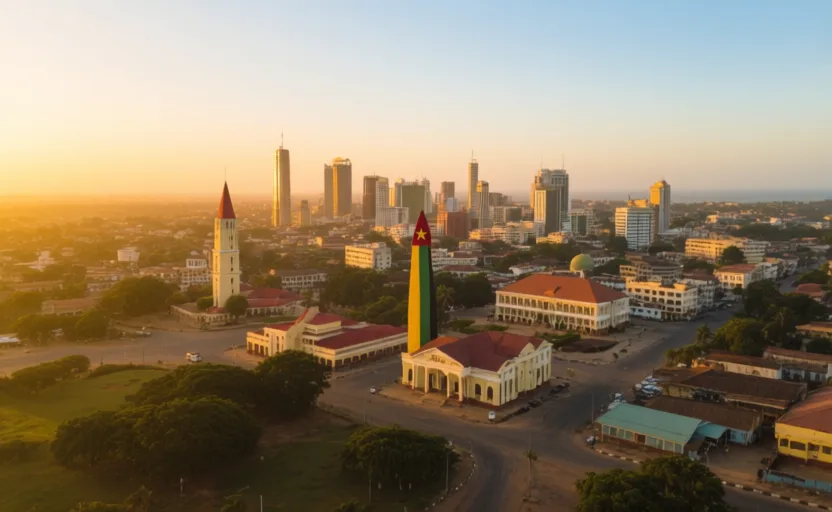 AI city illustration · Artistic impression
What people learn after moving
903,370 in Cabinda province (INE, definitive Censo 2024 results) — 87% urban
Portuguese (official); Ibinda, whose dialects include Iwoyo, Kiyombe, Kakongo and Ilinje
Angolan kwanza (AOA) — managed float; AOA 912.3845 = USD 1 on the BNA's reference rate, 3 Aug 2026
WAT (GMT+1, no daylight saving)
AI city illustration · Artistic impressionCost of living in Cabinda
Check your eligibility
Pick your passport to see entry rules and the long-stay routes we have researched.
Pick your passport to see whether you can enter Angola — and what it takes to stay.
Same national process: a consular visto de trabalho, then a separate SME autorização de residência, then the cartão de residente. The work visa is multiple-entry with a stay of up to 365 days renewable until the contract ends; temporary residence runs two years at a time and permanent residence needs ten consecutive years of it. The Cabinda-specific layer is that this is an exclave — any land movement between here and the rest of Angola exits and re-enters the country through the DRC, so multiple entries and a clean, current set of documents matter far more here than in Luanda.
DTSER exchanges a valid foreign licence for an Angolan one for foreign residents. Its document list includes one item outside Angola's control — a declaration of validity from the issuing authority or your embassy in Luanda — plus a medical certificate issued in Angola, residence proof and an employer's declaration. Start the validity declaration before you fly. Then learn the province's real driving rule: the city is ordinary, the roads north are not, and nothing crosses to the rest of Angola without leaving the country.
The requirements are the national ones: a resident card or a passport with a valid visa, an Angolan NIF, proof of address, proof of employment and a declaration of the origin of funds — and account opening is done in person. BFA asks AOA 20,000 as a minimum deposit on a standard current account and AOA 5,000 on its Conta Simplificada. Multicaixa is what you will actually pay with. In Cabinda, the extra rule is to get the file right first time, because the fallback of walking into a different branch tomorrow is much weaker here.
Get three things right. Before arrival: the yellow-fever certificate, which is an entry requirement and is checked, and malaria prophylaxis, because Angola is high-risk year-round and this is its wettest province. On arrival: confirm in writing that your insurance covers medical evacuation FROM CABINDA, not merely from Angola — and confirm who calls it, because in an emergency the difference between a policy that works and one that does not is a phone number somebody has to have on them.
Buy from an operator shop with your passport and register in your own name. Unitel has the deepest national footprint, Africell has competed hard on data since entering in 2022, and Movicel is the third. Then do the Cabinda-specific step everyone forgets: turn off automatic network selection and lock the handset to your Angolan operator, because the province borders the Republic of the Congo and the DRC and a roaming bill accumulated by accident is a genuinely expensive local rite of passage.
The 2026 budget law, Lei n.º 14/25 de 30 de Dezembro, set a new IRT table: the first AOA 150,000 a month is exempt and the top rate stays at 25%. INSS takes 3% from you and 8% from the employer. The genuinely useful structural point for a foreigner is what Angola does not tax — employment income for work performed in Angola is in scope; your foreign rent and investments are not taxed the way a residence-based system would tax them.
Each guide has verified costs, timelines, required documents, and the non-obvious gotchas — sourced from official government pages. Last verified August 2026.
Reading a list isn’t learning it. Globe Quest turns these into a trainer — hear each phrase spoken, drill them with spaced repetition, and get scored as you say them out loud.
Cabinda is an exclave: about 60 km of Democratic Republic of the Congo territory sits between it and the rest of Angola. The road journey means leaving Angola, transiting DRC and re-entering Angola, with DRC visas and two sets of border formalities. In practice everyone flies the roughly one-hour hop to Luanda. Budget for air fares as a fixed monthly cost, and never assume a single-entry Angolan visa is enough if any part of your plan touches the road.
The UK FCDO advises against all but essential travel to Cabinda Province — but explicitly excludes Cabinda city from that advice. Its reasons for the province are specific: regular violent incidents including kidnapping, and separatist attacks that have involved both foreigners and Angolans. Live and work in the city on ordinary big-city precautions; treat any trip north toward Buco-Zau, Belize or the Maiombe as something you plan with your employer's security adviser, not something you decide on a Saturday morning.
UK government advice is that healthcare outside Luanda is very limited, and Cabinda is exactly the case that describes. Anything beyond routine care is a flight — to Luanda, or out of the country entirely. Check that your insurance covers evacuation FROM Cabinda specifically and not just from the capital, and know before you need it who your employer calls at 2am.
The province is bordered by the Republic of the Congo to the north and the DRC to the east and south, and networks do not respect that line. Near the borders, and sometimes surprisingly far from them, handsets latch onto Congolese networks and bill international roaming without asking. Lock the network selection to your Angolan operator manually rather than leaving it automatic, and check the bar at the top of the screen before making a long call.
The province has its own language and a strong sense of its own history, and the word outsiders traditionally used for that language — fiote — literally means 'black'. Cabindans will correct you, politely and repeatedly. Using Ibinda costs nothing, is accurate, and is noticed. The same instinct applies to politics: the Cabindan question is live here, people have views, and a newcomer's job is to listen rather than to have an opinion.
Cabinda produces a large share of Angola's crude, most of it offshore, and the visible foreign population lives inside company arrangements — Chevron's Malongo camp being the extreme case, a self-contained enclave rather than a neighbourhood. If you are not inside one of those, the market for expatriate-standard housing and services is thin and priced accordingly. Establish exactly what your employer provides before you negotiate anything else.
Cabinda Gulf Oil Company (Chevron), Sonangol, ANPG, Angola LNG partners, TotalEnergies
Chevron's wholly owned CABGOC operates Block 0 with a 39.2% interest and holds 31% of the deepwater Block 14 production-sharing contract — a concession that runs along the Cabindan coast and has anchored the province's economy since the 1960s.
Refinaria de Cabinda (Gemcorp 90% / Sonangol 10%)
Angola's second refinery. It starts at 30,000 barrels a day and is designed to reach 60,000 in a second phase, with Sonangol marketing the diesel, jet fuel and naphtha. It is the largest single change to the province's non-upstream economy in decades.
Porto de Cabinda, offshore supply bases, Malongo terminal operators
Everything that is not flown in arrives by sea, because the land route runs through another country. That single geographic fact makes port and supply-base logistics a much larger share of local employment than the province's size suggests.
Small operators around the Maiombe; state forestry services under MINAMB
The Maiombe carries pau-preto, ebony and sandalwood, and the tension between that value and the Parque Nacional do Maiombe's conservation mandate is the province's defining environmental argument.
Governo Provincial de Cabinda, provincial health and education services, Porto de Cabinda
The province is 87% urban by the 2024 census — unusually concentrated for Angola outside Luanda — so provincial government and municipal services are a genuine employer rather than a rounding error.
Artisanal fleets at Cabinda and Landana, cocoa and palm smallholdings, coffee
Cabinda grew cocoa, coffee and palm oil long before it produced crude, and the smallholder sector survives alongside the oil economy rather than having been replaced by it.
Nature · Northern Cabinda, toward Buco-Zau and Belize
Angola's slice of the Congo Basin rainforest, protected as a national park and holding western lowland gorillas, forest elephants and hardwoods — pau-preto, ebony, sandalwood — that are worth more standing than felled and are constantly at risk of not being.
Local tip: This is genuinely spectacular and it is genuinely inside the area the FCDO advises against all but essential travel to. Do not freelance it: go with a properly organised operator, with your employer's knowledge, and with the security position checked that week rather than that month.
Landmark · Cabinda city
The waterfront the city is built around — the port on one side, the promenade and the fishing boats on the other, and the offshore rigs visible as lights after dark. It is where Cabinda takes its evening walk.
Local tip: Sunset along the Marginal is the city's social hour and is comfortable in a way the province's reputation does not suggest. As everywhere in Angola, keep the camera pointed at the water rather than at the port installations.
Nature · Futila, just north of the city
The city's beach: coconut palms, warm Atlantic water and grilled fish under thatch, close enough to be an ordinary evening rather than an expedition.
Local tip: Weekends are busy and are the point — this is where you meet people. Swim where others are swimming; the Atlantic on this coast has real currents and there are no lifeguards.
Culture · Cacongo municipality, north along the coast
The old Portuguese and Dutch trading station on the coast, with the remains of a 19th-century mission and a shoreline that is still working fishing rather than tourism.
Local tip: It is a straightforward daytime run north on the coast road and worth doing with a local driver who knows the checkpoints. Ask before photographing anything that looks official — that includes the port and the older colonial buildings still in state use.
Food · Cabinda city centre
Fish landed that morning, cassava, palm oil in reused bottles, forest fruit from the Maiombe, and the province's own textiles — the place where the informal economy that actually feeds Cabinda is visible in one square.
Local tip: Cash, in small notes, and expect to be quoted a foreigner's opening price. Go early for the fish and go with someone who speaks Ibinda if you want the real number.
Neighborhood · North of Cabinda city, on the coast
Chevron's oil camp: a self-contained enclave with its own housing, clinic, airstrip and services, and the single most important piece of geography in the province's economy. It is a workplace, not a district — you are inside it or you are not.
Local tip: Worth understanding early even if you will never set foot in it. Whether your employer's package places you inside a camp like this or in the city determines your housing, your healthcare, your transport and your social life, and it is the first question to settle in an offer conversation.
Side-by-side cost of living, language, climate and careers — to help you choose.