
Population
≈2.3 million in the city; ≈2.9 million across the metropolitan area
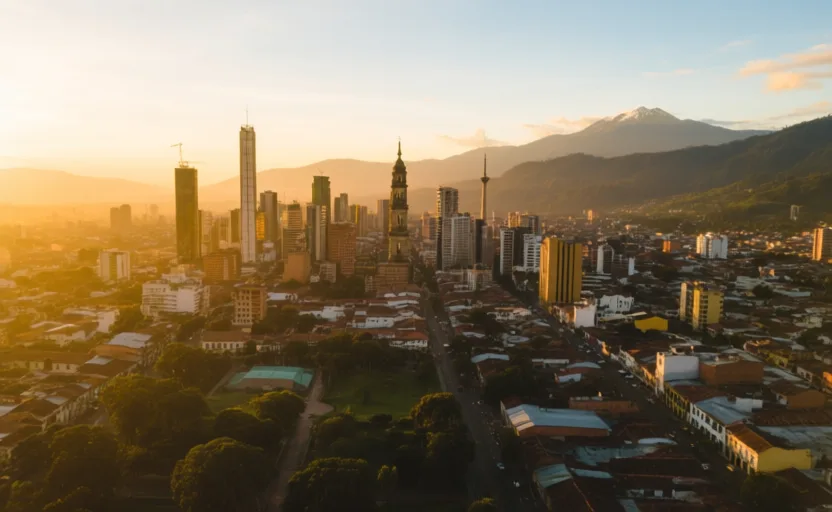 AI city illustration · Artistic impression
What people learn after moving
≈2.3 million in the city; ≈2.9 million across the metropolitan area
≈1,000 m — warm valley heat, and none of Bogotá's altitude problems
Spanish, in a fast Valluno accent that uses 'vos' and 've' constantly
Colombian peso (COP)
AI city illustration · Artistic impressionCost of living in Cali
Check your eligibility
Pick your passport to see entry rules and the long-stay routes we have researched.
Pick your passport to see whether you can enter Colombia — and what it takes to stay.
Colombia sorts long stays into three classes: V (Visitante, including the digital-nomad visa), M (Migrante — work, marriage, pensionado, investment) and R (Residente). You apply online through the Cancillería portal, with a published thirty-day decision window and no consular interview in most cases. The step people underestimate is the one after approval: any visa valid for more than three months must be registered with Migración Colombia within fifteen calendar days, which produces the cédula de extranjería — the ID card that unlocks banking, EPS health cover, leases and utility contracts. A tourist stamp gives 90 days, extendable to 180 days maximum in a calendar year, and is not a right to live or work here. Cali also sits inside Colombia's largest Venezuelan-migration corridor, which means the separate Estatuto Temporal de Protección regime is visible everywhere locally — it is a different system and does not apply to most other nationalities.
Cali is flat, warm and spread out, which makes it a much better cycling and motorbike city than Bogotá and a much worse walking one over distance. The MÍO — the Masivo Integrado de Occidente — is the articulated-bus backbone, with a flat fare of COP 3,500 since January 2026 and a cable line up to the western hillside; it is useful but has struggled financially and coverage is thinner than a city this size deserves, so ride apps do a lot of the work. If you drive, the thing to internalise is that Cali's pico y placa assigns two fixed plate digits to each weekday and rotates the entire table every 1 January and 1 July, and it applies on the entry and exit corridors as well as inside the city. Colombia does not exchange most foreign licences: after six months you need a Colombian one, via the RUNT, a medical assessment, a driving school and both exams.
The cédula de extranjería is the gate: with one you can open an account at Bancolombia, Banco de Occidente, Davivienda, BBVA or Banco de Bogotá, and without one you generally cannot, because anti-money-laundering rules key on it. Until then you run on a foreign card, cash and Wise. Two national developments matter more than the choice of bank. Bre-B, the Banco de la República's interoperable instant-payment scheme, has been live since 2025 and lets you pay any participating bank or wallet using a registered llave — your phone number, ID number, email or a chosen code — which ended the old Nequi-versus-Daviplata split. And the 4x1000 (GMF), a 0.4% levy on most withdrawals and transfers, can be legally avoided on one nominated account up to a monthly ceiling, but only if you ask. Cali is more cash-oriented than Bogotá outside the southern belt, so keep some.
Colombia's contributory system runs through EPS insurers. Employees contribute 4% of salary with employers adding 8.5%; the self-employed pay the full 12.5% of a declared income base that cannot fall below one minimum wage, so around COP 219,000 a month in 2026. Affiliation needs a cédula, and some visa classes — notably M-Pensionado and several V categories — cannot affiliate at all. The usual foreign setup is EPS plus a medicina prepagada plan for fast specialist access. The sector is in the middle of a contested reform, with several large insurers under Superintendencia intervention and 2026 rules restricting an EPS from operating where it holds too small a share of a department's members, so verify your chosen insurer is functioning normally in Valle del Cauca. Cali's saving grace is its hospitals: the Fundación Valle del Lili is consistently ranked among Latin America's best, and Clínica Imbanaco sits alongside it.
A prepaid (prepago) SIM takes about fifteen minutes, costs almost nothing and needs only your passport, which the clerk registers because Colombian law requires the line to be in a name. The trap is the handset, not the line: Colombia runs a national IMEI database against phone theft, and a device bought abroad that is never registered is cut off after roughly three to four weeks. Do it at the counter when you buy the SIM. Claro has the broadest coverage and the highest prices, Movistar and Tigo sit between, WOM is cheapest with solid city coverage. For fixed internet Cali has an unusual option: EMCALI, the municipally owned utility that also supplies your water and electricity, sells fibre across much of the city alongside Claro, Tigo and Movistar — which means your internet and your utility bill can arrive from the same public company.
Colombia taxes residents on worldwide income, and residency is a day count: 183 days or more within any rolling 365-day period, consecutive or not. A digital-nomad visa does not exempt you and neither does being paid abroad. Rates are progressive to 39% and every threshold is expressed in UVT, a peso unit DIAN republishes each December, which is why peso figures quoted in older guides are unreliable. You register a free RUT with DIAN, then file the declaración de renta between August and October on a date fixed by the last two digits of your NIT. The part newcomers miss in Cali is that three different authorities can want something from you: DIAN for income tax, the municipality for ICA on independent professional and business activity carried on in Cali, and the Gobernación del Valle del Cauca for the annual vehicle tax if you own a car registered here.
Each guide has verified costs, timelines, required documents, and the non-obvious gotchas — sourced from official government pages. Last verified August 2026.
Reading a list isn’t learning it. Globe Quest turns these into a trainer — hear each phrase spoken, drill them with spaced repetition, and get scored as you say them out loud.
Cali has a genuinely uneven security picture and the honest version matters more than reassurance. The southern and western belt — Granada, El Peñón, San Antonio, Santa Teresita, Ciudad Jardín, Pance — is where nearly all foreigners live and is broadly comfortable by day and evening. The eastern comunas around the Distrito de Aguablanca and parts of the western ladera are not places to wander into, and locals will say so plainly. Ask caleños where they will and will not go after dark, use apps rather than street taxis at night, and treat the advice as specific rather than general.
Cali assigns two plate digits to each weekday and rotates the whole table every six months. For the second half of 2026 it is Monday 9 and 0, Tuesday 1 and 2, Wednesday 3 and 4, Thursday 5 and 6, Friday 7 and 8, restricted 6am to 7pm. The rotation changes on 1 January and 1 July, so a memorised day is wrong twice a year. It also applies on the entry and exit corridors, so commuting in from Jamundí, Yumbo or Palmira does not get you around it.
Every dwelling carries a socioeconomic stratum from 1 to 6, attached to the property rather than to you, and it decides whether your electricity, water and gas are subsidised or carry a solidarity surcharge. That surcharge is capped at 20% of the service value for electricity and piped gas under Ley 142 de 1994 art. 89.1, but is far heavier on water, sewerage and rubbish, where Ley 1450 de 2011 art. 125 sets floors of 50% for estrato 5 and 60% for estrato 6. In a city that sits around 24–25°C with afternoons in the low thirties, that surcharge lands on fans and air conditioning. Ask to see a recent EMCALI bill: it shows the estrato and the real cost, and the difference between an estrato 3 and an estrato 6 flat with the same aircon is significant.
Cali claims to be the salsa capital of the world and behaves accordingly: children learn it, offices have dance nights, and the caleño style — very fast footwork, quiet upper body — is distinct enough that dancers from elsewhere are immediately spotted. Take classes in your first month even if you have no intention of being good. It is the single fastest route into caleño social life, and the alternative is being the person standing by the wall at every gathering for a year.
At roughly 1,000 m, Cali sits inside the zone where dengue circulates, unlike Bogotá up on the plateau. Dengue is endemic in Valle del Cauca and rises after the rains; repellent, screens and not leaving standing water on a balcony are ordinary precautions rather than paranoia. Colombia has also been under a yellow fever health emergency since April 2025, with vaccination required at least ten days before entering national parks — worth arranging before any Pacific or coffee-region trip.
Cali has the largest Afro-Colombian urban population in the country, and its cultural life leans toward the Pacific coast rather than the Andes. That gives you chontaduro carts, coconut rice, aguardiente-fuelled December and the Festival Petronio Álvarez every August — the biggest Afro-Pacific music festival in Latin America, which takes over the city for a week. The Feria de Cali runs 25 to 30 December. Plan around both; the city does not do anything else during either.
Ingenio Manuelita, Incauca, Riopaila Castilla, Mayagüez
The Valle del Cauca sugar cane belt around Cali is the industrial base the city was built on, now extending into ethanol, packaging and food processing.
Tecnoquímicas, Baxter, Genfar, Lafrancol
Cali is Colombia's pharmaceutical manufacturing centre — Tecnoquímicas is headquartered here and Baxter runs one of its largest Latin American plants nearby.
Banco de Occidente, Coomeva, Grupo Bolívar operations
Banco de Occidente is a Cali institution and one of the few major Colombian banks headquartered outside Bogotá, anchoring a real regional financial sector.
Bilingual contact centres and shared-services operations
A large and growing nearshore services sector, helped by lower salary costs than Bogotá and a substantial pool of bilingual university graduates.
Buenaventura port corridor, freight and customs operators
Cali is the inland city for Buenaventura, Colombia's main Pacific port about two hours west, which makes it the country's Pacific trade and customs hub.
Fundación Valle del Lili, Clínica Imbanaco, Centro Médico Imbanaco
Fundación Valle del Lili is consistently ranked among Latin America's best hospitals, and Cali draws patients from across the south-west and from Ecuador.
Neighborhood · Just west of the centre, on the hill
Cali's colonial quarter — a whitewashed chapel on a grassy hilltop, cobbled streets, small bars and the best sunset view of the city.
Local tip: Go up to the Iglesia de San Antonio in the late afternoon when families and buskers fill the park, then eat in the streets below. It is one of the few genuinely walkable evening areas in Cali.
Landmark · Cerro de las Tres Cruces / Los Cristales road
A 26-metre Christ statue on a ridge 1,440 m above the valley, with the whole city and the sugar plains spread out below.
Local tip: Take a taxi or ride app up rather than walking the road, and go in the morning for clear air. The craft stalls at the top sell better coffee than they look like they should.
Nightlife · Various — the Delirio warehouse, Juanchito, Menga
Delirio is a circus-scale salsa cabaret staged monthly in a warehouse; Juanchito and Menga are where caleños actually go to dance until dawn.
Local tip: Delirio tickets sell out weeks ahead and it is genuinely worth the planning. For an ordinary Friday, La Topa Tolondra in San Antonio is the standard answer and you can turn up and learn.
Nature · Santa Teresita, on the Río Cali
Regularly rated the best zoo in Colombia and one of the best in Latin America, built along the river with a strong Andean and Pacific species focus.
Local tip: Weekday mornings are quiet and cool. Combine it with a walk up the Río Cali path toward San Antonio rather than driving back out.
Nature · Southern edge, toward the Farallones
Cold clear river pools at the foot of the Farallones de Cali national park, where the whole city decamps on a hot Sunday.
Local tip: Go early — by midday the roadside spots are packed and the parking is chaos. Upstream past the main balnearios the water is cleaner and the crowd thins out fast.
Food · Alameda, south of the centre
A working produce market where the Pacific coast arrives in Cali — chontaduro, borojó, coconut, fish from Buenaventura and the sancocho stalls at the back.
Local tip: Come before 10am and eat where the vendors eat. Almost no visitors make it here and it explains more about Cali's food than any restaurant will.
Side-by-side cost of living, language, climate and careers — to help you choose.