
Population
≈1.2 million in the Union Territory; roughly 1.6 million across the Chandigarh–Mohali–Panchkula tricity
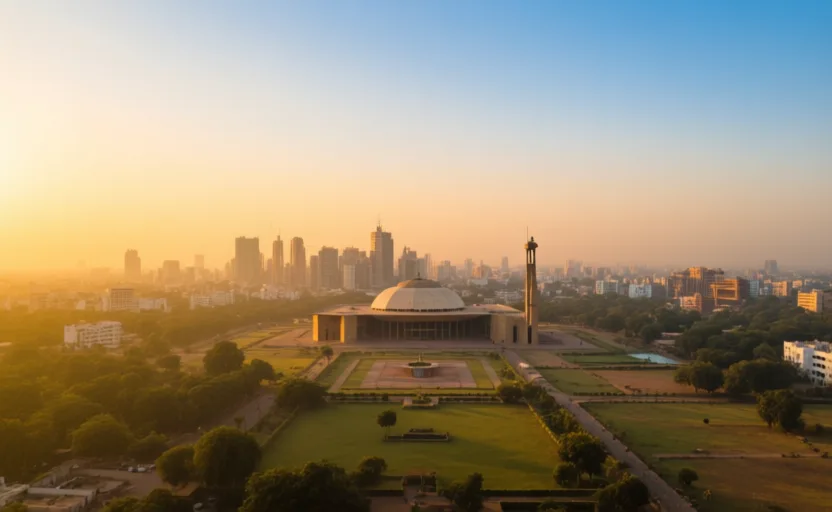 AI city illustration · Artistic impression
What people learn after moving
≈1.2 million in the Union Territory; roughly 1.6 million across the Chandigarh–Mohali–Panchkula tricity
Punjabi and Hindi in daily use; administration runs in English
Indian rupee (INR)
IST (GMT+5:30) — one time zone for the whole country, no daylight saving
AI city illustration · Artistic impressionCost of living in Chandigarh
Check your eligibility
Pick your passport to see entry rules and the long-stay routes we have researched.
Pick your passport to see whether you can enter India — and what it takes to stay.
India has no digital nomad or freelancer route. Salaried work means an employer-sponsored employment visa carrying a minimum annual salary, applied for from your country of residence before travel. Once you land, a fourteen-day registration clock starts from the immigration stamp. Chandigarh has a full FRRO of its own at the Police Headquarters in Sector 9, which is better than most Indian cities get — but the tricity straddles a jurisdictional line, and a Mohali address is in Punjab, which on current information is administered from Amritsar. Check the portal rather than assuming.
You may drive on a valid foreign licence accompanied by an International Driving Permit for a limited period after arrival, then need an Indian licence applied for through the Parivahan portal. Chandigarh is the easiest large Indian city to drive in by a wide margin — a planned grid, roundabouts instead of signals on the main network, real parking, and separated cycle paths that actually connect. The catch is that the UT, Punjab and Haryana each run their own registration and road-tax regime, and moving a vehicle across those lines is a formal process.
PAN first, then the account, then UPI. Which account you may open turns on your residential status under the Foreign Exchange Management Act — not on your visa and not on your income tax status, which are three different tests. Someone employed in India is generally FEMA-resident and opens an ordinary resident savings account rather than an NRE or NRO account. Chandigarh has an unusually high concentration of non-resident Indian family money, so branches here are practised at foreign-facing accounts — which is helpful, and also why staff sometimes reach for NRO by reflex.
Employer group cover is the normal route and the tricity's private hospitals are good and inexpensive by any international measure. The distinguishing feature is PGIMER, one of India's two or three leading tertiary institutes, which sits inside the city and takes referrals from five states — the level of specialist care available here is far beyond what a city of a million people would normally support. The distinguishing risk is the six weeks of post-harvest smoke each autumn.
Every Indian SIM requires full identity verification, and for a foreign national that means passport, visa, photographs and proof of a local address, followed by a tele-verification step before outgoing calls and data switch on. Buy from a company-owned Jio or Airtel store rather than a kiosk. There is one local wrinkle worth knowing: India's telecom licence areas do not follow the tricity, and the address on your KYC decides which circle your number belongs to.
You are resident if you spend 182 days or more in the financial year, or 60 days plus 365 across the preceding four. Most new arrivals then land in RNOR — Resident but Not Ordinarily Resident — for two or three years, during which foreign income is generally outside Indian scope. The new regime is the default and the old regime must be actively elected. Locally, the point to hold onto is that the tricity crosses a payroll boundary: an employer registered in Punjab deducts a monthly state development tax that a Chandigarh or Haryana employer does not.
Each guide has verified costs, timelines, required documents, and the non-obvious gotchas — sourced from official government pages. Last verified August 2026.
Reading a list isn’t learning it. Globe Quest turns these into a trainer — hear each phrase spoken, drill them with spaced repetition, and get scored as you say them out loud.
Chandigarh is administered directly by the central government through an Administrator — a role held ex officio by the Governor of Punjab — rather than by an elected state government. It is simultaneously the capital of Punjab and of Haryana, neither of which it belongs to. The practical consequence is that Punjab law and Haryana law do not automatically apply here: the UT administration notifies which laws extend to it, and on several things — stamp duty, payroll levies, excise, real estate regulation — the answer inside the UT differs from the answer three kilometres away. Whenever you are told 'in Punjab you have to…', the first question is whether the speaker means the state or the city.
Chandigarh, Mohali (Punjab) and Panchkula (Haryana) form a single continuous urban area you can cross in twenty minutes, governed by three different administrations. Property purchase attracts around 6% stamp duty in Chandigarh with no gender concession, and roughly 7% for men and 5% for women in both Punjab and Haryana, each plus a 1% registration fee. Real estate projects are regulated by three separate authorities. Punjab levies a monthly state development tax on income-tax payers that Chandigarh and Haryana do not, so a Mohali payroll and a Chandigarh payroll are not identical. And, on current information, foreigners in Chandigarh and Haryana register with FRRO Chandigarh while Punjab — which includes Mohali — is administered by FRRO Amritsar. Confirm the current position on e-FRRO before assuming, but do not assume the whole tricity is one answer, because it is not.
There are no street names in the residential parts of Chandigarh. Addresses read '#1234, Sector 22-B': the house number, the sector, and the sub-sector quadrant. Sectors are numbered 1 to 56 with no 13; Sector 1 is the Capitol Complex, and the numbering runs broadly north-east to south-west. Roads are classified V1 to V7 by function, from the fast peripheral roads down to the internal cycle paths. Once you have the logic it is the easiest large city in India to navigate; before you have it, every direction you are given sounds like a coordinate rather than a place. Delivery drivers, taxis and friends will all give directions in sector numbers, so learn yours and your office's on day one.
If your visa is valid for more than 180 days you must register within 14 days of the arrival stamp, filed online through e-FRRO. Chandigarh has a full Foreigners Regional Registration Office at the Police Headquarters in Sector 9, which is a materially better position than most Indian cities, where a district Superintendent of Police does registration as an additional duty. Its jurisdiction, on current information, covers the UT and Haryana; Punjab is administered from Amritsar. Because the tricity crosses that line, a flat in Mohali and a flat in Panchkula may register in different cities. Enter the address on the portal and let it tell you rather than assuming.
As a Union Territory, Chandigarh writes its own excise policy, and it has consistently kept duties below both Punjab's and Haryana's — which is why cross-border shopping runs are an established local habit rather than a rumour. The corollary is that carrying quantities across the state line is an excise matter, not a free choice, and the permitted personal quantity differs by jurisdiction. The minimum drinking age has also historically differed across the three, and Haryana has moved its own in recent years, so treat any figure you are quoted as needing confirmation against the current excise policy of the specific jurisdiction you are in.
Chandigarh is among the greenest large cities in India, with wide separated cycle paths, a lake in the middle and the Shivalik foothills on the edge of town. From late October to December it also sits downwind of post-harvest stubble burning across Punjab and Haryana, and the readings climb for several weeks. It is not Delhi, and the rest of the year is genuinely good — but if you are choosing Chandigarh partly for the air, choose it knowing about November, and buy an indoor purifier in September rather than during the season.
Punjab and Haryana Secretariats, Punjab and Haryana High Court, the UT Administration
Two state governments and a Union Territory administration sit inside one city of a million people, which is a concentration of public employment and of the law, consulting and contracting economy around it that no comparable Indian city has.
Infosys, TCS, Airtel, Dell, Amadeus, IDS Infotech
Concentrated at the Rajiv Gandhi Chandigarh Technology Park on the eastern edge and in Mohali's IT City. Smaller than Bengaluru or Pune, but the campuses are new and the commute is measured in minutes rather than hours.
PGIMER, Government Medical College Sector 32, Fortis Mohali, Max, Alchemist
PGIMER is one of India's leading tertiary hospitals and takes referrals from Punjab, Haryana, Himachal Pradesh, Jammu and Kashmir and beyond — the reason specialist care here is far above what a city of this size would normally support.
Panjab University, PEC, IISER Mohali, NIPER Mohali, NABI, CSIO
Panjab University traces to Lahore in 1882 and moved here after Partition; IISER and NIPER at Mohali are national institutes. The result is an unusually dense research population for the region.
Mohali pharma cluster, Baddi–Barotiwala belt in Himachal, Panacea, Ind-Swift
The Baddi industrial belt in Himachal Pradesh, roughly an hour from the city, is one of Asia's largest pharmaceutical manufacturing concentrations, and a lot of its management lives in the tricity.
Industrial Area Phases I and II, Mohali and Dera Bassi units, tractor and component suppliers
The UT's own industrial areas are light and clean by design; the heavier engineering and the agricultural machinery base sit just over the boundary in Punjab and Haryana.
Landmark · Sector 1
Le Corbusier's Assembly, Secretariat and High Court around a vast concrete plaza with the Open Hand monument — inscribed by UNESCO in 2016 as part of his transnational World Heritage listing.
Local tip: It is a working seat of two state governments, so access is by free guided tour at fixed times with photo ID, not a wander. Book ahead through the tourism office. Go in late afternoon when the concrete warms and the Open Hand turns in the wind.
Culture · Sector 1, near Sukhna
Forty acres of courtyards, waterfalls and thousands of mosaic figures made from broken bangles, tiles, sockets and rubble — built in secret and illegally by a road inspector, Nek Chand, over eighteen years.
Local tip: Go early on a weekday and go slowly; the point is the sequence of low doorways forcing you through the space, which is lost when it is crowded. The third phase with the swings and the arcade is the part most rushed visitors miss.
Nature · Sector 1, at the foot of the Shivaliks
A three-kilometre man-made lake dug in 1958 by damming a seasonal stream, with a long promenade, no motorboats, and the hills rising directly behind it.
Local tip: This is the city's living room. Come at sunrise for the light on the water and the regatta crews, or after six for the entire city walking laps. The Sukhna wildlife sanctuary path behind it is open and almost empty.
Neighborhood · Sector 17
The pedestrian city centre — a car-free concrete plaza of shopfronts, fountains and colonnades designed as the commercial heart of the whole city.
Local tip: It has faded since the malls arrived, which is exactly why it is worth seeing: an intact piece of mid-century civic planning, still working, still full at seven in the evening. The bookshops and the old restaurants around the edges are the substance.
Nature · Sector 16
Thirty acres and several thousand rose varieties, laid out in 1967 and claimed as Asia's largest rose garden.
Local tip: February and March are the point — the Rose Festival fills it and the flowering is genuinely spectacular. The rest of the year it is a very good ordinary park, which is still more than most Indian cities have.
Culture · Sector 10
A Corbusier-designed museum holding a major collection of Gandhara Buddhist sculpture, allotted to India at Partition and moved here from Lahore.
Local tip: Almost nobody goes, and the collection is nationally important — second-century stone Buddhas from the north-west frontier in a building by Le Corbusier. Combine it with the Government College of Art next door and you have the best quiet half-day in the city.
Side-by-side cost of living, language, climate and careers — to help you choose.