
Population
600,880 in the city (IT.NRW, 2025) — the Ruhr's largest and the biggest city in Westphalia
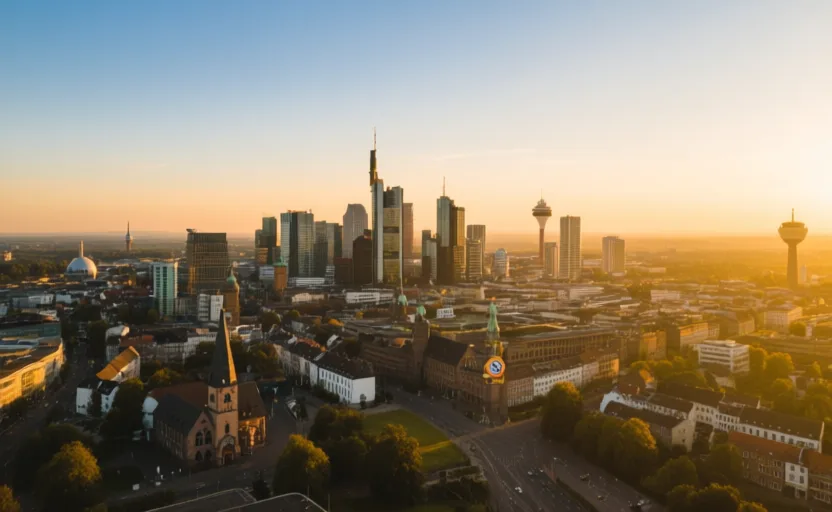 AI city illustration · Artistic impression
What people learn after moving
600,880 in the city (IT.NRW, 2025) — the Ruhr's largest and the biggest city in Westphalia
German, with audible Ruhrdeutsch; Turkish, Polish and Arabic widely spoken in the Nordstadt; English common in IT and at the university, less so elsewhere
Euro (EUR)
CET (GMT+1); CEST (GMT+2) from late March to late October
AI city illustration · Artistic impressionCost of living in Dortmund
Check your eligibility
Pick your passport to see entry rules and the long-stay routes we have researched.
Pick your passport to see whether you can enter Germany — and what it takes to stay.
Germany's sequence is rigid and identical everywhere: register your address within two weeks of moving in, which produces the confirmation needed for a tax ID, bank account, health insurance and residence permit. Dortmund spreads registration across district Bürgerdienste rather than one central office, and its rental market — cheap, covered by NRW's rent cap and documented by an official Mietspiegel — removes the housing bottleneck that stalls the sequence in the expensive German cities.
EU and EEA licences remain valid without action. Non-EU licences are valid for six months from taking up residence, after which you need a German licence — and whether tests are required depends on the issuing country and, for federal countries, the specific state or province. Locally, two things matter: the Ruhr's low emission zone runs continuously across thirteen cities including this one, and seventeen home matchdays a year rewrite the traffic and transport plan for half the city.
You need a German account for salary, rent and the direct debits German life runs on. Traditional banks require an Anmeldung first, creating a sequencing problem; digital banks generally do not. The Schufa problem is federal and identical everywhere — but landlords with a handful of applicants behave differently from landlords with forty, and Dortmund is firmly the former.
Germany requires everyone to hold health insurance. Employees below an annually-set income threshold must join the statutory system, where contributions are a percentage of income shared with the employer and dependants are covered free. Above the threshold, and for the self-employed, private cover becomes available — cheaper when young and healthy, considerably more expensive later, and very difficult to leave. Dortmund's practical advantage is capacity: registering with a GP is a phone call rather than the multi-week project it is in the expensive southern cities.
Germany requires identity verification for every SIM including prepaid — passport or ID, verified in a shop, by video call or at a post office. Prepaid needs no Anmeldung or Schufa. Postpaid contracts run a Schufa check a newcomer will fail or pass marginally, so start prepaid and switch once you have a record. Coverage across the city is good; the one predictable failure is 81,365 people in one place on a Saturday afternoon.
German income tax is progressive and deducted at source, with your tax class determining monthly withholding. Church tax adds 9% of your income tax liability in NRW if you declared a religious affiliation at Anmeldung. A solidarity surcharge applies to higher incomes. Filing is optional for many employees but frequently produces a refund, particularly in the relocation year and particularly if you commute across the Ruhr.
Each guide has verified costs, timelines, required documents, and the non-obvious gotchas — sourced from official government pages. Last verified August 2026.
Reading a list isn’t learning it. Globe Quest turns these into a trainer — hear each phrase spoken, drill them with spaced repetition, and get scored as you say them out loud.
The Anmeldung must be done at a Bürgerdienst within two weeks of moving in, and it produces the Meldebescheinigung required for your tax ID, bank account, health insurance and residence permit. Dortmund runs Bürgerdienste across the districts and availability is reasonable by German standards, but the deadline is legal and the whole first-month sequence waits on it. Book online as soon as you have a move date.
Declaring membership of a recognised church at your Anmeldung triggers automatic deduction of church tax at 9% of your income tax liability in NRW — the standard rate in most German states, against 8% in Bavaria and Baden-Württemberg. Declaring no affiliation means no church tax. It is decided in a five-minute appointment most newcomers do not realise carries an annual cost, and leaving later needs a formal appointment and a fee.
Everyone in Germany must hold health insurance. Employees below an annually-set income threshold join the statutory system; above it, and for the self-employed, private becomes available. Private is often cheaper when young and healthy, considerably more expensive later, prices each family member separately where statutory covers dependants free, and is very difficult to leave. Decide on the thirty-year view, not the first year's quote.
Dortmund publishes a qualified Mietspiegel — the 2025/26 edition, built from 2,443 flats, is legal evidence of the local comparative rent — and since 1 March 2025 the city has been inside NRW's Mieterschutzverordnung, which caps a new letting at 10% above that comparative rent. The gap is not academic: the index puts a modernised 1960s flat with a balcony at around EUR 6.60 per square metre net cold, while asking rents on the portals average closer to EUR 9.50. If a listing is far above the index band for its year and fit-out, you have a documented argument rather than a feeling.
Signal Iduna Park is Germany's largest football stadium and it fills. On a home matchday the U-Bahn and the S-Bahn run to a special timetable, the streets around Strobelallee close, regional trains arrive packed from across NRW, and finding a hotel room or a quiet restaurant becomes a project. Check the BVB fixture list before you book a flat viewing, a removal van, or anything at all near the Westfalenhallen.
The last blast furnace went in 2001 and Dortmund's employment now runs on insurance, software and logistics research. The Technologiepark beside TU Dortmund holds over 300 companies and roughly 10,000 jobs, Signal Iduna employs nearly 11,000 across the group, adesso runs its head office from Stadtkrone Ost and Amprion — one of Germany's four transmission grid operators — is headquartered here. If you are searching for work, search those clusters rather than the industrial history.
Signal Iduna, Continentale, Volkswohl Bund
Signal Iduna alone employs around 10,870 people across the group and has been headquartered here for over a century — insurance is the city's largest white-collar employer and the most stable graduate route in.
adesso, Materna, GAD/Atruvia units, Wilo digital
adesso's head office is its largest site anywhere and sits in Stadtkrone Ost; alongside Materna it anchors an IT sector that has grown into the Ruhr's biggest over two decades.
Fraunhofer IML, Rhenus, Amazon, Dortmunder Hafen operators
The Fraunhofer Institute for Material Flow and Logistics is Europe's leading applied logistics research centre and the reason a disproportionate number of supply-chain startups are founded in this city rather than a bigger one.
Amprion, DEW21, Westnetz regional units
Amprion runs one of Germany's four high-voltage transmission grids from Dortmund, which makes the city an unexpectedly central place to work on the physical side of the energy transition.
Wilo, KHS, Murtfeldt, Schmidt+Clemens regional units
Wilo — founded here in 1872 and now the highest-revenue company headquartered in the city — makes pumps for buildings and water systems worldwide, and KHS builds bottling and packaging lines.
TU Dortmund, Fraunhofer IML and ISST, IfADo, Technologiepark Dortmund
TU Dortmund is strong in statistics, computer science and mechanical engineering, and the adjoining Technologiepark holds over 300 companies and around 10,000 employees — one of the largest in Germany.
Landmark · Westfalendamm / Strobelallee
Germany's largest football stadium, opened in 1974 and holding 81,365 — its south stand is the largest standing terrace in European football.
Local tip: League tickets are close to impossible without a member's help; the stadium tour is not, and it puts you on the Südtribüne when it is empty, which is the only way to grasp the scale. If you do get a Südtribüne ticket, you stand for ninety minutes and you do not sit down.
Nature · Hörde
A 24-hectare lake in the middle of the city, flooded in 2010–11 directly on top of the Hoesch Phoenix-Ost steelworks that stood there until 2001.
Local tip: Walk the north bank for the promenade and restaurants, the south bank for the quiet. Then look up at the Hörde Burg and the old Hochofen structures on the ridge — the point of the place is that the water is where the furnaces were, and it is only forty years old as an idea.
Culture · City centre, west
The 1926 Union brewery's fermentation tower, its rooftop U visible across the city, converted into an arts and media centre in 2010.
Local tip: The Ostwall museum collection is on floors four and five and is genuinely good on Expressionism and Fluxus. Go up to the top-floor terrace regardless — it is the best free view of the city, and it explains the geography better than any map.
Neighborhood · South-west of the centre
The city's Wilhelminian quarter — bars, small shops and the student and academic population, between the Westpark and the Westfalenpark.
Local tip: This is where Dortmund actually goes out, and it is quieter and cheaper than the equivalent in Cologne. Vinzenzstraße and the streets off the Kreuzstraße are where to eat; on the Westpark in summer the whole neighbourhood sits on the grass.
Nature · South of the centre
A 70-hectare park laid out for the 1959 federal garden show, with the 209-metre Florianturm built for it and still standing.
Local tip: The German Rose Garden inside it holds thousands of varieties and almost no visitor knows it is there. Take the chairlift over the park rather than walking in — it is a strange, faintly 1959 experience and it costs almost nothing.
Culture · Bövinghausen, far west
A colliery built as a showpiece in 1898–1904, whose Art Nouveau machine hall was listed in 1969 in what is generally regarded as the founding case of industrial heritage protection in Germany.
Local tip: The glass-and-steel machine hall entrance is the single most beautiful industrial object in the Ruhr and hardly anybody outside the region has heard of it. It is a long way west — take the S-Bahn to Lütgendortmund or the bus — and it is worth the trip in a way the more famous sites sometimes are not.
Side-by-side cost of living, language, climate and careers — to help you choose.