
Population
573,618 in the city (IT.NRW, 2025); around 5 million in the Ruhr conurbation around it
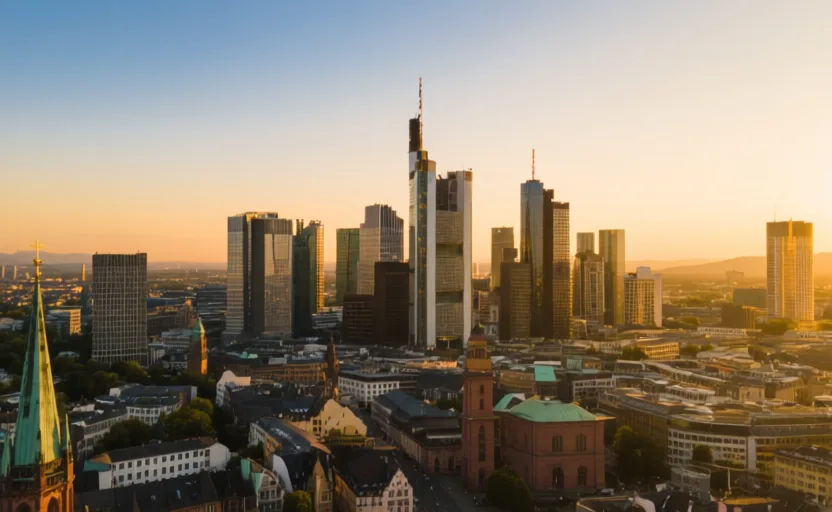 AI city illustration · Artistic impression
What people learn after moving
573,618 in the city (IT.NRW, 2025); around 5 million in the Ruhr conurbation around it
German, with audible Ruhrdeutsch; Turkish and Polish widely spoken; English common in the energy and consulting head offices, less so in the districts
Euro (EUR)
CET (GMT+1); CEST (GMT+2) from late March to late October
AI city illustration · Artistic impressionCost of living in Essen
Check your eligibility
Pick your passport to see entry rules and the long-stay routes we have researched.
Pick your passport to see whether you can enter Germany — and what it takes to stay.
Germany's sequence is rigid and identical in every city: register your address within two weeks of moving in, which produces the confirmation needed for a tax ID, bank account, health insurance and residence permit. What Essen changes is the queue. The city runs Bürgerämter across its districts rather than one central office, availability is materially better than in Cologne or Düsseldorf, and the rental market that normally stalls the whole sequence is the loosest of any large western German city.
EU and EEA licences remain valid without action. Non-EU licences are valid for six months from taking up residence, after which you need a German licence — and whether tests are required depends on the issuing country and, for federal countries, the specific state or province. The Essen-specific part is the Umweltzone: the Ruhr's low emission zone is one continuous area across thirteen cities, so a missing green badge is a regional problem rather than a local one.
You need a German account for salary, rent and the direct debits German life runs on. Traditional banks require an Anmeldung first, creating a sequencing problem; digital banks generally do not. The Schufa problem is federal and identical everywhere — but its consequences scale with how competitive the rental market is, and Essen's is the loosest of any large western German city.
Germany requires everyone to hold health insurance. Employees below an annually-set income threshold must join the statutory system, where contributions are a percentage of income shared with the employer and dependants are covered free. Above the threshold, and for the self-employed, private cover becomes available — cheaper when young and healthy, considerably more expensive later, and very difficult to leave. Essen's specific advantage is supply: the university hospital is the Ruhr's largest and a national referral centre, and GP capacity is far better than in the tight southern German cities.
Germany requires identity verification for every SIM including prepaid — passport or ID, verified in a shop, by video call or at a post office. Prepaid needs no Anmeldung or Schufa. Postpaid contracts run a Schufa check a newcomer will fail or pass marginally, so start prepaid and switch once you have a record. Coverage across the Ruhr is among the best in Germany simply because the population density is; the weak spots are indoors in older Altbau and in the wooded southern valleys.
German income tax is progressive and deducted at source, with your tax class determining monthly withholding. Church tax adds 9% of your income tax liability in NRW if you declared a religious affiliation at Anmeldung. A solidarity surcharge applies to higher incomes. Filing is optional for many employees but frequently produces a refund, particularly in the relocation year and particularly if you commute across the Ruhr.
Each guide has verified costs, timelines, required documents, and the non-obvious gotchas — sourced from official government pages. Last verified August 2026.
Reading a list isn’t learning it. Globe Quest turns these into a trainer — hear each phrase spoken, drill them with spaced repetition, and get scored as you say them out loud.
The Anmeldung must be done at a Bürgeramt within two weeks of moving in, and it gates your tax ID, bank account, health insurance and residence permit. Essen runs district Bürgerämter across the city rather than one central bottleneck, and availability is much better than in Cologne or Düsseldorf, let alone Munich. Book online as soon as you have a move date and take whichever district office has a slot — any of them can do it.
Declaring membership of a recognised church at your Anmeldung triggers automatic deduction of church tax at 9% of your income tax liability in NRW — the standard rate in most German states, against 8% in Bavaria and Baden-Württemberg. Declaring no affiliation means no church tax. It is decided in a five-minute appointment most newcomers do not realise carries an annual cost, and leaving later needs a formal appointment and a fee.
Everyone in Germany must hold health insurance. Employees below an annually-set income threshold join the statutory system; above it, and for the self-employed, private becomes available. Private is often cheaper when young and healthy, considerably more expensive later, prices each family member separately where statutory covers dependants free, and is very difficult to leave. Decide on the thirty-year view, not the first year's quote.
On 1 March 2025 North Rhine-Westphalia widened its Mieterschutzverordnung from 18 municipalities to 57 — Cologne, Düsseldorf, Bonn, Münster, Dortmund and a long list of smaller places. Essen is not on it. That means no 10% ceiling over the local comparative rent on a new letting here, the ordinary 20% three-year cap rather than the softened 15%, and the standard three-year rather than eight-year protection after a rental block is converted to condominiums. Rents are low enough that this rarely bites on arrival, but it is a real difference from every neighbouring big city and nobody will mention it at a viewing.
Essen's motorway is the line the region half-jokingly calls its social equator: the districts north of it grew around the pits and the steel and are poorer and denser, the districts south of it run into woodland, the Baldeneysee and the villa quarters. The gap is real in rents, schools and green cover, and it is visible from the train. It also means the same city offers two genuinely different housing markets — worth knowing before you narrow a search to one side.
Since 1 January 2012 the Ruhr has run a single joined-up low emission zone covering Essen, Bochum, Dortmund, Duisburg, Gelsenkirchen, Mülheim, Oberhausen, Recklinghausen, Castrop-Rauxel, Gladbeck, Herten, Herne and Bottrop, and since 1 July 2014 only vehicles with the green badge may enter any of it. Cross-Ruhr driving without a green Plakette is not a series of small local risks; it is one large continuous one. Check the badge before you buy any older diesel.
E.ON, RWE, Iqony (formerly STEAG), Open Grid Europe
Two of Germany's biggest energy groups are headquartered within a few streets of each other here, which makes Essen the country's densest concentration of utility and energy-transition employment.
Evonik, Brenntag, thyssenkrupp
Evonik and Brenntag both have their group headquarters in the city and thyssenkrupp its steel and industrial holding — Essen carries three DAX and three MDAX listings between them.
Hochtief, thyssenkrupp Industrial Solutions, Deilmann-Haniel, RAG-Stiftung
Hochtief is one of the world's larger construction groups and runs its headquarters here, alongside a deep bench of tunnelling, plant-engineering and mine-legacy firms the coal era left behind.
ALDI Nord, DEICHMANN, Medion, Schmitz Cargobull regional units
ALDI Nord and Deichmann — Europe's largest shoe retailer — are both family businesses run out of Essen, and the head-office functions that go with them are a steady source of commercial jobs.
DSV (formerly DB Schenker), Klöckner & Co, Contargo Rhine operations
DSV completed its EUR 14.3bn purchase of DB Schenker in 2025 and inherited the Essen head office — roughly 700 people, with jobs guaranteed to April 2027 and IT among the functions the buyer said it would keep here.
Universitätsmedizin Essen, University of Duisburg-Essen, Folkwang University of the Arts, Fraunhofer UMSICHT (Oberhausen)
The university hospital is the largest in the Ruhr and a national referral centre, and the University of Duisburg-Essen is one of Germany's biggest by enrolment — between them a large, stable non-industrial employer.
Landmark · Katernberg / Stoppenberg
The coal mine and coking plant that UNESCO listed in 2001 — Shaft XII is the Bauhaus-influenced pithead that became the region's symbol.
Local tip: Do not treat it as a museum visit. The site is a public park you can walk into freely, the Ruhr Museum sits inside the former coal washing plant, and in winter the coking plant's quenching channel is flooded and frozen into a 150-metre ice rink between the ovens.
Nature · Werden / Bredeney, southern Essen
A reservoir on the Ruhr in the wooded south of the city, ringed by sailing clubs, beer gardens and forest paths.
Local tip: The BaldeneySteig loops the lake and links onward to the Kettwiger Panoramasteig — roughly 60 km of waymarked walking that never leaves the city boundary. Take the S6 to Werden and walk back; almost no visitor realises this is inside Essen.
Neighborhood · South of the centre
The city's café, bar and restaurant spine along Rüttenscheider Straße — universally 'die Rü'.
Local tip: This is where Essen actually goes out, and it is where rents are highest: roughly EUR 10.50–11.80 per square metre against a city average well below that. Live one street back from the Rü rather than on it — the trams run down the middle and the bars run late.
Culture · Bredeney, above the Baldeneysee
The Krupp family's 19th-century house above the lake — over 260 rooms, in a 28-hectare park.
Local tip: The park is the point as much as the house. Go on a weekday, walk down through the grounds to the lake afterwards, and read the Krupp historical exhibition in the smaller building rather than skipping it — it is unusually frank about the firm's use of forced labour.
Neighborhood · South-west Essen
A garden suburb founded in 1909 by Margarethe Krupp and laid out by Georg Metzendorf — a listed, still-lived-in company town.
Local tip: Walk in under the stone gate bridge and the traffic noise stops. It is a working residential neighbourhood, not a monument, and flats come up through the Margarethe Krupp foundation rather than the portals — worth registering with directly if you want to live here.
Culture · Südviertel
One of Germany's most important collections of 19th and 20th century art, in a David Chipperfield extension opened in 2010.
Local tip: Entry to the permanent collection is free, paid for by the Krupp foundation — an unusual arrangement in Germany, and it means you can drop in for twenty minutes on a wet afternoon without the sunk-cost feeling. The photography holdings are outstanding and consistently overlooked.
Side-by-side cost of living, language, climate and careers — to help you choose.