
Population
2,677,715 in Gazipur City Corporation at the 2022 census — Bangladesh's third-largest city, formed in 2013 by merging the Gazipur and Tongi municipalities with surrounding rural areas
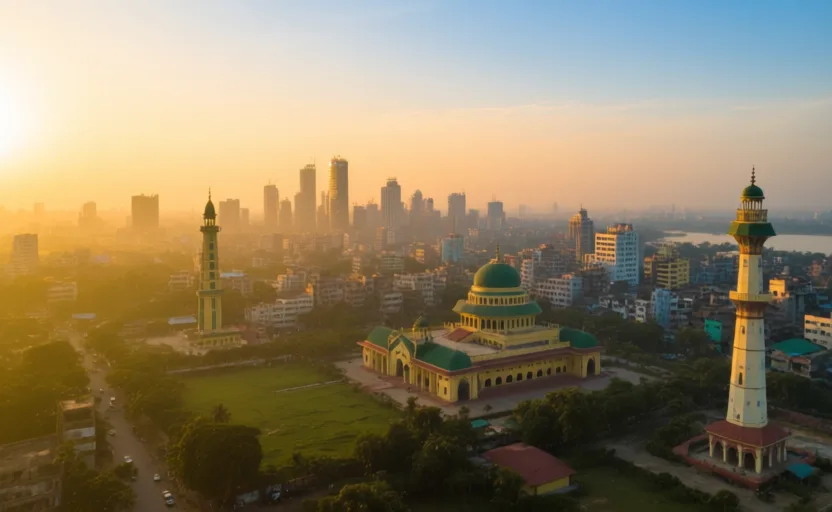 AI city illustration · Artistic impression
What people learn after moving
2,677,715 in Gazipur City Corporation at the 2022 census — Bangladesh's third-largest city, formed in 2013 by merging the Gazipur and Tongi municipalities with surrounding rural areas
Bengali (Bangla) in the standard Dhaka-region form, with no dialect barrier for anyone who has learned Bangla; English is used in the buying offices, the compliance sector and at the Islamic University of Technology
Bangladeshi taka (BDT)
BST (GMT+6) — no daylight saving
AI city illustration · Artistic impressionCost of living in Gazipur
Check your eligibility
Pick your passport to see entry rules and the long-stay routes we have researched.
Pick your passport to see whether you can enter Bangladesh — and what it takes to stay.
The decisive question is which body regulates your employer. BIDA handles private-sector employment on an E visa — which is almost everyone in Gazipur, because the district's industry sits outside the export processing zone system entirely. The NGO Affairs Bureau handles NGO and INGO appointments on an N visa. Both route through a Ministry of Home Affairs security clearance which, since October 2025, is applied for digitally through BIDA's One Stop Service portal and is deemed granted after 21 working days without objection. The one genuinely local fact is negative: Gazipur is in Dhaka division and has no Divisional Passport and Visa Office of its own, so in-country visa business means a trip into the capital.
The rule that strands people is national: an International Driving Permit must be obtained in your home country before you travel, because the BRTA does not issue them and the Automobile Association's process is built for BRTA licence holders going abroad. What is local, and consequential, is that Gazipur's transport future was supposed to be BRT Line 3 and is not. The corridor to Dhaka's airport was built for nine years, opened as an ordinary bus lane in December 2024, and was shelved in 2025. Plan your address on the road as it exists.
Bangladesh operates real foreign exchange controls, so the account you open determines what you can later take out. Foreign nationals may hold private foreign currency accounts and Non-Resident Foreign Currency Deposit accounts, and NFCD balances are freely repatriable — but the published minimum deposit for a foreign national is an order of magnitude above the non-resident Bangladeshi one. Locally, Gazipur's branch network is built around industrial banking — payroll, letters of credit and factory lending — rather than around foreign individuals, so the employer introduction is doing more work here than it would in Gulshan.
The national picture applies: no public cover for foreigners, competent and inexpensive private hospitals, and complex care routed to Bangkok, Singapore or India. Gazipur's local reality is that the serious private hospitals are in Dhaka, an hour or more down a corridor that is unpredictable — so the practical question is not which hospital you register with but how long it actually takes to reach it at three in the morning versus at five in the afternoon. On top of that, Gazipur sits inside the greater Dhaka airshed and adds its own industrial emissions, so the capital's dry-season air problem is your problem too.
SIM registration in Bangladesh is biometric and tied to an identity document, and the ceiling depends on which document you use: a Bangladeshi national ID supports a substantial number of SIMs, while a passport, driving licence or birth certificate supports only two. That is national and applies to foreigners and Bangladeshis alike. Gazipur's advantage over the smaller divisional cities is that it sits in the greater Dhaka telecoms footprint, so coverage and fixed broadband options are better than the population alone would suggest — but the market is still fragmented building by building.
Bangladesh's residency test is 182 days in the income year — not 183 — with a second limb catching people at 90 days if they were present more than 365 days across the preceding four years. The income year runs 1 July to 30 June. Non-residents face a flat rate on Bangladeshi income rather than the progressive scale, and you cannot leave permanently without a tax clearance certificate. All national. The local dimension in Gazipur is not tax law but wage structure: the Minimum Wage Board's sectoral garment minimum of Tk 12,500 a month, effective from December 2023, is the number every pay conversation in this district is anchored to.
Each guide has verified costs, timelines, required documents, and the non-obvious gotchas — sourced from official government pages. Last verified August 2026.
Reading a list isn’t learning it. Globe Quest turns these into a trainer — hear each phrase spoken, drill them with spaced repetition, and get scored as you say them out loud.
The Department of Immigration & Passports runs seven Divisional Passport and Visa Offices, which issue passports to Bangladeshi nationals in their jurisdiction and visas to foreign nationals. Chattogram, Khulna, Rajshahi, Sylhet, Rangpur and Barishal each have one. Gazipur does not, because it sits inside Dhaka division — so anything requiring a divisional visa office means the Dhaka office, down the same congested corridor you already commute on. That is not a hardship, but it does mean budgeting a whole day rather than a morning, and it is the sort of thing nobody mentions at offer stage.
BRT Line 3 was to run 20.5 kilometres from Shibbari in Gazipur to Hazrat Shahjalal International Airport with 25 stations. Construction started in December 2016; by December 2024 the corridor was nearly complete but the purpose-built buses had not been procured, so the Bangladesh Road Transport Corporation put ten ordinary air-conditioned buses onto the unfinished lane on 16 December 2024. In 2025 the project was shelved, after more than Tk 2,800 crore against an original Tk 2,040 crore budget. Anything you read that describes Gazipur as 'about to get rapid transit' is describing a plan that was abandoned. Choose where you live on today's road times.
Private-sector employment runs through BIDA: your sponsor obtains an E-visa recommendation, then a work permit through BIDA's One Stop Service portal. NGO and INGO employment runs through the NGO Affairs Bureau on an N visa. BEPZA runs the export processing zones — and there is no EPZ in Gazipur. The nearest is Dhaka EPZ at Savar, in a different district. Gazipur's industry sits outside the zone system, on ordinary BIDA permits, which is worth confirming before anyone files under the assumption that a garment job means a BEPZA file.
Between 5 August 2024 and late January 2025 — five and a half months — 51 garment factories closed in Gazipur, with another 17 across Savar, Ashulia and Dhamrai, and more than 50,000 workers affected across the belt. Owners cited market volatility, bank non-cooperation on letters of credit, loan defaults and raw material shortages. This is the operating environment for any commercial, sourcing or compliance role here, and it should shape how you read an employer's balance sheet and how much notice you would want in a contract.
The Bishwa Ijtema is held on the banks of the Turag at Tongi, inside Gazipur City Corporation, usually in January or February and in recent years across two phases. It draws millions of people from around 150 countries and is generally described as the second-largest Muslim gathering in the world after the Arba'in. For a resident this is a logistics fact before it is a cultural one: the Dhaka–Mymensingh corridor and the whole Tongi area are transformed for days at a time. Check the dates when you plan travel, deliveries or a factory audit schedule.
You are resident if present for 182 days or more in the income year, or 90 days or more if you were in Bangladesh for more than 365 days across the four preceding years. The income year runs 1 July to 30 June. That is national law, identical in Dhaka. Gazipur's wrinkle is administrative: your taxes circle is here rather than in the capital, and the exit clearance certificate has to come from your own circle — which matters because so many people working in Gazipur think of themselves as living in Dhaka.
Hundreds of manufacturers across the Tongi, Konabari, Kashimpur, Kaliakair and Sreepur belts, plus the buying offices that shadow them
Gazipur is the densest concentration of garment manufacturing in Bangladesh, and the industry is the reason the city corporation holds 2.7 million people. It is also under real pressure: 51 factories in Gazipur closed in the five and a half months to late January 2025. Foreign roles here are overwhelmingly technical, sourcing, quality and compliance.
The spinning, weaving, dyeing and washing plants that feed the garment factories, concentrated around Konabari and Kashimpur
The backward-linkage industry that lets Bangladesh convert yarn to garment domestically. It is also the district's biggest environmental problem — effluent, groundwater draw and energy demand — which is why environmental compliance is a live professional field here rather than a paper exercise.
The Department of Inspection for Factories and Establishments, brand compliance teams, third-party auditors and the successor bodies to the post-Rana Plaza safety programmes
Building and fire safety, structural integrity, and labour standards are inspected and audited continuously across this belt. For a foreign professional this is one of the most transferable and best-paid non-managerial routes into Bangladesh, and it is a Gazipur job rather than a Dhaka one.
Bangladesh Agricultural Research Institute and Bangladesh Rice Research Institute at Joydebpur, the National Agricultural Training Academy, and Gazipur Agricultural University
An unusual thing to sit next to a garment belt: the country's two principal crop research institutes are both headquartered in Gazipur, alongside the agricultural university renamed from Bangabandhu Sheikh Mujibur Rahman Agricultural University in February 2025. If your field is food security or plant science, this district is the centre of it.
Islamic University of Technology at Board Bazar, Dhaka University of Engineering & Technology, Bangladesh Open University, and the National University of Bangladesh
The Islamic University of Technology is a subsidiary organ of the Organisation of Islamic Cooperation, teaching in English with students from across the member states — a genuinely international campus in an industrial district. The National University, which affiliates most of the country's colleges, is also headquartered here.
Tenants of the government hi-tech park at Kaliakair, under the Bangladesh Hi-Tech Park Authority
The country's flagship government hi-tech park is in Gazipur district at Kaliakair. It is a policy bet rather than a mature cluster — nothing here yet resembles the software concentration around Karwan Bazar in Dhaka — but it is the main reason a technology role would be located in this district at all.
Nature · Rajendrapur, on the Dhaka–Mymensingh highway
A remnant of the sal forest that once covered this whole tract, managed as a national park since 1974 and formally declared under the Wildlife Act in 1982.
Local tip: Go on a weekday morning — at weekends it fills with picnic parties from Dhaka and the point of the place evaporates. The interior paths away from the entrance are where you actually see the forest.
Culture · Pirujali village, north of Gazipur town
The country estate the novelist and filmmaker Humayun Ahmed built from 1997 — a garden of hundreds of tree species, sculptures and ponds, now his resting place.
Local tip: It means far more if you have read anything of his first, and everyone Bangladeshi you meet will have. Go early and take a guide from the village; the trees are labelled and the stories behind several of them are the reason people come.
Nature · Baromchara, Sreepur upazila
A large drive-through and walk-through wildlife park laid out across roughly 3,810 acres of sal forest, opened in 2013 and among the largest in Asia.
Local tip: The core safari section is done by bus and is the part worth doing; the rest can be skipped. Weekdays only if you want to see anything — this is one of the most popular weekend destinations for the whole Dhaka metropolitan area.
Landmark · Joydebpur, central Gazipur
The zamindari palace of the Bhawal estate, now government offices, and the setting of the Bhawal case — a decades-long lawsuit over whether a returning ascetic was the estate's presumed-dead heir.
Local tip: The building is used by the administration so access is partial, but the exterior and the story are the draw. The Bhawal sannyasi case is one of the strangest legal sagas in South Asian history and is worth reading before you visit.
Neighborhood · Tongi, Zone 1 of Gazipur City Corporation
The industrial southern end of the city on the river opposite Dhaka — factories, the rail junction, the bridge, and the vast open ground where the Bishwa Ijtema is held.
Local tip: Walk the Ijtema ground out of season and the scale is hard to believe: a bare riverside field that holds millions of people for a few days each year and then empties completely. It is the most striking thing in the district and almost nobody visits it when it is empty.
Food · Chandana Chowrasta, on the Dhaka–Mymensingh highway
The junction that functions as the city's centre — highway restaurants, tea stalls and the late-night food that a shift-working industrial city needs.
Local tip: Go after the evening shift change, when the strip is at its busiest and the food is freshest. It is not a refined eating scene and that is the point; it is the honest social centre of a factory city.
Side-by-side cost of living, language, climate and careers — to help you choose.