
Population
≈2.65 million in the canton and ≈3.19 million in the metropolitan area at the 2022 census — Ecuador's largest city, ahead of Quito
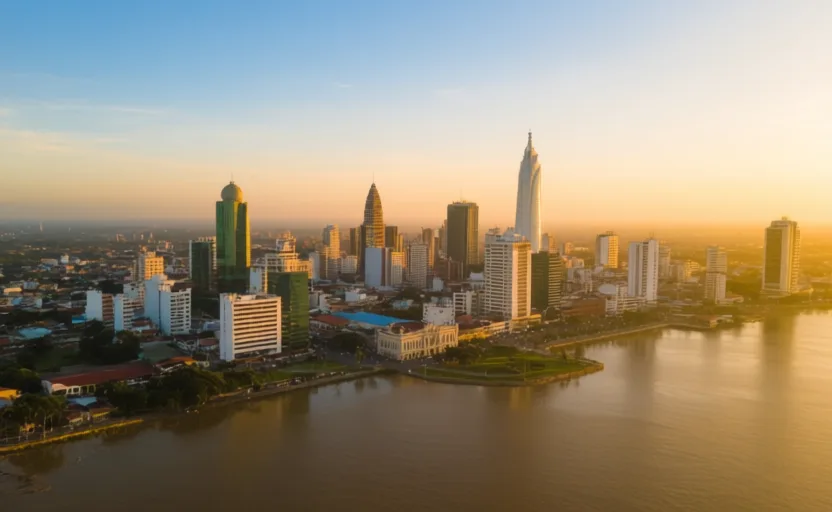 AI city illustration · Artistic impression
What people learn after moving
≈2.65 million in the canton and ≈3.19 million in the metropolitan area at the 2022 census — Ecuador's largest city, ahead of Quito
Spanish, in a coastal accent that drops final S and moves fast. English is common in the port, export and banking sectors and rare elsewhere
US dollar — Ecuador has been dollarised since 2000. US notes and coins circulate alongside Ecuadorian centavo coins
ECT (GMT−5) — no daylight saving, and near the equator the day is twelve hours long all year
AI city illustration · Artistic impressionCost of living in Guayaquil
Check your eligibility
Pick your passport to see entry rules and the long-stay routes we have researched.
Pick your passport to see whether you can enter Ecuador — and what it takes to stay.
Ecuador grants temporary residence for two years, renewable, across several categories — professional, rentista, investor, worker, student, remote worker — and permanent residence after 21 months of continuous temporary residence. Thresholds are expressed as multiples of the salario básico unificado, which is USD 482 for 2026. Guayaquil's practical advantage over the smaller coastal cities is that the ministry, the Registro Civil and the consular corps all have a full presence here, so nothing requires a trip to Quito. The rule that catches people is not any of this: it is the limit on time spent outside Ecuador.
Two different governments touch your car here. The licence itself is an ANT matter, national and identical everywhere in Ecuador, requiring a medical and psychosensometric assessment and — for most nationalities — a course and examination rather than a straight exchange. Everything to do with the vehicle is the municipality's: the ATM runs matriculación and the revisión técnica vehicular for the canton, and its inspection calendar keys off the last digit of your plate. Guayaquil does not operate the weekday circulation restriction Quito residents call pico y placa; here the plate digit decides your inspection month instead.
Ecuador uses the US dollar, which removes exchange risk, conversion spreads and the whole apparatus of currency management. What it adds instead is the Impuesto a la Salida de Divisas — a tax on money leaving the country — and a banking culture that is conservative about opening accounts for people without a cédula. Guayaquil is where Ecuador's private banking sector is headquartered, and the trade-finance side of it is unusually developed because the city exists to move shrimp, bananas and containers.
Employees are enrolled in the IESS by their employer from the first day of work — a legal obligation, not a benefit. Everyone else can affiliate voluntarily by declaring a contribution base and paying 17.60% of it, from USD 84.83 a month at the 2026 floor. Guayaquil's specific health picture is the opposite of Quito's: no altitude to adapt to, and instead a permanent vector-borne disease burden that the sierra does not have. Dengue is endemic at four metres above sea level and peaks with the January-to-April rains.
Three mobile operators cover the market and SIM registration against an identity document is mandatory. The good news specific to Guayaquil is topographic: the city is flat, dense and laid out on a grid, so the hillside coverage gaps that plague Quito barely exist here and fibre competition in the northern suburbs and Samborondón is genuinely strong. The constraint is power rather than signal — Ecuador's grid depends on hydro and drought has produced periods of scheduled load shedding.
Ecuador taxes its residents on worldwide income — which distinguishes it sharply from territorial neighbours like Costa Rica and Panama and is the single most misunderstood point among people comparing the region. Residence turns principally on days present. Employees are withheld at source; anyone invoicing needs a RUC. Ecuador also levies the Impuesto a la Salida de Divisas on money leaving the country. On top of the national system sits a municipal one: if you run a business or own property in Guayaquil you file with the Alcaldía as well as with the SRI.
Each guide has verified costs, timelines, required documents, and the non-obvious gotchas — sourced from official government pages. Last verified August 2026.
Reading a list isn’t learning it. Globe Quest turns these into a trainer — hear each phrase spoken, drill them with spaced repetition, and get scored as you say them out loud.
Guayas province recorded 47.81 homicides per 100,000 inhabitants in the first half of 2025 — the second-highest rate in the country and 49.56% of every homicide in Ecuador. Zone 8, which is Guayaquil, Durán and Samborondón, accounted for 39.5% of the national total on its own, and the canton of Guayaquil recorded 2,322 violent deaths in the eleven months to November 2025. For scale, Azuay province around Cuenca recorded 1.56 per 100,000 over the same first half and was one of only three provinces where the figure fell. The violence is concentrated, overwhelmingly organised and tied to the drug routes feeding the port, and ordinary residents in Urdesa or Los Ceibos are not its targets — but it changes how everyone lives. People do not walk at night, do not use their phone at a red light, use apps rather than street taxis, and treat the southern and north-western periphery as places you have a reason to be in. Read the security picture before you read anything else about this city, and do not carry a Quito-based impression of Ecuador into it.
The coastal year runs on words that invert what you expect. Invierno — winter — is roughly January to April: heavy rain, temperatures in the low thirties and humidity that makes them feel higher. Verano — summer — is May to December: dry, greyer, cooler, with the garúa mist. February and March average around 286–315 mm of rain each; July and August average between one and four millimetres. Annual mean temperature is 26.4°C and the annual rainfall is about 1,186 mm, essentially all of it in four months. There is no cold season, no altitude and no relief: air conditioning is not a luxury here, it is the largest line on your electricity bill and the single biggest cost difference from Quito.
A temporary resident may be outside Ecuador for no more than ninety days in a year, counted cumulatively across the visa's validity rather than resetting on renewal. Permanent residents have historically faced a 180-day annual limit during their first two years. There is no warning letter and no grace: exceeding it is a ground for losing the status, and it is how residence is most commonly lost in this country. The reforming law published on 24 October 2025 rewrote the article on losing permanent residence, so confirm the current wording before planning an extended trip. Keep a spreadsheet of every entry and exit from the day you land.
Quito's altitude keeps Aedes aegypti out of the valley. Guayaquil has no such protection: dengue is endemic here and circulates year-round with a sharp peak during the January-to-April rains, and chikungunya and Zika are present in the same vector. There is no altitude, no cold snap and no dry-season die-off deep enough to break the cycle. Screens on the windows, repellent in the bag and nothing standing in water on the balcony are the ordinary local defences, and standing water in a building's own common areas is a legitimate thing to raise with the administrator. Tap water is not drinkable — bottled or a filter, universally.
La Puntilla, the strip of gated urbanizaciones and malls across the river that houses much of the professional class, sits in the canton of Samborondón. Durán, on the far bank at the end of the Aerovía, is its own canton too. Each has its own mayor, its own municipal taxes, its own building rules and its own police relationship — and the difference is not cosmetic: Durán has among the highest homicide rates of any Ecuadorian canton with more than 100,000 people, while Samborondón is among the calmest addresses in the metropolitan area. When you sign a lease, know which municipality you are actually in, because it decides who levies your predial and who answers your complaint.
Guayaquil sits on the Guayas river, not the Pacific, and the water at the Malecón is brown estuarine river running through mangrove. The ocean is a drive: Playas is roughly an hour and a half, Salinas and the Ruta del Spondylus two to two and a half, Ayangue and the quieter Santa Elena coves a similar distance. Almost every resident with the means keeps some arrangement out there and empties the city at long weekends, which is when Guayaquil is at its most pleasant. Newcomers who assumed sea air from a map are the ones who are disappointed in month one.
Autoridad Portuaria de Guayaquil, Contecon, DP World Posorja, Naportec, freight forwarders and customs agencies along the Vía al Puerto
The Port of Guayaquil is the country's dominant trade gateway, handling the large majority of Ecuador's containerised imports and private exports. The concession terminal and the deepwater port at Posorja have pulled a substantial logistics, customs and shipping-services layer into the south and west of the city.
Omarsa, Songa, Expalsa, Santa Priscila, Nirsa, and the Cámara Nacional de Acuacultura
Ecuador is one of the world's largest shrimp exporters and the industry's corporate and processing base sits in and around Guayaquil, drawing on the mangrove estuaries of Guayas and El Oro. It is the single fastest-growing export sector of the last decade and the reason a lot of foreign commercial and quality-assurance work exists here.
Grupo Noboa, Reybanpac, Grupo Wong, Dole and Chiquita buying operations, AEBE members
Ecuador is the world's largest banana exporter and the trading, financing and shipping of the crop is run from Guayaquil even though the plantations are in Los Ríos, Guayas and El Oro. Cocoa and coffee move through the same commercial houses.
Banco Guayaquil, Banco Bolivariano, Banco del Pacífico, Produbanco, the Cámara de Comercio de Guayaquil
Guayaquil is Ecuador's commercial capital as distinct from its political one, and the distinction is real — the ministries and multilaterals that make Quito's public sector so large simply are not here. What is here is the private-sector head-office layer.
Cervecería Nacional, Holcim, Unilever, Nestlé, Industrias Ales, and the industrial estates along the Vía a Daule
The Vía a Daule corridor north of the city is Ecuador's densest industrial belt — brewing, cement, food processing, plastics and packaging — and it is where most non-extractive manufacturing employment in the country is concentrated.
Junta de Beneficencia de Guayaquil, Hospital Teodoro Maldonado Carbo (IESS), ESPOL, Universidad Católica de Santiago de Guayaquil, UEES
The Junta de Beneficencia is a private charitable institution founded in 1888 that runs several of the city's largest hospitals — an arrangement with no parallel elsewhere in Ecuador — and ESPOL supplies most of the coastal engineering workforce.
Landmark · The riverfront, from the centre north to Cerro Santa Ana
Two and a half kilometres of secured riverside promenade, ending at the oldest surviving quarter of the city climbing a hill in painted timber houses.
Local tip: Las Peñas is 444 steps up Cerro Santa Ana to a lighthouse and chapel, numbered so you know exactly how much suffering remains. Go late afternoon and stay for the lights on the river. Both the Malecón and the Cerro are gated and patrolled, which is precisely why they work and why the unlit streets immediately around them do not — do not wander off the route after dark.
Landmark · Beside the cathedral, in the centre
A small colonial square in the middle of downtown containing several dozen free-roaming land iguanas, some of them a metre long, entirely unbothered by anyone.
Local tip: Known to everyone as the Parque de las Iguanas. They come down from the trees to be fed in the morning and lie on the paths. It is genuinely startling the first time and it is thirty seconds from the cathedral — the most efficient piece of tourism in the country.
Nature · In the Guayas river, reached by a footbridge from the southern Malecón
A 2,200-hectare Ramsar-listed wetland island between Guayaquil and Durán, with a mangrove boardwalk, a crocodile pond and a small stilt village, reached only on foot or by bicycle.
Local tip: The bridge is pedestrian and cycle only, which is the whole point — no traffic, no noise, and a genuine wetland fifteen minutes from downtown. Go early, before the heat and before the mosquitoes get organised, take water and repellent, and hire a bike at the entrance rather than walking the whole loop.
Nature · Off the Vía a la Costa, about half an hour west of the city
Six thousand hectares of protected tropical dry forest — a globally rare habitat — with howler monkeys, guayacán trees that flower yellow for a few days a year, and over two hundred bird species.
Local tip: Most residents have never been, which is the standing joke about it. The dry forest is a different world from the Amazon everyone flies east to see, and it is a half-hour drive. Go on a weekday morning, book a guide for the longer trails, and if you can time it for the guayacán bloom after the first heavy rains, do.
Food · The centre, and the crab restaurants along the northern avenues
Where the coast eats: encebollado counters at seven in the morning, and, on the other side of the city, tables laid with newspaper for crab.
Local tip: Encebollado is a breakfast, not a lunch — the good places have sold out by eleven. For crab, go with people who know how, on a Wednesday or a weekend, and accept that you will be there for three hours and will need a shower afterwards. Both are cash businesses.
Neighborhood · North of the Malecón along the river
A regenerated riverside strip of towers, museums and restaurants built on the old brewery site, immediately below the historic hill.
Local tip: This is the one part of central Guayaquil where people actually live at street level and walk in the evening, because it is a managed private-public development with its own security. It is not representative of the centre and nobody pretends it is — but if you want to be downtown rather than in the northern suburbs, it is the realistic answer.
Side-by-side cost of living, language, climate and careers — to help you choose.