
Population
≈1.41 million and slowly declining, the sixth-largest Korean city and the largest in the Honam region
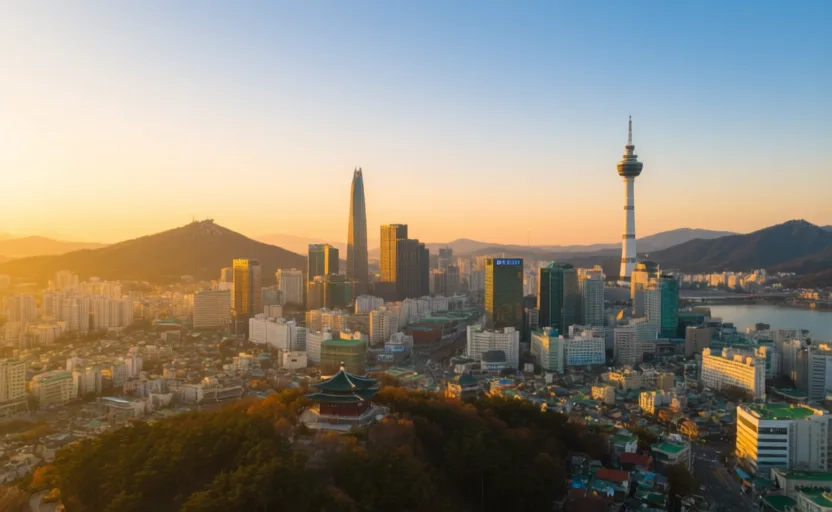 AI city illustration · Artistic impression
What people learn after moving
≈1.41 million and slowly declining, the sixth-largest Korean city and the largest in the Honam region
Korean, in the Jeolla dialect — softer and slower than Gyeongsang speech, marked by the sentence-final -잉 and by 거시기 as an all-purpose noun
South Korean won (KRW, ₩)
KST (GMT+9) — Korea does not observe daylight saving
AI city illustration · Artistic impressionCost of living in Gwangju
Check your eligibility
Pick your passport to see entry rules and the long-stay routes we have researched.
Pick your passport to see whether you can enter South Korea — and what it takes to stay.
Korea separates entry from residence completely. Visa-free entry or a K-ETA lets you visit and nothing else. The long-stay category — E-7 skilled work, E-2 teaching, D-8 startup, D-10 job search, D-2 study, F-6 spouse, F-1-D remote work — is normally issued by a Korean consulate before you fly, and several cannot be switched into from inside Korea. Once here you have ninety days to register and obtain the Alien Registration Card, and its thirteen-digit number is what every Korean system authenticates you against. Where Gwangju differs from Busan or Daegu is what it does not have: no district here is a designated population-decline area, so the regional F-2-R route those cities advertise is not available inside the city boundary.
You may drive on your home licence plus a Geneva Convention International Driving Permit for one year from entry, and the permit must be issued at home before you fly. Once you hold an ARC, KoROAD will exchange your foreign licence — an eyesight and aptitude check for reciprocity countries, a 40-question written test in English for everyone else. Gwangju has run on one metro line since 2004 and buses carry the rest of the load, so a car is more useful here than in Seoul or Busan; the Line 2 works currently under the main roads make the bus network less predictable than the timetable suggests.
A Korean account belongs to a verified identity, and for a foreigner that identity is the ARC. Before it arrives some banks will open a deposit-and-withdraw-only account on a passport — no transfers, no app banking, no outward remittance. A full account needs the ARC plus a Korean mobile number registered in exactly the same name. Even then, anti-fraud rules open every new account as a limited-transaction account capped around ₩1 million a day until you document its purpose. Locally, Gwangju Bank is the regional institution most employers, landlords and the city government itself use, and it is worth holding alongside a national bank with a stronger English app rather than instead of one.
National Health Insurance enrolment is compulsory once you pass six months of residence and cannot be declined because you hold private cover. With an employer the premium is split and payroll-deducted; without one you become a local subscriber billed a premium benchmarked to the national average rather than to your Korean income. Arrears can block a visa extension. Pension contributions are equally compulsory and reclaimable on departure only depending on your nationality. Gwangju's own layer is that its university hospitals are the tertiary referral centre for the whole Honam region, so specialist access is genuinely good — and the waiting rooms are full of people who travelled from three provinces to be in them.
The point of a Korean number is identity, not calls. Korean real-name verification binds your name, birth date, registration number and phone line together, and only a line registered to you personally passes it — which gates banking apps, delivery, government portals and most of the useful internet. A data eSIM or a passport-bought prepaid SIM gives connectivity and a number but not verification. The sequence is eSIM or prepaid as a bridge, then the ARC, then a postpaid or MVNO line in your own name. Home fibre is fast and cheap; the variable in Gwangju is the building, because the older low-rise stock in Dong-gu and Nam-gu often shares a basement connection.
You become a Korean tax resident by having a settled life here or by 183 days of presence in a tax year. Residents are taxed on worldwide income at progressive rates plus a 10% local surtax. Two national reliefs matter to foreigners: resident five years or fewer of the last ten and your foreign-source income is taxed only when a Korean payer pays it or you remit it; and foreign employees may elect a flat 19% on Korean employment income, forfeiting all deductions. The one that matters most in a low-rent city like Gwangju is smaller and far more widely missed: a tax credit on monthly rent, available to employees below an income threshold and unlocked by the move-in report you should already have filed.
Each guide has verified costs, timelines, required documents, and the non-obvious gotchas — sourced from official government pages. Last verified August 2026.
Reading a list isn’t learning it. Globe Quest turns these into a trainer — hear each phrase spoken, drill them with spaced repetition, and get scored as you say them out loud.
Unpaid national and local taxes rank ahead of your deposit when a property is auctioned, and until 2023 you could only see them with the landlord's written consent, which nobody granted. The National Tax Collection Act changed that from April 2023: if your deposit exceeds ₩10 million, you may view the landlord's unpaid national taxes at any tax office in the country — without their consent — from the moment the contract is signed until the lease start date, on production of your ID and a copy of the contract. Unpaid local taxes are viewable the same way at any si/gun/gu office. Before signing you still need consent, which is itself a useful question to ask. This costs an hour and is the single cheapest piece of due diligence available to a Korean tenant.
Beyond the priority right that your move-in report and fixed-date stamp create, the Housing Lease Protection Act ring-fences a slice of smaller deposits ahead of every other creditor — and the ceilings are regional. Gwangju, like Busan, Daegu and Ulsan, falls in the metropolitan-city band: under the enforcement decree as amended in February 2023 a deposit up to ₩85 million qualifies, with ₩28 million protected first in line, against ₩165 million and ₩55 million in Seoul. The protection is also capped at half the property's value overall. Both figures are set by decree and revised periodically, so confirm the current ones at your district office rather than trusting a dated blog.
The Ministry of Justice's regional-specialised visa lets designated local governments recommend foreigners for F-2-R residence below the ordinary points thresholds — but it runs on the Ministry of the Interior's list of designated population-decline areas, and no Gwangju district is on it. Dong-gu appears one tier down, on the eighteen-strong 'concern area' list, which is a different designation. The rural South Jeolla counties around the city are heavily designated, so the route exists in the region but generally not inside the metropolitan boundary. The whole designation is due for re-evaluation, so read the current year's operating plan rather than assuming either way.
Gwangju has run on a single metro line since 2004. Line 2 is a low-floor, shallow-tunnel loop being built in phases, and construction has had the city's main roads dug up in rotation for years with the completion date repeatedly pushed back. That is not a reason to avoid a district, but it is a reason to walk the route at rush hour before you sign — bus journeys that look fine on a map can be badly disrupted, and a flat facing an open trench is a different flat from the one in the photographs. Ask the agent specifically what is planned on that street and when.
The May 1980 uprising and its suppression are the central fact of Gwangju's modern identity, the archives were inscribed on UNESCO's Memory of the World register in 2011, and the old South Jeolla Provincial Office where the final stand took place is now part of the Asia Culture Centre. Nobody expects a foreign resident to have a position on Korean politics. What lands badly is treating it as a museum topic, or repeating the denialist talking points that still circulate elsewhere in the country. Go to the May 18 National Cemetery once, early, and listen more than you talk.
Scheduled international flights from the Gwangju area leave from Muan International, roughly forty minutes west in South Jeolla, not from Gwangju Airport, which handles Jeju and Gimpo. Moving Gwangju's remaining civil flights to Muan altogether has been agreed in principle and contested in practice for years, tangled up with the separate question of the military airbase that shares the site. Treat any date you are given as provisional, and do not choose a district for its airport run. In practice most people fly long-haul out of Incheon and take the KTX from Gwangju Songjeong to get there.
Kia AutoLand Gwangju, Gwangju Global Motors, a deep tier-two supplier belt
Kia's Gwangju complex is one of its three Korean assembly sites. Gwangju Global Motors, the joint venture between Hyundai and the city government that opened in 2021, was the first entirely new car plant built in Korea since 1998 and builds the Casper — the 'regional job-creation' model that other cities have since tried to copy.
National AI Industrial Convergence Complex, GIST, the Cheomdan 3 district
The national AI data centre in Cheomdan District 3 began service in November 2023 with tens of petaflops of H100-based compute and around 107 petabytes of storage, and it is the anchor of the city's explicit bet on AI. Access is largely through the complex's programmes rather than commercially, so the useful question for a job-seeker is which institute or startup holds an allocation.
Korea Photonics Technology Institute, the Cheomdan optics cluster
Gwangju built Korea's optics industry from the late 1990s — LEDs, optical communications, laser and sensor components — and the national photonics research institute is here. It is a smaller cluster than the headlines suggest but a genuinely deep one, and it feeds the AI and mobility programmes rather than standing apart from them.
Samsung Electronics Gwangju, the supplier estates around Hanam and Pyeongdong
Samsung's Gwangju site has been a premium home-appliance plant for decades and supports a large local supplier base. Production lines here have shifted over the years, so it is worth asking any employer in the belt which product families are actually made on site now.
Asia Culture Center, Gwangju Biennale Foundation, the city's design and content agencies
The Asia Culture Centre is a national institution, not a municipal one, and the Gwangju Biennale founded in 1995 is the longest-running contemporary art biennale in Asia. Between them they sustain a curatorial, production and translation job market that no other Korean city outside Seoul has.
Chonnam National University and its hospital, GIST, Chosun University
GIST is one of the four national science and technology institutes and runs a graduate-heavy, largely English-language research culture. Chonnam National is a former national flagship university whose hospital anchors the regional referral network for the whole of Honam.
Culture · Dong-gu
A vast, mostly underground national arts complex built into and around the old South Jeolla Provincial Office building — the site of the final stand in May 1980.
Local tip: Most visitors do the exhibition halls and miss the point. Start with the preserved Provincial Office annexe on the north side, then go into the galleries; the building's history is what the architecture is arguing with. The library park on the roof is free and the best place in the city to sit at dusk.
Landmark · Buk-gu
The national cemetery for the victims of the 1980 uprising, with an interpretive hall and the original burial ground preserved beside the new one.
Local tip: Go to the old cemetery (구묘역) behind the new one as well — it is where the bodies were first buried in secret and it is far more affecting than the formal memorial. The English signage is good. It is about half an hour from downtown by bus 518, which is named for the date.
Nature · Dong-gu and Buk-gu
The mountain the city is built against, promoted to national park in 2013, with columnar rock formations at the summit ridge that are a designated national natural monument.
Local tip: Ipseokdae and Seoseokdae, the stone columns, are the reason to go, and the summit itself sits inside a military area with only periodic public access — check before you plan around it. Jeungsimsa temple at the base is the usual start and there is a bus straight there from downtown.
Food · Seo-gu
The largest traditional market in the Honam region, a sprawling covered warren where the city's restaurants actually buy their ingredients.
Local tip: The jeon (savoury pancake) alley near the back is what to come for, and it is cheapest and best in the late morning rather than at the tourist hour. Bring cash for the smaller stalls. The market is a short walk from Line 1's Yangdong Market station.
Food · Gwangsan-gu
A street of grilled short-rib patty restaurants beside Gwangju Songjeong KTX station, several of them run by the same families for generations.
Local tip: Order the tteokgalbi with the bone-broth rice soup that comes as a set — locals treat them as one dish. It is directly across from the station, so it is the correct last meal before a train to Seoul, and the adjacent 1913 Songjeong Station Market is worth twenty minutes.
Neighborhood · Nam-gu
The old missionary quarter — 1900s western houses, a hillside of churches and schools, and an alley neighbourhood decorated entirely with salvaged household junk.
Local tip: Penguin Village got its name from how its elderly residents walked, and it is a working neighbourhood rather than an attraction, so keep the noise down. Combine it with the Owen Memorial Hall and the missionary houses ten minutes uphill; almost no visitors to Gwangju find this quarter at all.
Side-by-side cost of living, language, climate and careers — to help you choose.